KI-Beratung Beta

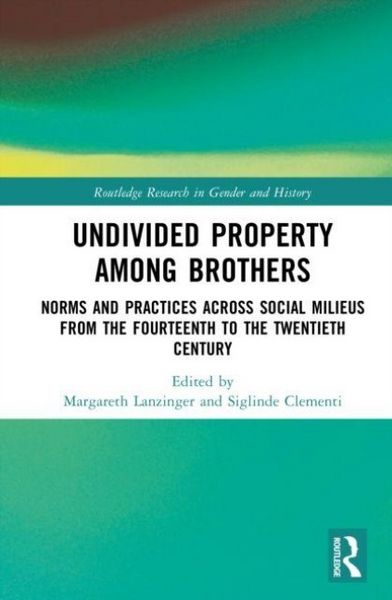
Produktbild: Undivided Property among Brothers
Vorbesteller Neu

Undivided Property among Brothers Norms and Practices across Social Milieus from the Fifteenth to the Twentieth Century

248,99 €

inkl. gesetzl. MwSt., Versandkostenfrei


Beschreibung

From the late Middle Ages to modern times, undivided inheritance among brothers was a widespread yet remarkably understudied strategy for preserving property, wealth and power within families. Practised in settings as diverse as the European nobility in the late Middle Ages and the beginning of the...

Beschreibung

From the late Middle Ages to modern times, undivided inheritance among brothers was a widespread yet remarkably understudied strategy for preserving property, wealth and power within families. Practised in settings as diverse as the European nobility in the late Middle Ages and the beginning of the early modern period, early modern Italian merchant dynasties and rural communities across south-eastern and Western Europe, it significantly shaped not only family relations but also broader social, economic and political structures. However, these different manifestations have largely been studied in isolation.

Bringing together these fragmented strands of scholarship for the first time, the volume offers a trans-epochal and multi-perspective approach to the undivided transmission of land, businesses, capital, authority and social networks to more than one male heir, usually several brothers. It explores how the competing and complementary logics relating to property, kinship and marriage influenced family strategies across different regions and historical periods, revealing both striking continuities and important local variations. By placing undivided property among brothers at the centre of the analysis, the volume sheds new light on the relationship between family organisation and the reproduction of wealth, connecting approaches from social and economic history with gender, family and kinship studies.

Portrait

Siglinde Clementi is the academic coordinator of the Centre for Regional History in Bressanone. She has led numerous research projects, including the current projects "Rural Society in Tyrol in the 16th Century: Households in Different Socio-Economic Contexts" and "Gender Relations among the Tyrolean Nobility, 1500-1700". Her main areas of research include wealth and kinship, inheritance and marriage, nobility, medicine, the body, gender history, historical anthropology, microhistory and research on ego-documents. Her main publication is Body, Self and Melancholy. The Self- Narratives and the Life of the Nobleman Osvaldo Ercole Trapp (1634-1710) (Routledge Series of Cultural History), London/New York 2024.

Margareth Lanzinger is Professor of Social and Economic History from the sixteenth to nineteenth centuries in the Department of Economic and Social History at the University of Vienna. She is a member of numerous international networks and editorial boards. Her research interests lie in social history, historical anthropology, microhistory, gender history and the history of administration. She has worked extensively on issues relating to property, marriage, kinship and transitional legal spaces. She has led several research projects and is currently the PI of the ERC AdG ALPINNKONNECT, "Agents of Logistics and Infrastructure in Eighteenth-Century Alpine Transit Traffic".

Produktdetails

Einband

Gebundene Ausgabe

Erscheinungsdatum

03.12.2026

Abbildungen

schwarz-weiss Illustrationen, Raster,schwarz-weiss

Herausgeber Margareth Lanzinger + weitere

Produktdetails

Einband

Gebundene Ausgabe

Erscheinungsdatum

03.12.2026

Abbildungen

schwarz-weiss Illustrationen, Raster,schwarz-weiss

Herausgeber
Verlag Taylor and Francis
Seitenzahl

294

Maße (L/B)

23,4/15,6 cm

Sprache

Englisch

ISBN

978-1-03-269138-1

Herstelleradresse

Libri GmbH
Europaallee 1
36244 Bad Hersfeld
DE

Email: gpsr@libri.de

Noch keine Bewertungen vorhanden

Verfassen Sie die erste Bewertung zu diesem Artikel

Helfen Sie anderen Kundinnen und Kunden durch Ihre Meinung.

Kundinnen und Kunden meinen

Bewertungen (0)

  • Produktbild: Undivided Property among Brothers
  • Chapter 1

    Introduction: Undivided Property among Brothers

    Siglinde Clementi and Margareth Lanzinger

    Part 1: Nobility

    Chapter 2

    The Second from the First Marriage and the First from the Second Marriage: Johann VIII von Nassau-Siegen (1583-1638) and Johann Moritz von Nassau-Siegen (1604-1679) between Shared and Undivided Transmission of Property and Succession in the Princely Society of the Early Modern Period - with Global Extensions

    Michaela Hohkamp

    Chapter 3

    To divide or not to divide. Patrilineal succession and the functions of fraternal co-ownership among a lineage of Austrian aristocrats (fifteenth to seventeenth centuries)

    Florian Andretsch

    Chapter 4

    Undivided Property among Brothers and Cousins - a Multifaceted Social Practice. The Case of Tyrolean Nobility in the Early Modern Period

    Siglinde Clementi

    Part II: Merchant Families

    Chapter 5

    Brothers, Brotherhoods and Fraterna in Early Modern Venice

    Anna Bellavitis

    Chapter 6

    Siblings in Business: Family Partnerships in Early Modern Genoa

    Andrea Zanini

    Chapter 7

    Between Interest and Solidarity: Merchant Families and Undivided Ownership in Trentino (Seventeenth to Nineteenth Centuries)

    Cinzia Lorandini

    Chapter 8

    "A Company with my Brothers". Brotherhood and Entrepreneurship between the Mediterranean Mountains and Northern Europe from the Late Nineteenth to the Mid-Twentieth Century

    Manuela Martini

    Part III: Rural Areas

    Chapter 9

    Undivided Fraternal Property in Rural Early Modern Southern Tyrol: Flexible Responses to Socio-Economic Demands

    Janine Maegraith

    Chapter 10

    Siblings, Sharing Property and Working the Land Together in Egalitarian France in the Eighteenth and Nineteenth Centuries

    Fabrice Boudjaaba

    Chapter 11

    Undivided Property among Joint Family Households in South-eastern Europe. Roots, Ideology and (Dis)Continuities

    Robert Pichler and Siegfried Gruber