KI-Beratung Beta

Gutscheinbedingungen

**Gültig bis 18.11.2026 auf englischsprachige Klassiker (klassiker-32728) online auf thalia.at und in der Thalia App. Einzelne Artikel können ausgeschlossen sein. Ausgenommen sind preisgebundene Artikel & eBooks. Pro Einkauf einmal einlösbar. Click & Collect nur bei Onlinevorabzahlung möglich. Keine Barauszahlung. Nicht kombinierbar mit anderen Aktionen und Gutscheinen. Gutschein wird auf max. 500€ Bestellwert angerechnet. Nicht gültig für Geschenkkarten, Versandkosten und Services.

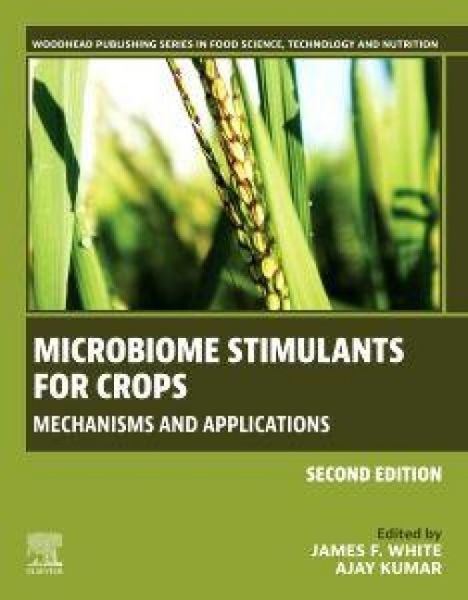
Produktbild: Microbiome Stimulants for Crops
Vorbesteller Neu

Microbiome Stimulants for Crops Mechanisms and Applications

279,99 €

inkl. gesetzl. MwSt., Versandkostenfrei


Beschreibung

Early work on the plant microbiome focused on establishing what it could do-cataloging endophytes, tracing their effects in individual crops, and testing bio-based inputs one mechanism at a time. Microbiome Stimulants for Crops: Mechanisms and Applications, Second Edition reflects how far the discipline...

Beschreibung

Early work on the plant microbiome focused on establishing what it could do-cataloging endophytes, tracing their effects in individual crops, and testing bio-based inputs one mechanism at a time. Microbiome Stimulants for Crops: Mechanisms and Applications, Second Edition reflects how far the discipline has since matured. The underlying biology is still here, updated throughout, but the center of gravity has shifted toward what happens after discovery: how microbial knowledge is engineered into stable preparations, scaled for commercial release, and evaluated for the risks it introduces alongside its benefits.
That shift changes who the book speaks to and how. A grower needs confidence that a product performs consistently across seasons and soils. A manufacturer needs formulations that survive storage, transport, and regulatory scrutiny. A policymaker needs evidence weighed against cost and environmental tradeoffs before any of it reaches a field at scale. Rather than treating these as separate conversations, the volume folds them into a single account of the microbiome as both a natural system and an emerging industry-one where scientific insight only matters once it becomes usable, repeatable, and safe.

Portrait

James F. White is professor of Plant Biology at Rutgers University, New Brunswick, NJ, United States. He received his BS and MS degrees in Botany and Plant Pathology/Mycology from Auburn University, Alabama, and completed his PhD in Botany at the University of Texas at Austin in 1987. Dr. White is internationally recognized for his research on symbiosis, with a focus on endophytic microorganisms. He has authored numerous scientific articles and has written or edited several influential reference books on the biology, taxonomy, and phylogeny of microbial endophytes. He and his research group currently investigate the diversity of endophytic and biostimulant microbes and their functional impacts on host plants, contributing foundational knowledge to plant–microbe interaction biology and sustainable agricultural innovation.

Dr. Ajay Kumar is currently working as an assistant professor at Amity Institute of Biotechnology, Amity University, Noida, India. Dr. Kumar recently completed his tenure as a visiting scientist from Agriculture Research Organization, Volcani Center, Israel. He has published more than 200 research, review articles, and book chapters in international and national journals. He serves as an associate editor for Frontiers in Microbiology, BMC Microbiology and as guest editor for various journals such as Plants, Microorganisms, and Sustainability. Dr. Kumar has also edited more than 40 books with the leading publishers such as Elsevier, Springer, and Wiley. Dr. Kumar’s research experience is in the field of plant–microbe interactions, postharvest management, cyanobacterial biology, and so on

Produktdetails

Einband

Taschenbuch

Erscheinungsdatum

01.01.2027

Herausgeber James F. White + weitere
Verlag Elsevier

Produktdetails

Einband

Taschenbuch

Erscheinungsdatum

01.01.2027

Herausgeber
Verlag Elsevier
Seitenzahl

494

Maße (L/B)

27,6/21,6 cm

Gewicht

449 g

Auflage

2nd edition

Sprache

Englisch

ISBN

978-0-443-45152-2

Herstelleradresse

Libri GmbH
Europaallee 1
36244 Bad Hersfeld
DE

Email: gpsr@libri.de

Noch keine Bewertungen vorhanden

Verfassen Sie die erste Bewertung zu diesem Artikel

Helfen Sie anderen Kundinnen und Kunden durch Ihre Meinung.

Kundinnen und Kunden meinen

Bewertungen (0)

Weitere Artikel finden Sie in

  • Produktbild: Microbiome Stimulants for Crops
  • PART I - Foundations: The Plant Microbiome
    1. Microbial Endophytes: Evolution, Diversity, Community Functions, and Regulation
    2. Plant Microbiome: Diversity, Distribution, and Functional Relevance in Crop Improvement and Sustainable Agriculture
    3. Influence of Root Exudates on Rhizosphere Microbial Structure and Dynamics
    4. Deciphering the Role of Root Exudates in Rhizosphere Microbial Assembly and Function
    5. Molecular and Genetic Factors Influencing Interactions Between Host and Pathogen

    PART II - Biostimulants: Mechanisms and Crop Benefits
    6. Redefining Crop Productivity: Microbial Biostimulants and Their Role in Modern Agriculture
    7. Role of Biostimulant Application in Improving Crop Growth, Physiological Performance, and Stress Tolerance Under Abiotic Stress Conditions
    8. Cyanobacteria as Biostimulants for Crops
    9. Role of Beneficial Fungi in Sustainable Agriculture

    PART III - Waste Valorization and Circular Inputs
    10. Biostimulant Development from Waste-Derived Microbiome Stimulants: Mechanisms, Applications, and Future Prospects
    11. Circular Utilization of Agro-Industrial Residues for Plant Microbiome Modulation
    12. Microbiome-Targeted Biostimulants from Agro-Industrial Residues: Valorization Strategies and Agricultural Applications
    13. Organic Amendments and Soil Microbial Interactions: Roles of Compost, Biochar, and Green Manures
    14. Current Research on Biochar and Its Impact on Plant-Microbe Interactions
    15. Bioprospecting Extremophiles for Sustainable Agriculture and the Future of Space Biotechnology

    PART IV - Design, Formulation, and Field Application
    16. Microbial Consortia: Designing and Optimizing Synergistic Communities for Sustainable Agriculture
    17. Microbial Biocontrol Formulations for Commercial Applications
    18. Precision Agriculture Revolution: Microbes in Integrated Farming
    19. Microbes and Food Security: A Holistic Approach to Alleviating Hunger

    PART V - Innovation, Commercialization, and Safety
    20. Cutting-Edge Technologies: Microbial Innovations in Agriculture
    21. Integrating Omics Approaches and Next-Generation Technologies in Microbial Biostimulant Research
    22. The Endophytic Microbiome in Sustainable Agriculture: Integrating Artificial Intelligence and Machine Learning
    23. Development and Commercialization of Microbiome-Based Stimulants: Innovations, Challenges, and Future Prospects
    24. Microbial Inoculants as Plant Biostimulants: Assessing Risks and Safety Considerations