KI-Beratung Beta

Produktbild: E-Learning and Interactive Learning
Vorbesteller Neu

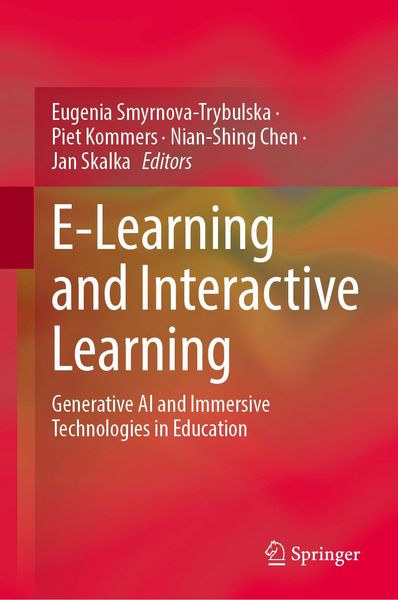
E-Learning and Interactive Learning Generative AI and Immersive Technologies in Education

186,99 €

inkl. gesetzl. MwSt., Versandkostenfrei


Beschreibung

Produktdetails

Einband

Gebundene Ausgabe

Erscheinungsdatum

04.12.2026

Abbildungen

XX, 455 p. 110 illus., 61 illus. in color.

Herausgeber

Eugenia Smyrnova-Trybulska + weitere

Verlag

Springer

Seitenzahl

455

Maße (B/H)

15,5/23,5 cm

Sprache

Englisch

ISBN

978-3-032-39285-5

Beschreibung

Portrait

Eugenia Smyrnova-Trybulska is Associate Professor at the University of Silesia, Poland. She researches e‑learning, digital technologies, robotics, and teacher training. She has coordinated major European projects, authored over 380 publications and 26 books, developed 160+ online courses, and serves as Editor‑in‑Chief of the International Journal of Research in E‑learning .

Piet Kommers is Professor and advisor to the European Commission, UNESCO, and national ministries. He was honored by UNESCO for his work in learning technologies across Europe and Southeast Asia. His methods have shaped global education policy. He has over 7,800 citations and an h-index of 34, and has supervised more than 20 doctoral dissertations. His research focuses on educational innovation, learning design, and team leadership in academic settings.

Nian-Shing Chen is Chair Professor at National Taiwan Normal University. He received Taiwan’s National Outstanding Research Award three times and is ranked among the top global scholars in educational technology. He served as Editor-in-Chief of Educational Technology and Society and is listed among the world’s top 2% scientists by Stanford University, USA. His work focuses on digital learning, research excellence, and international collaboration in education.

Jan Skalka is Associate Professor at Constantine the Philosopher University in Nitra, Slovakia. He researches artificial intelligence, human behavior, and virtual learning environments. He coordinates international projects on digital education and has developed over 2,000 microcourses and 12 modules on artificial intelligence. His work bridges computer science, psychology, and education, with a focus on personalized learning and curriculum development.

Produktdetails

Einband

Gebundene Ausgabe

Erscheinungsdatum

04.12.2026

Abbildungen

XX, 455 p. 110 illus., 61 illus. in color.

Herausgeber

Verlag

Springer

Seitenzahl

455

Maße (B/H)

15,5/23,5 cm

Sprache

Englisch

ISBN

978-3-032-39285-5

Herstelleradresse

Springer Nature Customer Service Center GmbH
Europaplatz 3
69115 Heidelberg
DE
ProductSafety@springernature.com

Noch keine Bewertungen vorhanden

Verfassen Sie die erste Bewertung zu diesem Artikel

Helfen Sie anderen Kundinnen und Kunden durch Ihre Meinung.

Kundinnen und Kunden meinen

Bewertungen (0)

Weitere Artikel finden Sie in

  • Produktbild: E-Learning and Interactive Learning
  • Empowering Pre-Service Teachers in the Era of Generative AI: Perceptions and Experiences of Training with Pedagogical AI Agents and R&T Learning Systems.- Transforming School Informatics Education in the AI Era: Paradigm Shift, Pedagogical Innovations, and Digital Competence.- Artificial intelligence technologies for researchers: analysis of the experience of universities in Ukraine and the European Union.- Towards Choosing Appropriate Research Design for Evaluating Generative AI's Impact on Solving Complex Tasks.- Artificial Intelligence in Ukrainian Secondary Education: Empirical Insights into Its Integration in Teaching Practice.- The Impact of AI on Business Students’ Competences.- AI Threat Modelling Active Learning.- Artificial intelligence in learning mathematics: an analysis of student experience.- Artificial intelligence in teaching English to preschoolers.- The Use of AI-Based Chatbots in the Professional Activities of Secondary School Teachers in Ukraine: Results of an Empirical Study.- Mapping the use of DeLone and McLean Information System Success Model with Emerging Technologies: A Systematic Literature Review of Empirical Research.- Rethinking Assessment in Metaverse-Based Teacher Training: A Theoretical Inquiry into Evidence, Competence, and Learning.- From blackboard to VR: a modern look at solving systems of linear equations.- Uncovering Common Dimensions in Player Typologies: A Statistical Analysis of User Models.- Interdisciplinary Approaches to Developing Digital Competencies through STEAME Education.- Adaptive E-learning with VARK Learning Style Model.- Towards a Unified Model for Content Personalization in Virtual Environments.- Dashboards as a Tool for Developing Students’ Analytical Thinking in the Context of E-Learning.- The use of digital educational resources in teaching variational calculus to future mathematics teachers.- Improved support for self-study of SCPI programming via portable Arduino device.- E-learning in computer hardware teaching and learning.