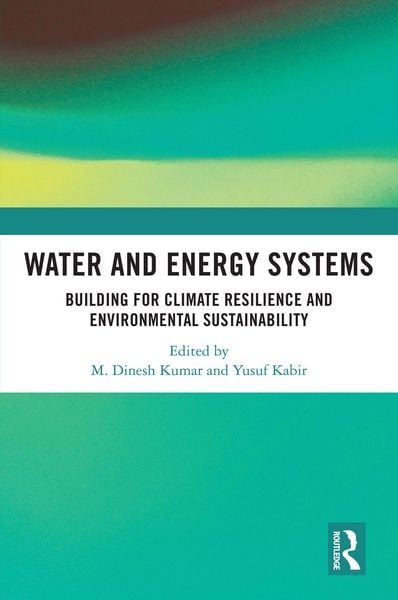
Water and Energy Systems Building for Climate Resilience and Environmental Sustainability
-
- Hardcover
- Taschenbuch ausgewählt
- eBook
-
Sprache:Englisch
57,99 €
inkl. gesetzl. MwSt.,
Beschreibung
Produktdetails
Einband
Taschenbuch
Erscheinungsdatum
28.09.2026
Abbildungen
schwarz-weiss Illustrationen, Raster,schwarz-weiss, Zeichnungen, schwarz-weiss, Tabellen, schwarz-weiss
Herausgeber
M. Dinesh Kumar + weitereVerlag
Taylor and FrancisSeitenzahl
314
Maße (L/B/H)
23,4/15,6/1,8 cm
Gewicht
480 g
Auflage
1. Auflage
Sprache
Englisch
ISBN
978-1-03-298761-3
This book addresses how water supply systems can be planned, designed, and managed for sustainability by presenting unique approaches and methodologies in rural drinking water supply schemes. It synthesizes the outcomes and findings of research studies undertaken by the Institute for Resource Analysis and Policy (IRAP) and pilot projects undertaken by RCUES (Regional Centre for Urban Environmental Studies) of AIILSG, Mumbai in collaboration with government of Maharashtra, with technical support from other development partners on climate-resilient water and energy systems.
Backed by empirical research, this volume aims to build the conceptual foundations of the subject, additionally bringing in results of pilot projects that apply some of the models in water conservation, clean energy production, and environmental management. Towards building a climate-resilient society, it also discusses the feasibility of reducing carbon emissions in rural water supply, to make it more energy efficient.
The book will be useful to students, researchers, and teachers working on Water Resources, Water Supply, Renewable Energy systems, Management of Climate-Induced Disasters, Water-Energy-Climate Policy, and Development Studies. This will also be an invaluable companion to policy makers, general administrators, civil society organizations, media persons, and bilateral agencies like WHO, UNICEF, UNDP, UNEP, World Bank, and the Gates Foundation.
Noch keine Bewertungen vorhanden
Verfassen Sie die erste Bewertung zu diesem Artikel
Helfen Sie anderen Kundinnen und Kunden durch Ihre Meinung.
Kurze Frage zu unserer Seite
Vielen Dank für Ihr Feedback
Wir nutzen Ihr Feedback, um unsere Produktseiten zu verbessern. Bitte haben Sie Verständnis, dass wir Ihnen keine Rückmeldung geben können. Falls Sie Kontakt mit uns aufnehmen möchten, können Sie sich aber gerne an unseren Kund*innenservice wenden.
zum Kundenservice