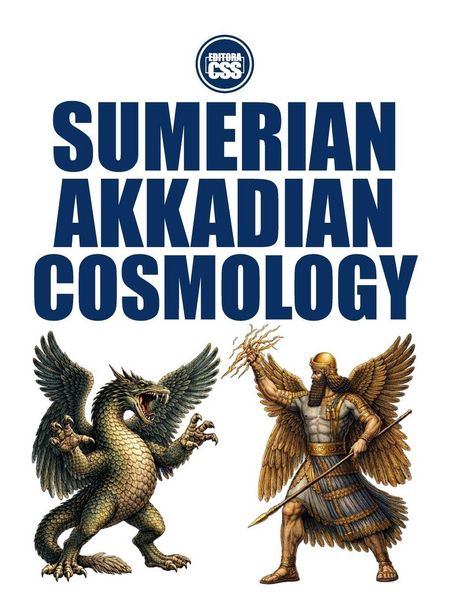
SUMERIAN-AKKADIAN COSMOLOGY - From the Primordial Waters to the Creation of Humanity
-
- Englisch ausgewählt
45,99 €
inkl. gesetzl. MwSt.,
Beschreibung
Produktdetails
Einband
Taschenbuch
Erscheinungsdatum
10.02.2026
Illustriert von
Diagramhouse Illustration
Herausgeber
Textus Receptus English EditionVerlag
Independently PublishedSeitenzahl
450
Maße (L/B/H)
27,9/21,6/2,3 cm
Gewicht
1037 g
Sprache
Englisch
EAN
9798247134695
SUMERIAN-AKKADIAN COSMOLOGY: From the Primordial Waters to the Creation of Humanity opens a window onto one of the oldest complete visions of the universe ever imagined. Long before classical Greece or the writings of the Bible, the people of Sumer and Akkad were asking where the world came from, why the sky is separate from the earth, and what role humans play between gods and destiny. From the undivided sea of Nammu, Apsu and Tiamat to the rise of An, Enlil, Enki (Ea) and the great gods of the second and third generations, this book follows the birth of a cosmos that is at once mythical, political, and profoundly human.
Built as a full, self-contained guide, the volume moves from the primordial chaos and the first separation of sky, earth, and underworld, through the generation of the gods and the dramatic cosmogony of the Enuma Elish, all the way to the creation of humanity from the blood of Kingu and the clay of the earth. It explores the structure of heaven, earth, and underworld; the roles of Inanna / Ishtar, Utu / Shamash, Nanna / Sin, Ninhursag / Ninmah, Nergal, Dumuzi, Ninurta and other powers; and the great myths of Inanna's descent, Enki and Ninhursag, and the Flood of Ziusudra / Utnapishtim. Rituals, sacrifices, festivals, omens, and the administration of fate by the Anunnaki show how this cosmology was lived in temple, city, and royal court.
At the center of the book stands the relationship between gods and humans. Humanity appears as a mixture of divine blood and clay, created to maintain temples, feed the gods, and help stabilize the cosmos through ritual service, justice, and work. The chapters on rituals and sacrifice, destiny, magic, and divination, and the gods as lords of the cities reveal a universe in which politics, religion, and nature are inseparable: to govern well is to keep heaven, earth, and the world below in balance. The king as divine representative, the temple-city as sacred mountain, and the tablets that record both law and destiny form a single symbolic system.
A distinctive feature of this volume is its sustained attention to biblical resonances. The sections on parallels with Genesis, the Flood and the narrative of Noah, and the garden, the serpent, and Sumerian motifs trace how themes such as a well-watered garden, a life-giving tree, a talking serpent, a world-destroying flood, and a remnant saved in a boat move from Mesopotamian myth into the Hebrew Bible. Without reducing one tradition to the other, the book shows how Eden, Noah's Flood, and the language of creation and order were shaped in dialogue with a much older Mesopotamian symbolic world. Later chapters follow the afterlife of this cosmology in the Epic of Gilgamesh, in cuneiform scholarship, and in its echoes in Egypt, the Levant, Anatolia, early Persia, and Archaic Greece.
Carefully structured yet highly readable, SUMERIAN-AKKADIAN COSMOLOGY is ideal for readers fascinated by ancient history, Near Eastern myth, biblical backgrounds, or the deep roots of philosophical thinking about the universe. It brings together the great myths, the daily cult, the political ideology, and the intellectual legacy of the land between the rivers, revealing how a world of gods, stars, cities, and clay tablets helped shape the way later civilizations-from Israel to Ionia-came to imagine creation, order, and the destiny of humankind.
Noch keine Bewertungen vorhanden
Verfassen Sie die erste Bewertung zu diesem Artikel
Helfen Sie anderen Kundinnen und Kunden durch Ihre Meinung.
Kurze Frage zu unserer Seite
Vielen Dank für Ihr Feedback
Wir nutzen Ihr Feedback, um unsere Produktseiten zu verbessern. Bitte haben Sie Verständnis, dass wir Ihnen keine Rückmeldung geben können. Falls Sie Kontakt mit uns aufnehmen möchten, können Sie sich aber gerne an unseren Kund*innenservice wenden.
zum Kundenservice