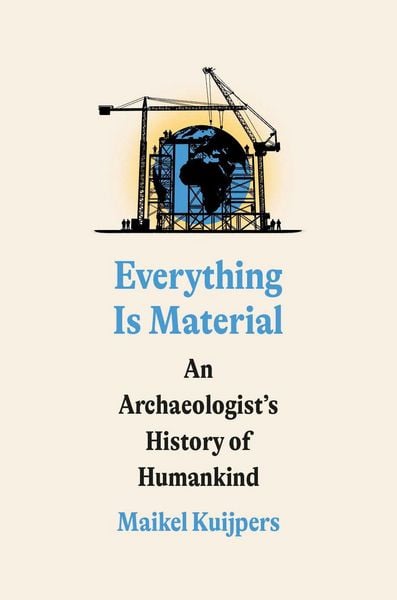
Everything Is Material An Archaeologist's History of Humankind
-
- Englisch ausgewählt
31,99 €
inkl. gesetzl. MwSt.,
Beschreibung
Produktdetails
Einband
Gebundene Ausgabe
Erscheinungsdatum
27.04.2027
Verlag
Random House N.Y.Seitenzahl
480
Maße (L/B/H)
23,5/15,6/2,3 cm
Gewicht
572 g
Sprache
Englisch
ISBN
978-0-593-59445-2
“What we think and say may turn out to be less telling than what we make and throw away. So argues Maikel Kuijpers in Everything Is Material, a work that is, at once, fascinating, eye-opening, and terrific fun.”—Elizabeth Kolbert, Pulitzer Prize-winning author of Under a White Sky
Entire prehistoric epochs are named after materials: Stone Age, Bronze Age, Iron Age. But something changes when “history” begins. There is no Concrete Age that follows the Iron Age, even though the Roman Empire could not have been built without concrete. The Age of Enlightenment is really the Age of Glass—without microscopes and telescopes, there wouldn’t have been much enlightenment. Today, materials we have dug up, hauled, sawn, built, and manufactured—from screwdrivers to skyscrapers—now exceed the weight of all living biomass on earth, an unimaginable total of 1,154 gigatons. Nearly half of all that material mass is concrete. And yet, we hardly pay attention to this material world.
In Everything Is Material, archaeologist Maikel Kuijpers draws on original research on archaeology, anthropology, and material and environmental sciences to reveal the hidden lives of the materials that have tipped the scale of human history: wood, soil, brick, ceramics, steel, concrete, glass, plastic, and fertilizer. Take any one of these away and modern society would look radically different, from the adoption of farming (soil), to urbanization (brick), the scientific revolution (glass), expansion and colonization (wood), industrialization (iron and steel), consumerism (ceramics), standardization and globalization (concrete), the widespread adoption of meat-heavy diets (fertilizer), and the great acceleration (plastic). Following these materials through time offers a new story of our human saga: our ideas, values, language, and cultures are embedded in and derived from the material world. Materials help us think.
At the same time, many of these materials produce pollution in a way that threatens our existence. It’s the Catch-22 of the 21st century: the materials we build our civilization with are also the ones that are destroying it. But how did it come to this? And can we do something about it?
Deeply researched and perspective-shifting, Everything Is Material proves material history is human history—and understanding this relationship is the key to a more sustainable future.
Noch keine Bewertungen vorhanden
Verfassen Sie die erste Bewertung zu diesem Artikel
Helfen Sie anderen Kundinnen und Kunden durch Ihre Meinung.
Kurze Frage zu unserer Seite
Vielen Dank für Ihr Feedback
Wir nutzen Ihr Feedback, um unsere Produktseiten zu verbessern. Bitte haben Sie Verständnis, dass wir Ihnen keine Rückmeldung geben können. Falls Sie Kontakt mit uns aufnehmen möchten, können Sie sich aber gerne an unseren Kund*innenservice wenden.
zum Kundenservice