Gutscheinbedingungen

**Gültig bis 02.09.2026 auf fremdsprachige Bücher in der Thalia App. Einzelne Artikel können ausgeschlossen sein. Ausgenommen sind preisgebundene Artikel & eBooks. Pro Einkauf einmal einlösbar. Click & Collect nur bei Onlinevorabzahlung möglich. Keine Barauszahlung. Nicht kombinierbar mit anderen Aktionen und Gutscheinen. Gutschein wird auf max. 500€ Bestellwert angerechnet. Nicht gültig für Geschenkkarten, Versandkosten und Services.

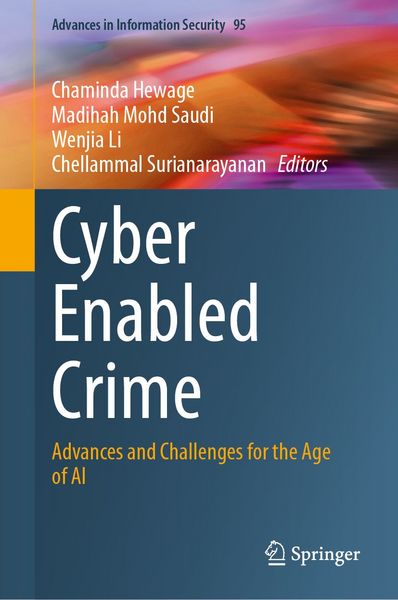
Produktbild: Cyber Enabled Crime
Band 95 Vorbesteller

Cyber Enabled Crime Advances and Challenges for the Age of AI

201,99 €

inkl. gesetzl. MwSt., Versandkostenfrei


Beschreibung

Produktdetails

Einband

Gebundene Ausgabe

Erscheinungsdatum

08.01.2027

Abbildungen

XVIII, 488 p. 52 illus., 40 illus. in color.

Herausgeber

Chaminda Hewage + weitere

Verlag

Springer

Seitenzahl

488

Maße (B/H)

15,5/23,5 cm

Sprache

Englisch

ISBN

978-3-032-37858-3

Beschreibung

Portrait

Dr Chaminda Hewage is an academic leader, researcher, and educator specialising in cybersecurity, data security, and multimedia communications. He currently serves as Associate Dean for Research (Interim) in the Cardiff School of Technologies at Cardiff Metropolitan University, where he is also a Reader (Associate Professor) in Data Security and Programme Director for Computer Security.

He obtained a BSc (First Class Honours) in Electrical and Information Engineering from the University of Ruhuna, Sri Lanka, before completing a PhD in Multimedia Communications at the University of Surrey, United Kingdom. Earlier in his career, he worked as a telecommunications engineer at Sri Lanka Telecom and later as a researcher at the University of Surrey and Kingston University London.

Dr Hewage’s research spans cybersecurity, data protection, multimedia systems, and data visualisation, with particular emphasis on Quality of Experience (QoE), data privacy, and next-generation communication systems. 


Prof Madihah Mohd Saudi is a Professor at Information Security and Assurance (ISA) Programme, Faculty of Science and Technology (FST), Universiti Sains Islam Malaysia (USIM), Malaysia. She is an honorary Research Fellow at the Cyber Security Group (CSG), University of Bristol, United Kingdom and a Visiting Professor at Universitas Magelang Muhammadiyah (UNIMMA), Indonesia, Widyatama University, Bandung Indonesia and Samarkand Tashkent University of Technology (SAMTUIT), Uzbekistan and Visiting Academic Fellow at Faculty of Advanced Technology and Multidisciplinary, Universitas Airlangga (UNAIR), Indonesia. Formerly as Chief Information Officer (CIO) at USIM, currently she is also a member of the National Council of Professors (MPN), Malaysia, a Technologist Specialist (Ts) from Malaysia Board Of Technologists (MBOT), Malaysia, a senior member of the IEEE Computer Society and IEEE Sensors Council, and Technical Committee for IEEE Pattern Analysis and Machine Intelligence andIEEE Security and Privacy and as Deputy Secretary for Cyber Akademia Malaysia (CSAM),Malaysia. 

Dr Wenjia Li has been a tenure-track assistant professor of computer science at New York Institute of Technology since fall 2014. Prior to joining New York Tech, Li was a tenure-track assistant professor at Georgia Southern University. He obtained his Ph.D. in computer science from University of Maryland Baltimore County in August 2011. His master’s degree in computer science (2005) and a bachelor’s degree in telecommunications engineering (2002) are from Hunan University, China.

Li’s main research areas are cybersecurity, networking, and mobile computing. He studies trust management policies in wireless networks; cyber-physical systems (such as intelligent transportation systems); the internet of things; and Android mobile devices. Li has published over 70 research papers in peer-reviewed journals and conference proceedings.


Dr. Chellammal Surianarayanan is an Associate Professor of Computer Science at Bharathidasan University, Tiruchirappalli, India. She brings a rich and diverse professional background to her work, combining 12 years of core research and development service as a Scientific Officer at the prestigious Indira Gandhi Centre for Atomic Research (IGCAR) with 16 years of dedicated academic service. A distinguished researcher and author, her expertise spans cutting-edge domains including cloud computing, microservices architecture, semantic web, and the convergence of artificial intelligence with edge computing and healthcare.

She has authored definitive textbooks, including Essentials of Cloud Computing published by Springer and Essentials of Microservices Architecture: Paradigms, Applications, and Techniques published by CRC Press. 


Produktdetails

Einband

Gebundene Ausgabe

Erscheinungsdatum

08.01.2027

Abbildungen

XVIII, 488 p. 52 illus., 40 illus. in color.

Herausgeber

Verlag

Springer

Seitenzahl

488

Maße (B/H)

15,5/23,5 cm

Sprache

Englisch

ISBN

978-3-032-37858-3

Herstelleradresse

Springer Nature Customer Service Center GmbH
Europaplatz 3
69115 Heidelberg
DE
ProductSafety@springernature.com

Noch keine Bewertungen vorhanden

Verfassen Sie die erste Bewertung zu diesem Artikel

Helfen Sie anderen Kundinnen und Kunden durch Ihre Meinung.

Kundinnen und Kunden meinen

Bewertungen (0)

  • Produktbild: Cyber Enabled Crime
  • .- Introduction to Cyber Enabled Crimes - Challenges and Advances.

    Section I: Emerging Threats and Societal Impacts.

    .- Extremism and Radicalism in Religious Aspects on Online Platforms: Definition and Proactive Measures.

    .- Cyber-Enabled Crimes in Malaysia: Challenges and Future Directions.

    .- Self-Transgression Control on Adolescents' Cyber-Enabled Crime Prevention Model using PLS-SEM Analysis.

    .- Deceptive Design and AI-driven Risks: A Human Trafficking Case Study Highlighting the Need for Stronger Online Interface Protections.

    .- Feast on the Desperate.

    Section II: Cyber Abuse, Online Harm, and Content Moderation.

    .- Classification of Online Sexual Abuse and Hate Speech in Education Through Deep Learning.

    .- Flaming Classification for Cyberbullying: Malay Dataset.

    .- Real-Time Content Filtering for Gaming: A Proof-of-Concept System.

    Section III: Artificial Intelligence and Advanced Threat Landscapes.

    .- Advanced AI-Driven Threats and Cyber-Warfare: Technical Challenges and Global Security Implications.

    .- Illustrating the Power of Agentic AI for Cyber Security.

    .- Deepfake Detection Using Vision Transformer: A State-of-the-Art.

    Section IV: Cybersecurity Technologies and Defensive Frameworks.

    .- A Neural Network Model for Real-Time Network Intrusion Detection within the Suricata–Wazuh Environment.

    .- Strengthening SME Defences: A Framework for Malware Resilience.

    .-  Artificial Intelligence in Clinical Diagnostics as a Cyber-Enabled Crime Vector: Health Data Vulnerabilities, Regulatory Gaps, and Frontline Clinical Perspectives.

    Section V: Governance, Privacy, and Regulatory Challenges.

    .- Assessing Privacy, Information Governance and Cyber Resilience in Paper Based Bedside Documentation in NHS South Wales: A Case Study of Bed and Hydration Charts.

    .- AI and Neurotechnology: The Urgent Need for Agile Legal Frameworks and Post-Human Ethical Perspectives on Mental Privacy.

    .- Digital Lex Mercatoria: Deconstructing Crypto-Legal Personhood in the Fintech Epoch.

    Section VI: Cyber Risk, Policy, and Organizational Capacity.

    .- Cyber-Enabled Risk and the Digital Transformation Paradox in Nigeria.

    .-  Integrating Leadership Competencies into Cybersecurity Education: A Thematic Analysis of Postgraduate Student Scorecards for SMEs.