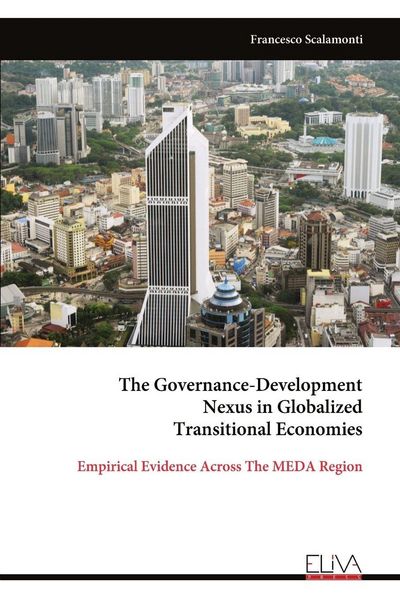
The Governance-Development Nexus in Globalized Transitional Economies Empirical Evidence Across The MEDA Region
-
- Englisch ausgewählt
64,99 €
inkl. gesetzl. MwSt.,
Beschreibung
Produktdetails
Einband
Taschenbuch
Erscheinungsdatum
21.07.2026
Verlag
Eliva PressSeitenzahl
116
Maße (L/B/H)
22,9/15,2/0,7 cm
Gewicht
181 g
Sprache
Englisch
EAN
9789999344647
Despite decades of theoretical analysis and empirical research, the governance-development nexus is a non-univocal issue, particularly when examined through the lens of transitional economies, where institutional legacies, cultural specificities, and geopolitical vulnerabilities intersect in ways that challenge universalist policy prescriptions. This work addresses this gap by presenting three empirical investigations of the governance-development nexus across the globalized MEDA transitional economies-Morocco, Algeria, Tunisia, Libya, Egypt, Israel, Jordan, Lebanon, Syria, and Turkey-over the period 1996-2019. These countries, united by their membership in the Euro-Mediterranean Partnership launched with the "Barcelona Declaration" of 1995, remain profoundly heterogeneous in their institutional and business environments, resource endowments, and sociocultural habits-offering a particularly instructive laboratory for examining the macro-determinants of governance climate and development paths-however they may also share common history, traditions, and religious foundations. The contribution of these investigations is both empirical and theoretical: first, it provides novel empirical evidence on the governance-development nexus in an under-researched region, employing rigorous econometric methods that address issues of heterogeneity, persistence, and causal precedence. Second, it theoretically advances the integration of neo-institutionalism and cultural specificity, considering the globalization process, demonstrating that institutional analysis cannot be divorced from the sociocultural contexts in which institutions are embedded. Finally, the overall composite index of governance climate, as recalled by the studies, proves valuable in summarizing the three dimensions of governance-political, economic, and institutional-without incurring the disadvantage of multicollinearity between its components.
Noch keine Bewertungen vorhanden
Verfassen Sie die erste Bewertung zu diesem Artikel
Helfen Sie anderen Kundinnen und Kunden durch Ihre Meinung.
Kurze Frage zu unserer Seite
Vielen Dank für Ihr Feedback
Wir nutzen Ihr Feedback, um unsere Produktseiten zu verbessern. Bitte haben Sie Verständnis, dass wir Ihnen keine Rückmeldung geben können. Falls Sie Kontakt mit uns aufnehmen möchten, können Sie sich aber gerne an unseren Kund*innenservice wenden.
zum Kundenservice