Produktbild: On-Demand Learning for Lifelong and Responsive Education
Vorbesteller Neu

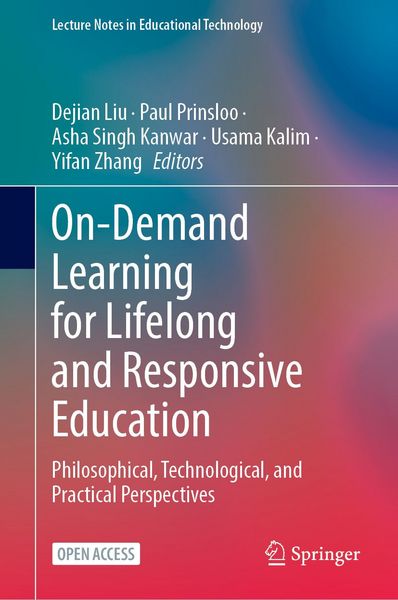
On-Demand Learning for Lifelong and Responsive Education Philosophical, Technological, and Practical Perspectives

49,99 €

inkl. gesetzl. MwSt., Versandkostenfrei


Beschreibung

Produktdetails

Einband

Gebundene Ausgabe

Erscheinungsdatum

27.10.2026

Abbildungen

VIII, 400 p. 24 illus., 16 illus. in color.

Herausgeber

Dejian Liu + weitere

Verlag

Springer Singapore

Seitenzahl

400

Maße (B/H)

15,5/23,5 cm

Sprache

Englisch

ISBN

978-981-9251-96-4

Beschreibung

Portrait

Dr. Dejian Liu is the Founder and Chairman of NetDragon Websoft Holdings Limited, and serves as Co-Dean of the Smart Learning Institute and the National Engineering Research Center for Big Data Application in Education at Beijing Normal University, China. He is a member of the Governing Board of the United Nations Educational, Scientific and Cultural Organization (UNESCO) Institute for Information Technologies in Education (IITE), and is widely regarded as a leader in the field of smart education innovation. As a contributor to China’s National Smart Education Platform, Dr. Liu has driven technological innovations aimed at enhancing educational equity. He has played a pivotal role in global education initiatives under UNESCO and the Belt and Road Initiative, with impact across Africa, the Middle East, and the Association of Southeast Asian Nations (ASEAN) regions. Through NetDragon’s education technologies, his work now supports over 1.3 million classrooms in more than 150 countries. Dr. Liu and his team hold over 1,400 patents and have authored 17 books and more than 30 academic papers.

Paul Prinsloo is a Research Professor in Open and Distance Learning (ODL) in the Department of Business Management, College of Economic and Management Sciences, University of South Africa (Unisa). He is a visiting professor at the National Open University of Nigeria (NOUN), a Research Associate for Contact North/Contact Nord (Canada), a member of the Center for Open Education Research at the Carl von Ossietzky University of Oldenburg, Germany, a Senior Fellow of the European Distance and E-Learning Network (EDEN), a member of the Executive Committee for the Society of Learning Analytics Research (SoLAR), and serves on several editorial boards.

Professor Asha Singh Kanwar, the former President and Chief Executive Officer of the Commonwealth of Learning (COL), is one of the world’s leading advocates of learning for sustainable development. Throughout a career spanning over 40 years, she has made outstanding contributions in the areas of teaching, research and international development. Prior to joining COL, Professor Kanwar was a senior consultant in open and distance learning at UNESCO’s (United Nations Educational, Scientific and Cultural Organization) Regional Office for Education in Africa (BREDA). She has also served as Director of the School of Humanities and as Pro-Vice Chancellor at the Indira Gandhi National Open University (IGNOU) in New Delhi, India. She was a Fulbright Fellow for post-doctoral research at Iowa State University in the United States of America, where she was later invited to teach. Currently, she serves on the boards of several organizations, including the Governing Board of the UNESCO Institute for Information Technologies in Education (IITE).

Dr. Usama Kalim is a Post-Doctoral Associate at Beijing Normal University, China, specializing in Artificial Intelligence (AI) in education. He holds a PhD in Educational Leadership and Management from Southwest University, China. His research focuses on educational technology, teacher education, and educational management, with publications in international journals such as Scientific Reports, SAGE Open, and Smart Learning Environments. He has also contributed book chapters and presented at global conferences in China, Japan, and Australia.

Dr. Yifan Zhang is a research associate at the National Engineering Research Center for Cyberlearning and Intelligent Technology at Beijing Normal University, China. His research focuses on the application and evaluation of generative Artificial Intelligence (AI) in education, learning sciences, and on computational thinking formation.

Produktdetails

Einband

Gebundene Ausgabe

Erscheinungsdatum

27.10.2026

Abbildungen

VIII, 400 p. 24 illus., 16 illus. in color.

Herausgeber

Verlag

Springer Singapore

Seitenzahl

400

Maße (B/H)

15,5/23,5 cm

Sprache

Englisch

ISBN

978-981-9251-96-4

Herstelleradresse

Springer Nature Customer Service Center GmbH
Europaplatz 3
69115 Heidelberg
DE
ProductSafety@springernature.com

Noch keine Bewertungen vorhanden

Verfassen Sie die erste Bewertung zu diesem Artikel

Helfen Sie anderen Kundinnen und Kunden durch Ihre Meinung.

Kundinnen und Kunden meinen

Bewertungen (0)

Weitere Artikel finden Sie in

  • Produktbild: On-Demand Learning for Lifelong and Responsive Education
  • Part 1. Foundations and Frameworks: Philosophical and epistemological underpinnings, historical trajectories, and political economy of On-Demand Learning.- Chapter 1. Introduction: Reimagining On-Demand Learning in a Changing World (Liu, Prinsloo, Kanwar, Kalim, Zhang and Chen).- Chapter 2. The Crisis of Learning and the Loss of the World: Reinterpreting On-Demand Learning through Hannah Arendt’s Vita Activa (Serpil).- Chapter 3. When Flexibility Becomes the Problem: Discourses, Educational Ideals and Individuals as Obstacles to On-Demand Learning (Sørensen and Stenalt).- Chapter 4. On-Demand Learning and Epistemic Justice: A Global South Critique of Demand, Platformisation, and Skill Formation (Gao; Tadesse and Khalid).- Part 2. Technologies and Practices: AI, mobile platforms, micro-credentialing, modular pathways, and institutional readiness.- Chapter 5. From Heat to Headset: Virtual Firefighting and the Lived Body in Training (Sellberg and Viktorelius).- Chapter 6. Seeing and Being Seen: How might On-Demand Learning be reimagined through AI-enabled smart glasses? (Marland, Welsman and Arantes).- Chapter 7. AI-Guided Reflection to Bridge Formal Learning and Work (Pammer-Schindler, Kennedy, Echeverria and Littlejohn).- Chapter 8. Microcredentialing Framework for On-Demand Learning: Easing Tensions and Expanding Learning Pathways (Peña Bandalaria and Almodiel).- Chapter 9. On-Demand Learning as a Catalyst for Inclusive, Scalable, and Sustainable Transformation in AI-Driven Education Policy and Practice (Ossiannilsson).- Part 3. Equity, Access, and Inclusion: ODL in resource-constrained or marginalized contexts, barriers/enablers, social justice, workforce participation.- Chapter 10. On-demand Learning to Address Gender Disparities in the Drone Economy – A Case Study from South Africa (Davis, Muzata and Mpofu).- Chapter 11. On-Demand Learning in Health: Lifelong Learning for Public Systems in the Global South (de Oliveira, Neves and Ubal).- Chapter 12. A Praxis of Emergence and Intentional Adaptation at Equity Unbound (Bali, Zamora, Aboulmagd, Abulfadl, Atef and Maweu).- Part 4. Global Case Studies and Models: Vocational and post-school institutions, lifelong learning systems, national policies.- Chapter 13. Global Pathways to Skills on Demand: Practical Models and Toolkits for On-Demand Learning Across Vocational, Higher, and Lifelong Education (Quang Bao and Thi Truc).- Chapter 14. On-Demand Learning for the Workforce in the Organised Sector: Mapping India's National Policies, Provisions, and the Futures (Panda, Mishra).- Part 5. Future Directions: Reimagining qualifications, ODL and the future of work, opportunities, risks, unresolved tensions.- Chapter 15. Vocational Education in Transition: Conceptualizing On-Demand Learning for the Future of Skills and Work (Parveen and Shafiq).- Chapter 16. Micro-credentials as Catalysts for Skills Transformation: Trends and Developments in Mauritius and Namibia (Mohee, Beukes-Amiss, Baguant and Maghoo).- Chapter 17. Concluding chapter: On-Demand Learning (Prinsloo, Kanwar, Kalim, Zhang, and Chen).