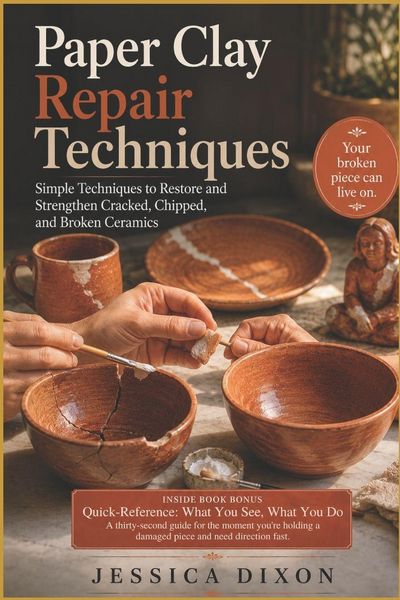
Paper Clay Repair Techniques Simple Techniques to Restore and Strengthen Cracked, Chipped, and Broken Ceramics
-
- Englisch ausgewählt
17,99 €
inkl. gesetzl. MwSt.,
- Kostenlose Lieferung ab 30 € Einkaufswert
- Versandkostenfrei für Bonuscard-Kund*innen
Beschreibung
Produktdetails
Einband
Taschenbuch
Erscheinungsdatum
19.07.2026
Verlag
Amazon Digital Services LLC - KdpSeitenzahl
46
Maße (L/B/H)
22,9/15,2/0,3 cm
Gewicht
77 g
Sprache
Englisch
EAN
9798187890736
Your Broken Piece Isn't Finished Yet
You opened the kiln or crossed the studio and found it. A crack running where it shouldn't be. A handle separated clean off. A chip missing from a rim you spent an hour refining. Your first thought was probably the same one most potters have: start over.
But what if that piece could still become finished work?
Paper Clay Repair Techniques walks you through a repair material that does what plain slip cannot: it bonds. The cellulose fiber in paper clay creates a mechanical bridge across cracks, gaps, and breaks. When mixed and applied correctly, it holds through drying and firing. This book shows you how, step by step, in plain language.
I wrote this because most clay books treat repair as a footnote. A paragraph on vinegar slip. A troubleshooting tip that rarely works. Repair deserves its own skillset. A cracked piece represents hours of your hands on clay. Sometimes it's worth saving. Sometimes it's not. This book helps you tell the difference and gives you the tools to act on either answer.
Inside, you'll find clear instruction on:
- Making an honest assessment of whether a repair is worth your time
- Mixing paper clay specifically for repair, not general building
- Closing cracks so they stay closed through drying and firing
- Rebuilding missing sections layer by bonded layer
- Rejoining clean breaks with joinery that survives the kiln
- Blending and texturing repairs so they become difficult to spot
- Firing repaired work without the repair failing
- Understanding what went wrong when a repair doesn't hold
This book is complete on its own. At the end, I've included an optional bonus resource for readers who want a fast damage-to-solution reference without rereading full chapters.
Who this is for: anyone with basic clay experience who has made something they care about and wants the option to save it when damage happens. Not your first clay book. The one you reach for when things go wrong.
What this book won't do: promise every repair will be invisible. Some will show under transparent glazes. Some damage isn't worth the effort, and you'll learn to recognize that early. What it offers is a reliable process for giving damaged work its best possible outcome.
If you have a piece sitting on a shelf that you couldn't bring yourself to throw away, this book was written for that moment.
Noch keine Bewertungen vorhanden
Verfassen Sie die erste Bewertung zu diesem Artikel
Helfen Sie anderen Kundinnen und Kunden durch Ihre Meinung.
Kurze Frage zu unserer Seite
Vielen Dank für Ihr Feedback
Wir nutzen Ihr Feedback, um unsere Produktseiten zu verbessern. Bitte haben Sie Verständnis, dass wir Ihnen keine Rückmeldung geben können. Falls Sie Kontakt mit uns aufnehmen möchten, können Sie sich aber gerne an unseren Kund*innenservice wenden.
zum Kundenservice