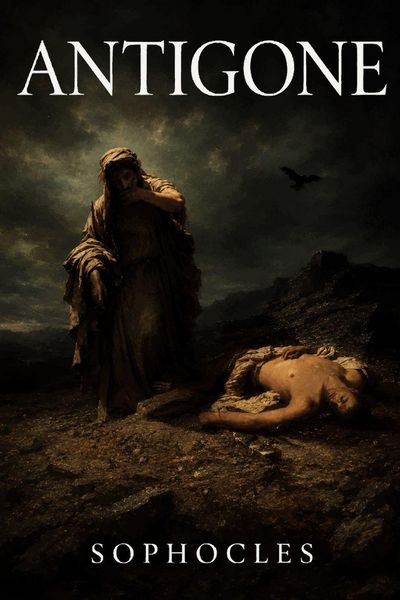
Antigone The Classic Greek Tragedy of Duty and Defiance
-
- Hardcover
- Taschenbuch ausgewählt
- eBook
- Hörbuch
-
Sprache:Englisch
- Englisch 11,99 € ausgewählt
- Türkisch 9,99 €
-
Verlag:Independently Published
- Arcturus Publishing Ltd 9,99 €
- Hachette Children's Book 9,99 €
- Lushena Books 11,99 €
- Penguin Books USA 11,99 €
- Oxford University Press 9,99 €
- Yale University Press 8,49 €
- Random House N.Y. 7,99 €
- Wordsworth Editions Ltd 7,99 €
- HarperCollins 6,99 €
- Independently Published 11,99 € ausgewählt
- Arizona Center for Medieval and Renaissance Studies (ACMRS) 9,99 €
- Pki 9,99 €
- Carlton Publishing 9,99 €
- Ingram Publishers Services 11,99 €
- Faenum Publishing, Ltd. 12,99 €
- Simon & Schuster N.Y. 9,99 €
11,99 €
inkl. gesetzl. MwSt.,
- Kostenlose Lieferung ab 30 € Einkaufswert
- Versandkostenfrei für Bonuscard-Kund*innen
Beschreibung
Produktdetails
Einband
Taschenbuch
Erscheinungsdatum
18.07.2026
Verlag
Independently PublishedSeitenzahl
70
Maße (L/B/H)
22,9/15,2/0,4 cm
Gewicht
108 g
Übersetzt von
Hazel Evermore
Sprache
Englisch
ISBN
978-1-918966-59-6
Antigone by Sophocles, first performed in Athens around 441 BCE, is one of the foundational plays of the Western dramatic tradition. It is also one of the most argued-over. For nearly two and a half thousand years readers and audiences have returned to its central conflict - between a young woman's obligation to bury her dead brother and a king's insistence on the authority of the state - and found in it the terms of their own moral and political moment. Hegel called it the perfect tragedy. Every generation since has read it differently.
The action is compressed and unrelenting. Antigone's brothers Eteocles and Polynices have killed each other in the civil war for Thebes. Their uncle Creon, now king, orders that Eteocles be buried with honour and that Polynices be left unburied outside the city walls, as a traitor. Anyone who attempts to bury Polynices will be put to death. Antigone, betrothed to Creon's own son Haemon, chooses her brother over her king. She goes out onto the plain in the darkness, scatters dust over her brother's body according to the rites, and is caught. What follows is the terrible working-out of consequences that Sophocles handles with the concision and inevitability that made him the greatest of the Athenian tragedians.
The play is short - under fifteen hundred lines - and structurally perfect. Sophocles brings Antigone and Creon into direct confrontation in a series of scenes whose intellectual and emotional force has never been surpassed. The debate between them is one of the foundational documents of Western political thought, and every subsequent argument about civil disobedience, the limits of state power, the claims of family against the claims of law, and the moral standing of the individual conscience against the sovereign has taken place in the shadow of what Sophocles wrote in Athens nearly twenty-five hundred years ago.
Antigone is also, and equally, a play about grief. Sophocles was interested throughout his career in what it is to lose the people we love and to be left living. Antigone's insistence on her brother's burial is not an abstract point of law but the last thing she can do for him. The great choral odes of the play - on the wonders and dangers of human power, on the sorrows inherited across generations, on the strangeness of love - give the play a lyric weight beneath its dialectical surface. It is a work of unusual formal beauty as well as of unusual moral force.
This edition is a new English translation from the Greek by Hazel Evermore, working directly from the original text. The translation aims to preserve the compressed intensity and formal control of Sophoclean verse while making the play immediately available to the English-language reader.
For readers approaching Greek tragedy for the first time, Antigone is the right place to begin - short, direct, and containing in compressed form the questions that Athenian drama was invented to explore. For readers who already know the Greeks, it is one of the plays that most repays return.
A short, essential classic of the Western dramatic tradition, in a new English translation.
Available in Kindle, Paperback, and Hardcover.
Noch keine Bewertungen vorhanden
Verfassen Sie die erste Bewertung zu diesem Artikel
Helfen Sie anderen Kundinnen und Kunden durch Ihre Meinung.
Kurze Frage zu unserer Seite
Vielen Dank für Ihr Feedback
Wir nutzen Ihr Feedback, um unsere Produktseiten zu verbessern. Bitte haben Sie Verständnis, dass wir Ihnen keine Rückmeldung geben können. Falls Sie Kontakt mit uns aufnehmen möchten, können Sie sich aber gerne an unseren Kund*innenservice wenden.
zum Kundenservice