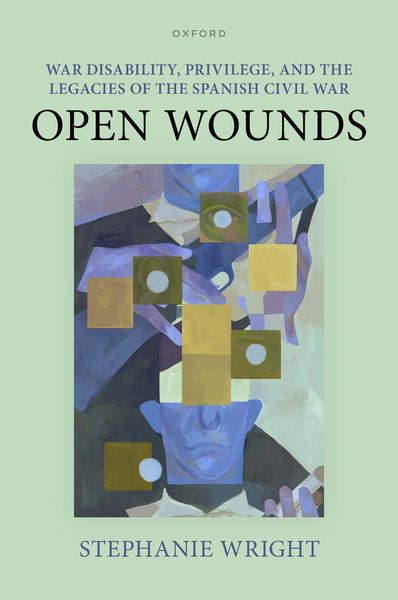
War Disability, Privilege, and the Legacies of the Spanish Civil War Open Wounds
-
- Englisch ausgewählt
118,99 €
inkl. gesetzl. MwSt.,
Beschreibung
Produktdetails
Einband
Gebundene Ausgabe
Erscheinungsdatum
18.03.2027
Abbildungen
18 b&w illustrations
Verlag
Oxford AcademicSeitenzahl
272
Maße (L/B)
23,4/15,6 cm
Sprache
Englisch
ISBN
978-0-19-792971-1
An open access title available under the terms of a CC BY-NC-ND 4.0 International licence At its foundations, this book explores the history of war disability after the Spanish Civil War of 1936-39, particularly as it pertained to soldiers who fought on the victorious side of the man who would become dictator of Spain until his death in 1975, General Francisco Franco. But this book is also about the legacies of civil wars and the social hierarchies these create. Over nine chapters, Stephanie Wright asks how the Francoist regime sought to manage its war disabled as a symbolically important group, how experiences of war disability varied according to personal background, and how non-elites--here viewed through the example of disabled veterans--negotiated the shifts in historical memory upon which their social status relied. The 'open wounds' of the book's title refer not only to the literal injuries of disabled veterans, but also to the contentious nature of such wounds, which were used by the regime to reinforce a whole host of post-Civil War social hierarchies. These included hierarchies between victors and vanquished, but also between military personnel and civilians, physical and mental wounds, as well as Spanish and colonial Moroccan troops. The idea of 'openness' captures, too, the highly variable meanings and experiences of permanent injuries sustained during the Civil War, which remained sensitive to shifts in Spain's evolving socio-political context. While contributing to our understanding of modern Spain, the book also speaks to broader scholarship on disability history. In Spain, the existence of not one, but two, cohorts of disabled veterans returning from war in 1939 and the Francoist regime's vindictive disenfranchisement of those who had fought for the defeated Republic, reconfigured traditional disability hierarchies. Franco's 'Mutilated Gentlemen' were not pitied in the Spanish post-war, but rather appeared to enjoy a privileged social status that set them apart from the millions of Spaniards struggling to negotiate the hardships of the 1940s. In this sense, Wright explores the relationship between disability and privilege, including an analysis of war veterans' disability activism following Spain's transition to democracy and the demise of the dictatorship that had guaranteed their relatively privileged status.
Noch keine Bewertungen vorhanden
Verfassen Sie die erste Bewertung zu diesem Artikel
Helfen Sie anderen Kundinnen und Kunden durch Ihre Meinung.
Kurze Frage zu unserer Seite
Vielen Dank für Ihr Feedback
Wir nutzen Ihr Feedback, um unsere Produktseiten zu verbessern. Bitte haben Sie Verständnis, dass wir Ihnen keine Rückmeldung geben können. Falls Sie Kontakt mit uns aufnehmen möchten, können Sie sich aber gerne an unseren Kund*innenservice wenden.
zum Kundenservice