Gutscheinbedingungen

**Gültig bis 14.09.2026 auf Spielzeug, Schreibwaren, Filme, Geschenke & Trends, Musik, tolino eReader & Zubehör, Hörbücher, nicht preisgebundene Bücher und Kalender in der Thalia App. Einzelne Artikel können ausgeschlossen sein. Aufgrund der Buchpreisbindung sind deutschsprachige Bücher und eBooks ausgenommen. Zusätzlich ausgenommen sind Abos & Flatrates, Games, Geschenkkarten/-boxen, Shelfies, Software, Zeitschriften sowie einzelne Artikel von tonies®. Pro Einkauf einmal einlösbar. Nur gültig mit im Onlineshop hinterlegter Bonuscard. Click & Collect nur bei Onlinevorabzahlung möglich. Keine Barauszahlung. Nicht kombinierbar mit anderen Aktionen und Gutscheinen. Gutschein wird auf max. 500€ Bestellwert angerechnet. Nicht gültig für Versandkosten und Services.

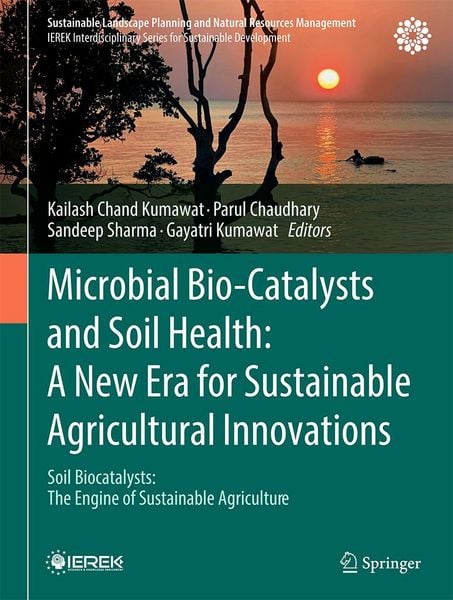
Produktbild: Microbial Bio-Catalysts and Soil Health: A New Era for Sustainable Agricultural Innovations
Vorbesteller Neu

Microbial Bio-Catalysts and Soil Health: A New Era for Sustainable Agricultural Innovations Soil Biocatalysts: The Engine of Sustainable Agriculture

192,99 €

inkl. gesetzl. MwSt., Versandkostenfrei


Beschreibung

Produktdetails

Einband

Gebundene Ausgabe

Erscheinungsdatum

16.11.2026

Abbildungen

V, 202 p. 27 illus., 26 illus. in color.

Herausgeber

Kailash Chand Kumawat + weitere

Verlag

Springer

Seitenzahl

202

Maße (B/H)

21/27,9 cm

Sprache

Englisch

ISBN

978-3-032-36753-2

Beschreibung

Portrait

Dr. Kailash Chand Kumawat is an Assistant Professor (Microbiology) in the Department of Industrial Microbiology, Jacob Institute of Biotechnology and Bioengineering, Sam Higginbottom University of Agriculture, Technology and Sciences, Prayagraj, India. He received his B.Sc. (Hons.) in Agriculture from Sher-e-Kashmir University of Agricultural Sciences and Technology of Kashmir and his M.Sc. (2014) and Ph.D. (2018) in Microbiology from Punjab Agricultural University, Ludhiana, Punjab, India. His research focuses on plant–microbe interactions, endophytic microbiomes, legume symbiosis, and sustainable agriculture. He has published 32 research papers, 17 book chapters, and has received over 1,804 citations, with an h-index of 20 and an i10-index of 25.

Dr. Parul Chaudhary is an Assistant Professor in the Faculty School of Agriculture, Graphic Era Hill University, Dehradun, India. Dr. Chaudhary earned her Ph.D. in Microbiology from Govind Ballabh Pant University of Agriculture and Technology, Pantnagar, India. She has served as a Junior Research Fellow at GBPUAT and a Senior Research Fellow at ICAR–National Dairy Research Institute, Karnal, in Government of India-funded projects. Her research focuses on soil microbiology, nanotechnology, bioremediation, antimicrobial resistance, and sustainable agriculture. She has published over 50 peer-reviewed articles, including 33 research papers, 9 review articles, and 18 books, and edited a CRC Press book. She has over 1,580 citations, an h-index of 24, and an i10-index of 30.

Dr. Sandeep Sharma is a Soil Microbiologist in the Department of Soil Science, Punjab Agricultural University, Ludhiana, India. He earned his B.Sc. (Hons.) in Agriculture, M.Sc., and Ph.D. in Soil Science from CSK Himachal Pradesh Krishi Vishvavidyalaya, Palampur. His research focuses on soil microbial transformations, soil quality indices, microbial functional diversity, conservation agriculture, crop residue management, and composting technologies in rice–wheat and maize–wheat systems. He has published 55 peer-reviewed research papers, 10 book chapters, one Elsevier book, and several conference and extension articles. He has served as Principal Investigator or Co-Principal Investigator on ten externally funded research projects.

Dr. Gayatri Kumawat is an Assistant Professor of Genetics and Plant Breeding at the Livestock Feed Resource Management and Technology Centre, Rajasthan University of Veterinary and Animal Sciences, Bikaner, India. She earned her Ph.D. in Plant Breeding and Genetics from Sri Karan Narendra Agriculture University, Jobner, with research conducted at ICAR–Central Soil Salinity Research Institute, Karnal, on QTL mapping for salinity tolerance in Indian mustard. Her research interests include molecular breeding, stress physiology, QTL mapping, and trait association studies. She has published over 20 research papers, contributed book chapters, and received several prestigious academic awards.

Produktdetails

Einband

Gebundene Ausgabe

Erscheinungsdatum

16.11.2026

Abbildungen

V, 202 p. 27 illus., 26 illus. in color.

Herausgeber

Verlag

Springer

Seitenzahl

202

Maße (B/H)

21/27,9 cm

Sprache

Englisch

ISBN

978-3-032-36753-2

Herstelleradresse

Springer International Publishing AG
Gewerbestr. 11
6330 Cham
Schweiz
Url: www.springer.com

Noch keine Bewertungen vorhanden

Verfassen Sie die erste Bewertung zu diesem Artikel

Helfen Sie anderen Kundinnen und Kunden durch Ihre Meinung.

Kundinnen und Kunden meinen

Bewertungen (0)

  • Produktbild: Microbial Bio-Catalysts and Soil Health: A New Era for Sustainable Agricultural Innovations
  • Chapter 1. Introduction to Microbial Bio-Catalysts and Their Role in Soil Health: Overview of Microbial Enzymes and Soil Ecological Function.- Chapter 2. Soil Microbiome Diversity and Functional Dynamics: Structure, Function, and Ecological Significance.- Chapter 3. Harnessing Enzymatic Biocatalysts for Sustainable Nutrient Cycling: A Plant–Microbiome Perspective.- Chapter 4. Rhizosphere Engineering: Mechanisms, Signaling, and Plant-Microbial Interactions.- Chapter 5. Metagenomics and Proteomics Approaches for Biocatalyst Discovery: Omics-Driven Exploration of Novel Microbial Enzymes.- Chapter 6. Microbial Consortia and Multi-Enzyme Systems for Soil Regeneration: Mechanisms and Applications.- Chapter 7. Biocatalysts for Soil Organic Carbon Sequestration and Climate Resilience: Roles in Carbon Stabilization and Greenhouse Gas Mitigation.- Chapter 8. Biocatalysts in rehabilitating degraded and saline soils: Use in land restoration and Marginal Soil Recovery.- Chapter 9. Microbial Biocatalysts in Organic and Regenerative Agriculture: Integration with Sustainable Farming Practices.- Chapter 10. Case Studies on Commercial Biocatalyst Products: Successes, Limitations, and Real-World Applications.- Chapter 11. Assessment of Soil Health: Indicators and Monitoring Tools for Biocatalyst Applications.- Chapter 12. Biocatalyst Scale-Up and Commercialization: Industry–Academia Perspectives and Partnership Models.- Chapter 13. Regulatory Framework and Biosafety of Microbial Bio-Catalysis: Legal, Safety, and Environmental Considerations.- Chapter 14. Microbial Biocatalysts for Climate-Smart Agriculture: Future Directions and Global Perspectives.