Gutscheinbedingungen

**Gültig bis 14.09.2026 auf Spielzeug, Schreibwaren, Filme, Geschenke & Trends, Musik, tolino eReader & Zubehör, Hörbücher, nicht preisgebundene Bücher und Kalender in der Thalia App. Einzelne Artikel können ausgeschlossen sein. Aufgrund der Buchpreisbindung sind deutschsprachige Bücher und eBooks ausgenommen. Zusätzlich ausgenommen sind Abos & Flatrates, Games, Geschenkkarten/-boxen, Shelfies, Software, Zeitschriften sowie einzelne Artikel von tonies®. Pro Einkauf einmal einlösbar. Nur gültig mit im Onlineshop hinterlegter Bonuscard. Click & Collect nur bei Onlinevorabzahlung möglich. Keine Barauszahlung. Nicht kombinierbar mit anderen Aktionen und Gutscheinen. Gutschein wird auf max. 500€ Bestellwert angerechnet. Nicht gültig für Versandkosten und Services.

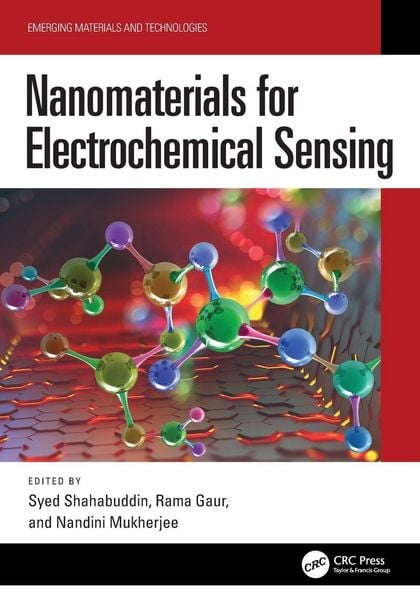
Produktbild: Nanomaterials for Electrochemical Sensing
Neu

Nanomaterials for Electrochemical Sensing

91,99 €

inkl. gesetzl. MwSt., Versandkostenfrei


Beschreibung

Produktdetails

Einband

Taschenbuch

Erscheinungsdatum

26.08.2026

Abbildungen

schwarz-weiss Illustrationen, Raster,schwarz-weiss, Zeichnungen, schwarz-weiss, Tabellen, schwarz-weiss

Herausgeber

Syed Shahabuddin + weitere

Verlag

Taylor and Francis

Seitenzahl

362

Maße (L/B/H)

25,4/17,8/2 cm

Gewicht

649 g

Sprache

Englisch

ISBN

978-1-03-265489-8

Beschreibung

Portrait

Syed Shahabuddin did his Ph.D. degree in Polymer Chemistry from University of Malaya, Malaysia, in September 2016. Currently, he is working as an assistant professor in Pandit Deendayal Petroleum University, Gandhinagar, and Gujrat. He has published more than 70 research articles in International journals of repute and presented 10 papers in International/National conferences. He is the member of Royal Society of Chemistry (MRSC) and reviewer of many high impact journals. His current research focus on the synthesis of Nanomaterials, 2D-MXene, Graphene, conducting polymer nanocomposites for water treatment, photocatalysis, supercapacitors, DSSCs, nanofluids for solar thermal applications, waste lubricant oil refining and phase change materials.

Rama Gaur is working as an Assistant Professor, School of Technology, PDPU Gandhinagar, Gujarat. She received her Ph.D. degree in Chemistry from IIT Roorkee in 2017. Dr. Gaur has expertise in synthesis of nanoscale materials with interesting and unique morphologies by simple and economical chemical approaches; Shape and size dependent optical, magnetic and electrochemical properties; Applications in photocatalysis, optoelectronics, electrochemical sensing, electrocatalytic reduction/oxidation, solar energy conversion, energy storage devices, supercapacitors, water splitting and environmental remediation.

Nandini Mukherjee received her Ph.D. degree in Bioinorganic and Medicinal Chemistry from Indian Institute of Science, Bangalore in 2020. Currently, she is working as an Assistant Professor in the Department of Chemistry, Pandit Deendayal Energy University (PDEU), Gandhinagar, and Gujarat. Prior to joining PDEU she has also worked as a research associate in IISc Bangalore. She has more than 5 years of research experience in organic synthesis and coordination chemistry and published her research in international peer-reviewed journals. Her current research interest focuses on the design and synthesis of molecules that have applications in the field of chemo-sensing of toxins and monitoring biological phenomena.

Produktdetails

Einband

Taschenbuch

Erscheinungsdatum

26.08.2026

Abbildungen

schwarz-weiss Illustrationen, Raster,schwarz-weiss, Zeichnungen, schwarz-weiss, Tabellen, schwarz-weiss

Herausgeber

Verlag

Taylor and Francis

Seitenzahl

362

Maße (L/B/H)

25,4/17,8/2 cm

Gewicht

649 g

Sprache

Englisch

ISBN

978-1-03-265489-8

Herstelleradresse

Libri GmbH
Europaallee 1
36244 Bad Hersfeld
DE

Email: gpsr@libri.de

Noch keine Bewertungen vorhanden

Verfassen Sie die erste Bewertung zu diesem Artikel

Helfen Sie anderen Kundinnen und Kunden durch Ihre Meinung.

Kundinnen und Kunden meinen

Bewertungen (0)

  • Produktbild: Nanomaterials for Electrochemical Sensing
  • 1.Introduction to Electrochemical Sensors 2. Contemporary Techniques of Fabrication of Electrochemical Sensors 3. Analytical Methods for Electrochemical Sensors 4. Carbon-Based Materials for Electrochemical Sensing 5. Metal Oxide Nanomaterials Based Materials For Electrochemical Sensing 6. Metal Nanoparticles for Electrochemical Sensing 7. Two-dimensional Materials for Electrochemical Sensing 8. Recent Advancement in Electrochemical Biosensors: The Role of Conducting Polymer Nanohybrid Materials 9. Emerging Materials for Gas Sensing 10. Mycotoxins as Food Contaminants and Their Detection Methods 11.Reviewing the Prospects of Machine Learning for High¿Performance Electrochemical Sensors 12. Nanomaterials for Electrochemical Sensing of Explosive Substances 13. Fabrication of MOF¿Based Electrochemical Sensor 14. Porphyrin¿Functionalized Hybrid Materials for Biosensing Applications 15. Graphene¿Based Metamaterial Absorbers for Electrochemical Sensing 16. Electrochemical Biosensors Based on Nanomaterial Functionality 17. Influence of Diffusion, Convection, and Reaction Time Scales on Cyclic Voltammetry Targeting Efficient Electrochemical Sensor Design 18. Advances, Opportunities, and Challenges in Development of 2¿D MXene¿Based Aptasensors for Early Cancer Detection19. Process Design of Electrochemical Sensors 20. Challenges and Future Prospects in Electrochemical Sensing