KI-Beratung Beta

Gutscheinbedingungen

**Gültig bis 30.11.2026 auf Spielzeug, Schreibwaren, Filme, Geschenke & Trends, Musik, tolino eReader & Zubehör, Hörbücher und Hörbuch-Downloads, nicht preisgebundene Bücher und Kalender online auf thalia.at und in der Thalia App. Einzelne Artikel können ausgeschlossen sein. Aufgrund der Buchpreisbindung sind deutschsprachige Bücher und eBooks ausgenommen. Zusätzlich ausgenommen sind Abos & Flatrates, Games, Geschenkkarten/-boxen, Shelfies, Software, Zeitschriften sowie einzelne Artikel von tonies®. Pro Einkauf einmal einlösbar. Nur gültig mit im Onlineshop hinterlegter Bonuscard. Click & Collect nur bei Onlinevorabzahlung möglich. Keine Barauszahlung. Nicht kombinierbar mit anderen Aktionen und Gutscheinen. Gutschein wird auf max. 500€ Bestellwert angerechnet. Nicht gültig für Versandkosten und Services.

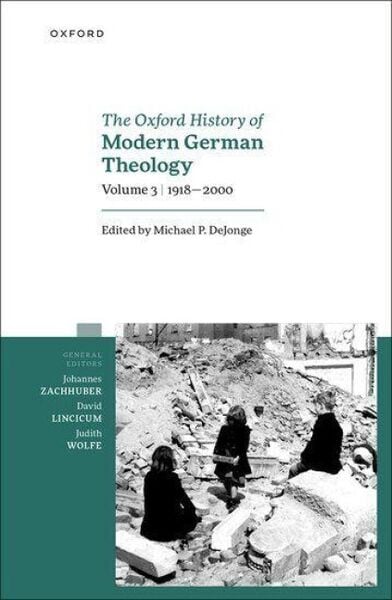
Produktbild: The Oxford History of Modern German Theology
Vorbesteller Neu

The Oxford History of Modern German Theology Volume 3: 1918-2000

262,99 €

inkl. gesetzl. MwSt., Versandkostenfrei


Beschreibung

This third volume of The Oxford History of Modern German Theology traces the dramatic reconfiguration of theology in the German-speaking world from the aftermath of the First World War to the end of the twentieth century. Across a century marked by political catastrophe, social upheaval, and ecclesial...

Beschreibung

This third volume of The Oxford History of Modern German Theology traces the dramatic reconfiguration of theology in the German-speaking world from the aftermath of the First World War to the end of the twentieth century. Across a century marked by political catastrophe, social upheaval, and ecclesial transformation, theology was repeatedly compelled to rethink its methods, institutions, and public role. Two world wars, the rise and fall of National Socialism, the Holocaust, the division and reunification of Germany, and the reforms of the Second Vatican Council reshaped not only European society but also the very conditions under which theology could speak. Bringing Protestant and Catholic developments into a single narrative, the volume follows theology through four pivotal periods: the ferment of the Weimar Republic, the crises of the Nazi regime, the work of postwar reconstruction, and the pluralistic and global landscape after Vatican II. Along the way, readers encounter dialectical theology, the Confessing Church, ressourcement, political and liberation theologies, new hermeneutical approaches, and the emergence of feminist and interreligious perspectives. Rather than presenting a sequence of great thinkers alone, the volume situates figures such as Karl Barth, Rudolf Bultmann, and Karl Rahner within the institutions, debates, and political pressures that shaped their work. The result is a richly contextualized history that shows theology not as an isolated intellectual enterprise but as a socially embedded practice continually responding to crisis, reform, and global exchange. Comprehensive, critical, and ecumenical in scope, this volume offers the most complete account to date of modern German theology's turbulent and transformative twentieth century.

Portrait

Michael P. DeJonge is the James F. Strange Chair of Religious Studies at the University of South Florida. A scholar of religion in modernity, he has published on themes in modern Christian thought, theory of religion, and social system theory.

Produktdetails

Einband

Gebundene Ausgabe

Erscheinungsdatum

15.03.2027

Herausgeber DeJonge Michael P.
Verlag Oxford Academic

Produktdetails

Einband

Gebundene Ausgabe

Erscheinungsdatum

15.03.2027

Herausgeber DeJonge Michael P.
Verlag Oxford Academic
Seitenzahl

760

Maße (L/B)

23,4/15,6 cm

Sprache

Englisch

ISBN

978-0-19-884575-1

Herstelleradresse

Libri GmbH
Europaallee 1
36244 Bad Hersfeld
DE

Email: gpsr@libri.de

Noch keine Bewertungen vorhanden

Verfassen Sie die erste Bewertung zu diesem Artikel

Helfen Sie anderen Kundinnen und Kunden durch Ihre Meinung.

Kundinnen und Kunden meinen

Bewertungen (0)

  • Produktbild: The Oxford History of Modern German Theology
    • 1: Benedikt Brunner: Historical Introduction: A Laboratory for Modern Christianity (1918-1933)
    • 2: Gary Dorrien: Religious Socialism
    • 3: Christian Stoll: Catholic Anti-modernism and Reform
    • 4: Christophe Chalamet: Dialectical Theology
    • 5: Christine Svinth-Værge Põder: Rediscovering Luther-The Luther Renaissance
    • 6: Benedikt Kranemann and Lea Lerch: Liturgical Movement
    • 7: Keith Clements: Internationalism and Ecumenism
    • 8: Martin Bauspieß: Form Criticism and Biblical Theology
    • 9: Jennifer Wasmuth: Theological Engagement with Orthodox Religious Thought
    • 10: Thomas R. Blanton IV: The Continuing Influence of the Religionsgeschichtliche Schule
    • 11: Ulrich Volp: Patristics and Philology
    • 12: Beth A. Griech-Polelle: Historical Introduction: The Twelve-Year Reich: Crises and the Loss of Community (1933-1945)
    • 13: Susannah Heschel: Theology, National Socialism, and Antisemitism
    • 14: Philip G. Ziegler: The Theology of the Confessing Church
    • 15: Christian Stoll: Early Political Theology
    • 16: John Betz and James Orr: Phenomenology and Thomism
    • 17: Kevin M. Vander Schel: Karl Rahner and the Anthropological Turn in Catholic Theology
    • 18: Matthew D. Hockenos: Historical Introduction, 1945-1962
    • 19: Grant Kaplan: Reception of the Catholic Tübingen School
    • 20: Bernd Oberdorfer: The Great Theological Systems
    • 21: Jörg Frey: Demythologizing and Hermeneutical Theology
    • 22: Hans-Richard Reuter: Peace Ethics
    • 23: Mirjam Zimmermann: Postwar Developments in Practical Theology
    • 24: Wilhelm Damberg: Historical Introduction: The Period of Vatican II and after (1962-1989)
    • 25: Roman A. Siebenrock: Vatican II and Conciliar Theology
    • 26: Reinhold Bernhardt: Theology of Religions
    • 27: Martin Hailer: Human Language and God
    • 28: Markus Mühling: Rediscovering Trinitarian Theology
    • 29: Saskia Wendel: Political Theology in West Germany
    • 30: Henning Theißen: Theology and Politics in the GDR
    • 31: Marie-Theres Wacker: Beginnings of Christian Feminist Theology
    • 32: Stefan Holtmann: Barth's Controversial Legacy
    • 33: Mark W. Elliot: New Directions in Biblical Studies
    • 34: Ernst Michael Dörrfuß: Jewish-Christian Dialogue
    • 35: Ulrike Ernst-Auga: Contextual Theologies and the Conciliar Process