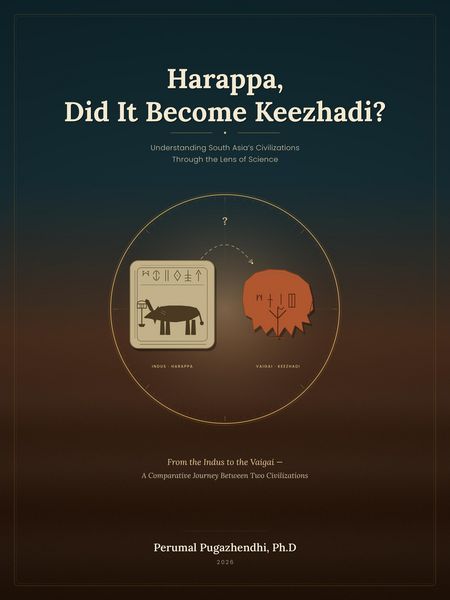
Harappa, Did It Become Keezhadi?
-
- Einzelkauf Download ausgewählt
-
Sprache:Englisch
8,99 €
inkl. gesetzl. MwSt.Beschreibung
Produktdetails
Format
ePUB
Kopierschutz
Ja
Family Sharing
Ja
Text-to-Speech
Ja
Erscheinungsdatum
01.07.2026
Verlag
Perumal PugazhendhiSeitenzahl
(Printausgabe)
Dateigröße
8892 KB
Sprache
Englisch
EAN
9798235391932
History is rarely a story of sudden beginnings or abrupt endings. Civilizations emerge over centuries, shaped by geography, climate, technology, trade, and the movement of people and ideas. One of the most intriguing questions in South Asian archaeology is whether the Indus (Harappan) Civilization and the later Tamil civilization represented by Keezhadi share a historical relationship. This book explores that question through the lens of modern science rather than speculation.
The Indus Civilization, one of the world's earliest urban societies, flourished between about 2600 and 1900 BCE with remarkable achievements in city planning, engineering, craft production, and international trade. More than a thousand years later, the excavations at Keezhadi revealed an advanced urban settlement in the Vaigai Valley, providing strong archaeological evidence for an early literate Tamil society. The discoveries at Keezhadi have transformed our understanding of ancient South India and inspired renewed interest in its place within the broader history of the subcontinent.
This book examines whether these two civilizations are connected through direct continuity, cultural exchange, shared ancestry, or independent development. To answer this question responsibly, it draws upon published research in archaeology, radiocarbon dating, ancient DNA, linguistics, environmental science, and comparative history. Every chapter distinguishes clearly between established evidence, reasonable interpretation, and questions that remain unresolved.
The purpose of this work is neither to promote political narratives nor to defend cultural assumptions. Instead, it seeks to demonstrate how scientific investigation allows us to reconstruct the past with increasing clarity while acknowledging the limits of current knowledge. Where the evidence is strong, conclusions are presented confidently; where uncertainties remain, they are stated honestly.
Written in accessible language for students, educators, researchers, and general readers, this book combines clear explanations with illustrations, maps, tables, and comparative analyses to make complex archaeological evidence understandable. It encourages readers to evaluate evidence critically and appreciate how new discoveries continue to reshape our understanding of South Asia's ancient civilizations.
The relationship between Harappa and Keezhadi is not simply a question about two archaeological sites; it is a window into the long and complex story of human civilization. As future excavations, genetic studies, and the possible decipherment of the Indus script expand our knowledge, our understanding will continue to evolve. Until then, this book offers an evidence-based journey through one of archaeology's most fascinating and important questions.
Noch keine Bewertungen vorhanden
Verfassen Sie die erste Bewertung zu diesem Artikel
Helfen Sie anderen Kundinnen und Kunden durch Ihre Meinung.
Kurze Frage zu unserer Seite
Vielen Dank für Ihr Feedback
Wir nutzen Ihr Feedback, um unsere Produktseiten zu verbessern. Bitte haben Sie Verständnis, dass wir Ihnen keine Rückmeldung geben können. Falls Sie Kontakt mit uns aufnehmen möchten, können Sie sich aber gerne an unseren Kund*innenservice wenden.
zum Kundenservice