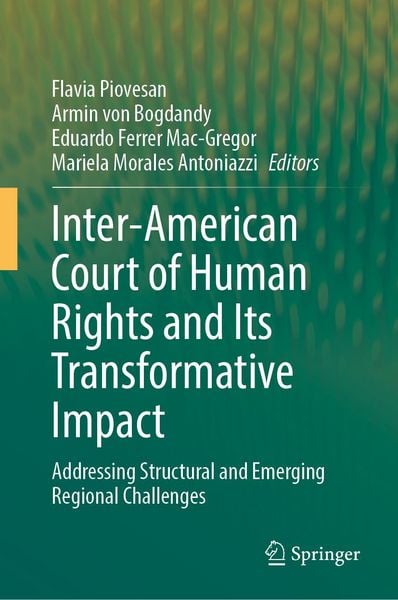
Produktbild: Inter-American Court of Human Rights and Its Transformative Impact
Vorbesteller Neu

Inter-American Court of Human Rights and Its Transformative Impact Addressing Structural and Emerging Regional Challenges

146,99 €

inkl. gesetzl. MwSt., Versandkostenfrei


Beschreibung

Produktdetails

Einband

Gebundene Ausgabe

Erscheinungsdatum

16.11.2026

Abbildungen

XX, 556 p. 1 illus.

Herausgeber

Flavia Piovesan + weitere

Verlag

Springer

Seitenzahl

556

Maße (B/H)

15,5/23,5 cm

Sprache

Englisch

ISBN

978-3-032-35316-0

Beschreibung

Portrait

Armin von Bogdandy is Director at the Max Planck Institute for Comparative Public Law and International Law in Heidelberg and Professor of Public Law at the University of Frankfurt/ Main. He has been president of the OECD Nuclear Energy Tribunal as well as a member of the German Science Council and the Scientific Committee of the European Union Agency for Fundamental Rights. He has held visiting positions at the New York University School of Law, the European University Institute, the Xiamen Academy of International Law, and the National Autonomous University of Mexico, among others. Armin von Bogdandy is the recipient of the Leibniz Prize; the prize for outstanding scientific achievements in the field of legal and economic foundations by the Berlin- Brandenburg Academy of Sciences; the Premio Internacional Fix- Zamudio; and the gavel of the Inter- American Court of Human Rights. Flávia Piovesan is a Professor of Constitutional Law and Human Rights at the Pontifical Catholic University of São Paulo (PUC- SP). She was a human rights visiting fellow at the Human Rights Program at Harvard Law School in 1995 and 2000; a fellow at the Centre for Brazilian Studies, at the University of Oxford in 2005; and has been a visiting fellow at the Max Planck Institute for Comparative Public Law and International Law on numerous occasions. From 2009 to 2014, she was at the Institute as a Humboldt Foundation Georg Forster Research Fellow. She was also a Visiting Scholar at the David Rockefeller Center for Latin American Studies at Harvard University (DRLCAS) in 2018. Flavia Piovesan is a former member of the UN High Level Task Force on the implementation of the right to development and of the OAS Working Group working on the monitoring of the Protocol of San Salvador on social, economic, and cultural rights. In 2016, she was appointed Special Secretary for Human Rights in Brazil and President of the National Commission against Forced Labor. She was a Vice President and a Commissioner for the Inter- American Commission on Human Rights. She was the recipient of the Humboldt Georg Foster Research Award in 2022. Eduardo Ferrer Mac-Gregor is a former judge of the Inter-American Court of Human Rights (2013–2024), serving as President (2017–2018), Vice President (2016–2017, 2023), and ad hoc Judge (2009–2010). He is currently a member of the International Commission of Jurists (Geneva) and a senior researcher at the National University of Distance Education (UNED) in Madrid. He has served as a senior researcher at the Institute for Legal Research and as a law professor at the Law School, both of the National Autonomous University of Mexico. Eduardo Ferrer Mac-Gregor has served as a visiting professor and/or lecturer at numerous universities and research centers in Europe, the United States, and Latin America, including Paris-Sorbonne University (Panthéon-Paris), American University College of Law (Washington, D.C.), the Complutense University of Madrid, and the Max Planck Institute for Comparative Public Law and International Law (Heidelberg). Mariela Morales Antoniazzi is a senior research fellow at the Max Planck Institute for Comparative Public Law and International Law in Heidelberg. She studied law at Andrés Bello Catholic University, obtained her LLM at the University of Heidelberg, and earned her PhD at the University of Frankfurt/ Main. Her doctoral thesis focuses on the suprana- tional protection of democracy in South America and the Ius Constitutionale Commune. Mariela Morales Antoniazzi is a visiting professor at various Latin American universities and Vice President of the German section of the Iberoamerican Institute of Constitutional Law. She coordinates the Ius Constitutionale Commune en América Latina (ICCAL) project at the Max Planck Institute for Comparative Public Law and International Law.
Produktdetails

Einband

Gebundene Ausgabe

Erscheinungsdatum

16.11.2026

Abbildungen

XX, 556 p. 1 illus.

Herausgeber

Verlag

Springer

Seitenzahl

556

Maße (B/H)

15,5/23,5 cm

Sprache

Englisch

ISBN

978-3-032-35316-0

Herstelleradresse

Springer International Publishing AG
Gewerbestr. 11
6330 Cham
Schweiz
Url: www.springer.com

Noch keine Bewertungen vorhanden

Verfassen Sie die erste Bewertung zu diesem Artikel

Helfen Sie anderen Kundinnen und Kunden durch Ihre Meinung.

Kundinnen und Kunden meinen

Bewertungen (0)

  • Produktbild: Inter-American Court of Human Rights and Its Transformative Impact
  • 1) Introduction.- PART 1 – INTER-AMERICAN COURT OF HUMAN RIGHTS AND ITS TRANSFORMATIVE IMPACT.- 2) Enduring Impact, Institutional Resilience and Future Trajectories of the Inter-American Court of Human Rights.- 3) Keeping Transformation Alive: Narrative Technologies in Latin American Inter-American Human Rights Practice.- 4) Dialogue between Brazil’s Federal Supreme Court and the Inter-American Human Rights System: a perspective from the context of Brazil’s structural processes.- 5) The Inter-American Court of Human Rights and other Regional Human Rights Courts: Comparative Perspectives from Europe with Specific Focus on Addressing Climate Change.- PART 2 - INTER-AMERICAN COURT OF HUMAN RIGHTS: ADDRESSING STRUCTURAL REGIONAL CHALLENGES.- 6) The Weight of the Inter-American Court’s Jurisprudence in the Argentine Process to Obtain Justice for Massive Crimes.- 7) Inter-American Court and the Protection of Judicial Independence.- 8) Inter-American Court and the Protection of Democratic Institutions.- 9) Impact of the Implementation of Inter-American Decisions from the Perspective of Strategic and Dialogical Monitoring of Public Policies on Investigations into Serious Human Rights Violations.- 10) The Inter-American Court of Human Rights and the Direct Justiciability of Social Rights (With Regard to Advisory Opinion OC-31 on the Right to Care).- 11) Inter-American Court of Human Rights, Intersectionality, and the Combat of Historical and Structural Discrimination.- 12) Feminist Constitutionalism and the Transformative Potential of the Inter-American Jurisdiction in Brazil and Latin America.- 13) Symbolic Impact of the Inter-American Court’s Decisions: Meanings, Memories, and Mobilizations in LGBTI+ Cases.- 14) Older Persons and the Inter-American Court of Human Rights:  Standards and Impacts.- 15) Child Rights Approach and Inter-American Jurisprudence The Ius Constitutionale Commune in Latin America (ICCAL).- 16) Indigenous Rights and the Inter-American Court of Human Rights:  The Xukuru Case and Its Domestic Implementation in Brazil.- 17) The Transformative Impact of the IACtHR Jurisprudence on Afrodescendant Peoples in Latin America: Beyond Equality and Difference.- 18) Inter-American Court of Human Rights and persons deprived of their liberty.- 19) The Transformative Impact of Inter-American Jurisprudence on Enforced Disappearances.- PART 3 - INTER-AMERICAN COURT OF HUMAN RIGHTS: ADDRESSING EMERGING REGIONAL CHALLENGES.- 20) Democracy, Judicial Activism and the Inter-American Court.- 21) Inter-American Court of Human Rights, academic freedom, and university autonomy: pillars for democratic resilience.- 22) The Inter-American Court of Human Rights on the Climate Emergency: Opportunities, Limits and Comparisons – versão final entregue.- 23) The Inter-American Court of Human Rights and Climate Change: Contributions on Intergenerational Equity to Recent International Advisory Proceedings – versão final entregue.- 24) Digital transformation and human rights: new challenges for transformative constitutionalism.- 25) Inter-American Court of Human Rights and Structural Algorithmic Discrimination of Vulnerable Groups.- 26) The Ongoing Latin American Transformation: The Human Right to Care.