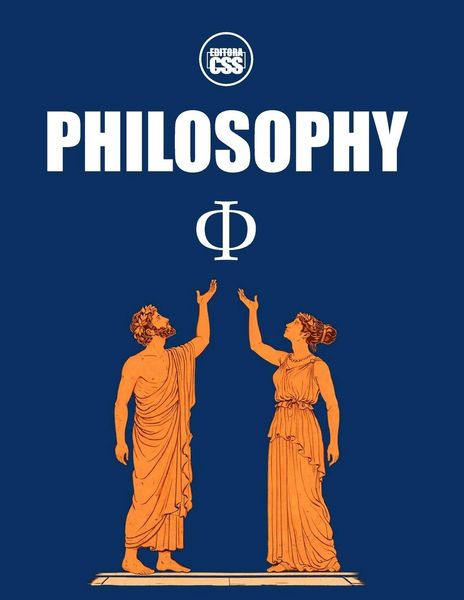
PHILOSOPHY - From the Pre-Socratics to Post-Structuralism
-
- Englisch ausgewählt
44,99 €
inkl. gesetzl. MwSt.,
Beschreibung
Produktdetails
Einband
Taschenbuch
Erscheinungsdatum
08.02.2026
Illustriert von
Diagramhouse Illustration
Herausgeber
Textus Receptus English EditionVerlag
Independently PublishedSeitenzahl
452
Maße (L/B/H)
27,9/21,6/2,3 cm
Gewicht
1041 g
Sprache
Englisch
EAN
9798246828700
PHILOSOPHY - From the Pre-Socratics to Post-Structuralism
From the first questions of the Pre-Socratics to the intricate debates of post-structuralism, this volume presents a complete and continuous arc of Western philosophical thought in a single work. PHILOSOPHY: From the Pre-Socratics to Post-Structuralism traces the long movement from myth to rational explanation, from cosmos to subject, from system to critique, showing how ideas of being, truth, freedom, and power were formed, challenged, and transformed over more than two millennia.
Structured in four parts and twenty-five chapters, the book unfolds with historical rigor and conceptual clarity. It begins with Thales, Heraclitus, Parmenides, and the first cosmologies, advances through Socrates, Plato, and Aristotle, and explores philosophy as a way of life in Stoicism, Epicureanism, and Skepticism. The transition to Late Antiquity and Neoplatonism reveals philosophy as both metaphysical inquiry and spiritual discipline.
The medieval world is treated as a complex intellectual landscape rather than a mere bridge between antiquity and modernity. Augustine, Byzantine thinkers, and Islamic and Jewish philosophers appear alongside the Latin scholastic tradition, where questions of faith and reason, law and universals, and nature and creation are systematically examined. Scholasticism, nominalism, and humanism are presented as responses to deep crises of authority, knowledge, and meaning.
The early modern transformation marks a decisive shift. The Scientific Revolution, Rationalism, Empiricism, Social Contract theory, and the Enlightenment are shown as interconnected attempts to reconstruct knowledge, subjectivity, and political legitimacy. Descartes, Spinoza, Locke, Hume, Rousseau, and Kant emerge within a shared debate on certainty, experience, freedom, and moral autonomy.
The nineteenth and twentieth centuries introduce powerful systems and radical critiques. German Idealism, Positivism, Marxism, the philosophy of suspicion (Nietzsche, Freud), Phenomenology, Hermeneutics, Existentialism, Critical Theory, Pragmatism, Analytic philosophy, Structuralism, and Deconstruction are each examined in their internal logic and historical impact. Thinkers such as Hegel, Marx, Husserl, Heidegger, Sartre, Foucault, and Derrida frame debates on history, science, language, ideology, and power.
A defining feature of this work is the systematic integration of women philosophers across all periods. Teano, Aspasia, Diotima, Hypatia, Macrina, Hildegard of Bingen, Marguerite Porete, Elisabeth of Bohemia, Damaris Masham, Mary Wollstonecraft, Hannah Arendt, Simone de Beauvoir, G. E. M. Anscombe, Philippa Foot, Judith Butler, and Angela Davis are presented not as exceptions, but as essential contributors to the philosophical tradition.
Each chapter combines historical context with conceptual analysis, revealing how philosophical ideas emerge from concrete problems-cosmological, theological, scientific, political-and how they continue to shape contemporary debates on reason, justice, identity, and meaning.
PHILOSOPHY: From the Pre-Socratics to Post-Structuralism is both a panoramic history and a conceptual map of Western thought-rigorous, inclusive, and attentive to philosophy as an ongoing, unfinished inquiry.
Noch keine Bewertungen vorhanden
Verfassen Sie die erste Bewertung zu diesem Artikel
Helfen Sie anderen Kundinnen und Kunden durch Ihre Meinung.
Kurze Frage zu unserer Seite
Vielen Dank für Ihr Feedback
Wir nutzen Ihr Feedback, um unsere Produktseiten zu verbessern. Bitte haben Sie Verständnis, dass wir Ihnen keine Rückmeldung geben können. Falls Sie Kontakt mit uns aufnehmen möchten, können Sie sich aber gerne an unseren Kund*innenservice wenden.
zum Kundenservice