Gutscheinbedingungen

**Gültig bis 14.09.2026 auf Spielzeug, Schreibwaren, Filme, Geschenke & Trends, Musik, tolino eReader & Zubehör, Hörbücher, nicht preisgebundene Bücher und Kalender in der Thalia App. Einzelne Artikel können ausgeschlossen sein. Aufgrund der Buchpreisbindung sind deutschsprachige Bücher und eBooks ausgenommen. Zusätzlich ausgenommen sind Abos & Flatrates, Games, Geschenkkarten/-boxen, Shelfies, Software, Zeitschriften sowie einzelne Artikel von tonies®. Pro Einkauf einmal einlösbar. Nur gültig mit im Onlineshop hinterlegter Bonuscard. Click & Collect nur bei Onlinevorabzahlung möglich. Keine Barauszahlung. Nicht kombinierbar mit anderen Aktionen und Gutscheinen. Gutschein wird auf max. 500€ Bestellwert angerechnet. Nicht gültig für Versandkosten und Services.

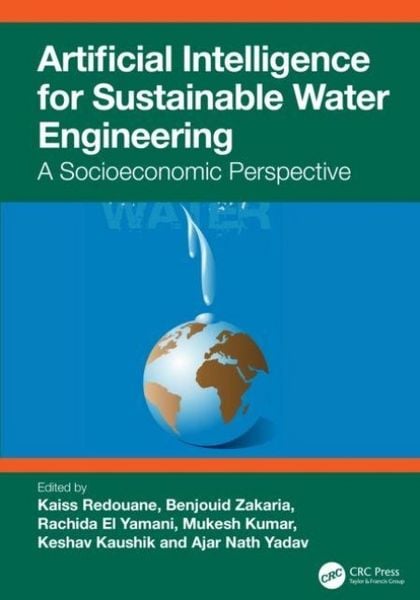
Produktbild: Artificial Intelligence for Sustainable Water Engineering
Vorbesteller Neu

Artificial Intelligence for Sustainable Water Engineering A Socioeconomic Perspective

142,99 €

inkl. gesetzl. MwSt., Versandkostenfrei


Beschreibung

Produktdetails

Einband

Gebundene Ausgabe

Erscheinungsdatum

13.11.2026

Abbildungen

Tabellen, schwarz-weiss

Herausgeber

Ajar Nath Yadav + weitere

Verlag

Taylor and Francis

Seitenzahl

240

Maße (L/B)

25,4/17,8 cm

Sprache

Englisch

ISBN

978-1-04-122377-1

Beschreibung

Portrait

Kaiss Redouane is a doctoral student in Economic Sciences, specializing in econometrics and statistics. His research focuses on the application of quantitative methods to economic analysis, with expertise in time series modeling, data analysis, and statistical inference.

Benjouid Zakaria is an econometrician, statistician, and data scientist. He serves as aprofessor and researcher at the Faculty of Economics and Management of Hassan FirstUniversity in Settat, Morocco. His areas of expertise cover a wide range of issues, including territorial governance, public policy evaluation, social and territorial innovation, and the application of quantitative methods to development challenges.

Rachida El Yamani is a researcher and academic specializing in sustainabledevelopment, public policy analysis, and socio-economic transformations in the context ofenvironmental challenges. She serves as a professor at the Faculty of Economics and SocialSciences, where she is actively involved in interdisciplinary research and teaching related todevelopment economics, environmental governance, and climate resilience.

Mukesh Kumar is an accomplished academic and researcher currently serving as anAssociate Professor at the Advanced Centre of Research & Innovation (ACRI), Department ofComputer Application, Chandigarh School of Business, Chandigarh Group of Colleges,Jhanjeri, Mohali, Punjab, India.

Keshav Kaushik is a distinguished cybersecurity and digital forensics expert, currentlyserving as an Associate Professor at the Center for Cyber Security and Cryptology, ShardaSchool of Computer Science & Engineering, Sharda University, Greater Noida, India.

Ajar Nath Yadav is a Deputy Director, RDC; Deputy Director, IQAC; Assistant Controller ofExaminations; Associate Professor & Head, Department Genetics, Plant Breeding andBiotechnology, at Eternal University, Baru Sahib, Himachal Pradesh, India. He has 10 yearsof teaching and 15 years of research experience in the field of microbial biotechnology,microbial diversity and plant-microbe-interactions.

Produktdetails

Einband

Gebundene Ausgabe

Erscheinungsdatum

13.11.2026

Abbildungen

Tabellen, schwarz-weiss

Herausgeber

Verlag

Taylor and Francis

Seitenzahl

240

Maße (L/B)

25,4/17,8 cm

Sprache

Englisch

ISBN

978-1-04-122377-1

Herstelleradresse

Libri GmbH
Europaallee 1
36244 Bad Hersfeld
DE

Email: gpsr@libri.de

Noch keine Bewertungen vorhanden

Verfassen Sie die erste Bewertung zu diesem Artikel

Helfen Sie anderen Kundinnen und Kunden durch Ihre Meinung.

Kundinnen und Kunden meinen

Bewertungen (0)

  • Produktbild: Artificial Intelligence for Sustainable Water Engineering
  • Chapter 1. AI and Sustainable Water Economics-An Introduction. Chapter 2. AI in Agriculture Water Use: Economic Impacts and Efficiency Gains. Chapter 3. Water, Climate Change, and Economic Resilience: A Data-Driven Perspective. Chapter 4. AI for Green Economic Planning and Risk Reduction. Chapter 5. Evaluating the Socio-Economic Impact of Water Scarcity using Artificial Intelligence. Chapter 6. AI in Public Policy for Water and Climate Governance. Chapter 7. Digital Transformation and Economic Innovation in the Water Sector in the MENA Region. Chapter 8. Challenges and opportunities for AI in Emerging Economics. Chapter 9. AI in Agricultural Water Use: Economic Impacts and Efficiency Gains. Chapter 10. Evaluating the Socio-Economic Impacts of Water Scarcity Using AI. Chapter 11. AI in Public Policy for Water and Climate Governance. Chapter 12. Digital Transformation and Economic Innovation in the Water Sector. Chapter 13. Challenges And Opportunities for AI in Emerging Economies. Chapter 14. Artificial Intelligence for Prediction Models in Water Engineering. Chapter 15. AI Applications in Water Treatment for Optimization and Automation. Chapter 16. AI to serve hydrological and water resources management. Chapter 17. Climate-Resilient infrastructure and Smart Cities