KI-Beratung Beta

Gutscheinbedingungen

**Gültig am 20.11.2026 ab einem Mindestbestellwert von 30€ auf Spielzeug, Schreibwaren, Filme, Geschenke & Trends, Musik, tolino eReader & Zubehör, Hörbücher und Hörbuch-Downloads, nicht preisgebundene Bücher und Kalender online auf thalia.at und in der Thalia App. Einzelne Artikel können ausgeschlossen sein. Aufgrund der Buchpreisbindung sind deutschsprachige Bücher und eBooks ausgenommen. Zusätzlich ausgenommen sind Abos & Flatrates, Games, Geschenkkarten/-boxen, Shelfies, Software, Zeitschriften sowie einzelne Artikel von tonies®. Pro Einkauf einmal einlösbar. Click & Collect nur bei Onlinevorabzahlung möglich. Keine Barauszahlung. Nicht kombinierbar mit anderen Aktionen und Gutscheinen. Gutschein wird auf max. 500€ Bestellwert angerechnet. Nicht gültig für Versandkosten und Services. Preisgebundene Artikel sind vom Mindestbestellwert ausgeschlossen.

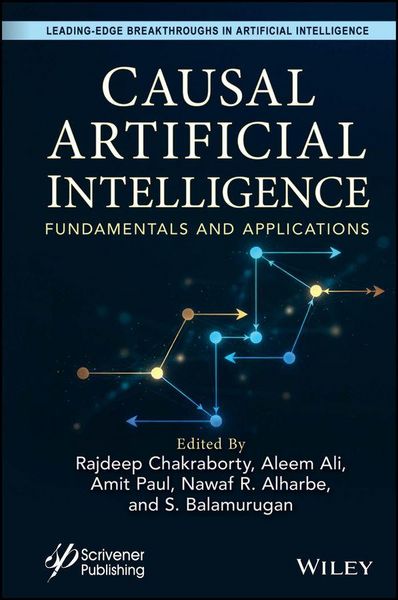
Produktbild: Causal Artificial Intelligence
Neu

Causal Artificial Intelligence Fundamentals and Applications

259,99 €

inkl. gesetzl. MwSt., Versandkostenfrei


Beschreibung

Bridging cutting-edge theoretical foundations with high-impact, real-world applications across healthcare, cybersecurity, and autonomous systems, this essential guide empowers researchers, practitioners, and policymakers to move beyond brittle correlation models and lead the next wave of transparent,...

Beschreibung

Bridging cutting-edge theoretical foundations with high-impact, real-world applications across healthcare, cybersecurity, and autonomous systems, this essential guide empowers researchers, practitioners, and policymakers to move beyond brittle correlation models and lead the next wave of transparent, safe, and truly interpretable AI.

Causal Artificial Intelligence (CAI) represents a significant advancement in the development of AI systems, marking a shift from purely correlation-based models to those capable of understanding and reasoning cause-and-effect relationships. In the context of disciplinary and industry development, casual AI addresses critical challenges in AI's ability to generalize, explain decisions, and make safe interventions across dynamic environments. Its emergence is reshaping fields like healthcare, economics, autonomous systems, and social sciences, offering a more reliable and interpretable form of AI that can predict the effects of actions, simulate outcomes, and inform decision-making more accurately. This book provides a comprehensive exploration of how causal reasoning can enhance the transparency, reliability, and ethical foundations of artificial intelligence systems. Addressing both theoretical and practical dimensions, it examines structural causal models, explainable AI, and privacy-preserving learning frameworks across diverse fields, including healthcare, climate science, manufacturing, automotive safety, and cybersecurity. It highlights innovative research in areas such as CNN-based causal inference for signal detection, explainable mobile AI for disease prediction, image processing for Ayurvedic material identification, and AI-driven systems for driver fatigue and collision detection. By bridging theoretical foundations with real-world applications, this book serves as a valuable resource for researchers, practitioners, and policymakers committed to developing transparent, secure, reliable, and ethically aligned intelligent technologies.

Readers will find the volume:

  • Offers a deep dive into frameworks like structural causal models (SCMs), Bayesian networks, and do-calculus, allowing readers to explore how AI systems can identify and leverage cause-and-effect relationships;
  • Emphasizes real-world applications of causal artificial intelligence through detailed case studies in fields such as healthcare, economics, and autonomous systems;
  • Illustrates how causal models are applied in complex, dynamic environments, demonstrating casual AI's potential to revolutionize industries by providing actionable insights;
  • Focuses on the ethical implications and interpretability of AI systems built on causal reasoning.

Audience

AI researchers, data scientists, academics, industry professionals, business leaders, medical researchers, and policymakers interested in advancing from traditional machine learning techniques to causal models.

Portrait

Rajdeep Chakraborty, PhD is a Professor in the Computer Science and Engineering Department at SAGE University, Indore, Madhya Pradesh, India, with two decades of teaching and research experience. He has made notable contributions through various publications, including patents, books, journal articles, and conference papers. His interests include cryptography, network security, Internet of Things, and blockchain.

Aleem Ali, PhD is a Professor and Research Coordinator in the Department of Computer Science and Engineering at Chandigarh University, Punjab, India. With over 17 years of academic and research experience, he has established himself as a leading contributor in the areas of Internet of Things, artificial intelligence, machine and deep learning, and network security. He has an extensive research portfolio with more than 65 peer-reviewed publications in reputed journals and conferences and six books.

Amit Paul, PhD is an Associate Professor of Computer Science and Engineering at St. Thomas' College of Engineering and Technology, Kolkata, India. He has authored five journal articles and seven international conference papers. His research centers on causal inference and interpretable machine learning for biomedical applications.

Nawaf R. Alharbe, PhD is a Professor in the College of Computer Science and Engineering at Taibah University in Saudi Arabia. He has more than 20 publications in international journals and conferences of repute. His interests include knowledge management systems in smart healthcare operations using emerging technologies such as RFID, ZigBee, Internet of Things (IoT), and cloud computing.

S. Balamurugan, PhD is the Director of Intelligent Research Consultancy Services, Coimbatore, India. He has published more than 70 books, 300 articles in international and national journals and conferences, and 300 patents. He is a research consultant for many companies, startups, SMEs, and MSMEs.

Produktdetails

Einband

Gebundene Ausgabe

Erscheinungsdatum

09.11.2026

Herausgeber Rajdeep Chakraborty + weitere
Verlag Wiley

Produktdetails

Einband

Gebundene Ausgabe

Erscheinungsdatum

09.11.2026

Herausgeber
Verlag Wiley
Seitenzahl

384

Sprache

Englisch

ISBN

978-1-394-40399-8

Herstelleradresse

Libri GmbH
Europaallee 1
36244 Bad Hersfeld
DE

Email: gpsr@libri.de

Noch keine Bewertungen vorhanden

Verfassen Sie die erste Bewertung zu diesem Artikel

Helfen Sie anderen Kundinnen und Kunden durch Ihre Meinung.

Kundinnen und Kunden meinen

Bewertungen (0)

Die Leseprobe wird geladen.
  • Produktbild: Causal Artificial Intelligence
  • Series Preface xix
    Preface xxi
    Acknowledgement xxv

    Part I: Fundamentals 1

    1 Causal Artificial Intelligence: Fundamentals and Applications 3
    Barnali Gupta Banik and Geeta Ambildhuke

    1.1 Introduction 4
    1.2 Literature Survey 7
    1.3 Basics of Causal AI 8
    1.4 Applications of AI 13
    1.5 Benefits, Limitations, and Challenges 15
    1.6 Conclusion and Future Scope 16

    2 Unveiling the Power of Causal AI: From Structural Causal Model to Bug Resolution Analysis 19
    Reshmi Maulik, Subhajit Datta, Subhashis Majumder and Soumen Santra

    2.1 Introduction 20
    2.2 Literature Review 22
    2.3 Methodology 23
    2.4 Model Construction 27
    2.5 Discussion 37
    2.6 Sensitivity Analysis of Treatment Variables 38
    2.7 Threats to Validity 39
    2.8 Conclusion 41
    2.9 Future Scope 41

    3 Exploring Causal AI through Deep Learning: A CNN-Based Framework for Signal Detection in Climate and Space Sciences 45
    Aditya Sharma and Inderdeep Kaur

    3.1 Introduction 46
    3.2 Literature Review 50
    3.3 Gravitational Waves and Their Detection 54
    3.4 Results and Discussion 57
    3.5 Performance Evaluation 62
    3.6 Conclusion 68

    4 Predictive Health Mate: An Explainable AI for Disease Prognosis and Prevention on Android Device 73
    Abhishek Roushan, Gurmeet Kaur, Inderdeep Kaur, Vatsala Singh, Harsh Yadav and Yash Srivastava

    4.1 Introduction 74
    4.2 Literature Review 75
    4.3 Model Architecture 81
    4.4 Conclusion 92
    4.5 Future Scope 93

    Part II: Applications 99

    5 A Machine Learning-Based Approach for Identifying Ayurvedic Medicinal Raw Materials via Image Processing 101
    Ankit Raj, Subhajit Chanda, Ashutosh Dubey, Dyuti Mitra and Debraj Chatterjee

    5.1 Introduction 102
    5.2 Literature Survey 104
    5.3 Methodology 117
    5.4 Results and Discussions 118
    5.5 Key Findings 119
    5.6 Future Scope 119

    6 AI and Machine Learning in Healthcare: Transforming Treatment, Ethics, and Resource Optimization 123
    Aakansha Khanna, Inderdeep Kaur, Inzimam Ul Hassan and Pratyansh Singh

    6.1 Introduction 124
    6.2 What is Machine Learning? 126
    6.3 Categories of Machine Learning 127
    6.4 Challenges and Architecture of the I-Healthcare System 130
    6.5 Deep Learning 132
    6.6 Case Study and Applications 132
    6.7 Conclusion 138

    7 Real-Time Driver Fatigue Monitoring Using AI: An Ethical and Non-Intrusive Approach to Road Safety 141
    Sumanta Chatterjee and Amit Majumder

    7.1 Introduction 141
    7.2 Leveraging Artificial Intelligence for Safer Roads through Real-Time Fatigue Monitoring 144
    7.3 AI and ML Technologies for Drowsiness Detection 149
    7.4 Challenges in Driver Drowsiness Detection 160
    7.5 Future Directions and Innovations 166
    7.6 Conclusion 172

    8 AI-Powered Collision Detection: A Neural Network System for Automotive Safety 175
    Sumanta Chatterjee and Amit Majumder

    8.1 Introduction 175
    8.2 Background and Literature Review 179
    8.3 Proposed Framework 184
    8.4 Neural Network-Based Collision Detection: Architecture Framework 191
    8.5 Components of Neural Network Architecture 193
    8.6 Training the Neural Network 196
    8.7 Neural Network-Based Collision Detection: Collision Prediction Framework 197
    8.8 Neural Network Architecture for Collision Prediction 199
    8.9 Collision Prediction Models 202
    8.10 Training the Collision Prediction Model 202
    8.11 Neural Network-Based Collision Detection with System Integration Framework 204
    8.12 Neural Network Deployment 206
    8.13 Real-Time Inference 207
    8.14 Control and Feedback Loop 208
    8.15 Testing and Validation 209
    8.16 Applications and Benefits of Neural Network-Based Collision Detection Systems 210
    8.17 Benefits of Neural Network-Based Collision Detection 211
    8.18 Conclusion 213

    9 Facial Emotion Detection Using Causal AI 217
    Esha Kundu and Arijit Ghosal

    9.1 Introduction 218
    9.2 Literature Survey 219
    9.3 Proposed Approach 221
    9.4 Experimental Results: Deep Learning Methods 228
    9.5 Conclusion 237

    10 Causal and Data-Driven Machine Learning Algorithm for Predicting Temperature Profiles in Friction Stir Additive Manufacturing of Aluminum Alloy A16061 241
    MD Masud Rana

    10.1 Introduction 242
    10.2 Friction Stir Additive Manufacturing Process 245
    10.3 Problem Statement Related to Friction Stir Additive Manufacturing 246
    10.4 Proposed Machine Learning Algorithm for Parameter Predictions of the FSAM Process 247
    10.5 Results and Discussions 248
    10.6 Conclusion 252

    11 Enhancing Cybersecurity in EVs: Causal and Resilient ML-Based Detection of False Data Injection and Denial of Service Attacks 255
    MD Masud Rana, Amir Shahirinia, Amer Dawoud and Ahad Ali

    11.1 Introduction 256
    11.2 Problem Statement 259
    11.3 Proposed Methodology 263
    11.4 Simulation Results and Discussions 264
    11.5 EV Cyberattack CVSS Assessment 266
    11.6 Conclusion and Future Work 268

    12 Cyber Resilience in Industry 4.0: Causal and Ethical ML-Based Detection of Cyberattacks in Smart Manufacturing Systems 273
    MD Masud Rana

    12.1 Introduction 274
    12.2 Proposed Methodology and Algorithm 276
    12.3 Simulation Results and Discussions 277
    12.4 End-to-End Software Development Life Cycle 286
    12.5 Action Recommendations 287xvi Contents
    12.6 Intellectual Merit and Broader Impacts 287
    12.7 Conclusions 288

    13 Explainable Privacy-Preserving Federated LLM Fine-Tuning on Distributed Edge Healthcare Infrastructure 293
    Amit Chakraborty, Chirantana Mallick, Saptarshi Das, Madhvi Chakraborty and Abhijnan Chakraborty

    13.1 Introduction 294
    13.2 Literature Review and Gap Identification 295
    13.3 Prerequisites 296
    13.4 Privacy Enhancement Technique 299
    13.5 Dataset 301
    13.6 Proposed Architecture 301
    13.7 Architectural Telemetry 310
    13.8 Explainability 314
    13.9 Conclusion 315
    13.10 Future Work 317

    14 Enhancing the Robustness of Causal AI Systems against Adversarial Threats 323
    Sakshi Thakur, Mohit Singh Bisht and Dinesh Singh Dhakar

    14.1 Introduction 324
    14.2 Fundamentals of Causal AI 326
    14.3 Nature of Adversarial Threats in Causal AI 329
    14.4 Challenges in Ensuring Robustness 331
    14.5 Strategies for Enhancing Robustness 332
    14.6 Case Studies and Experiments 335
    14.7 Future Directions 339
    14.8 Conclusion 340

    References 341
    Index 343