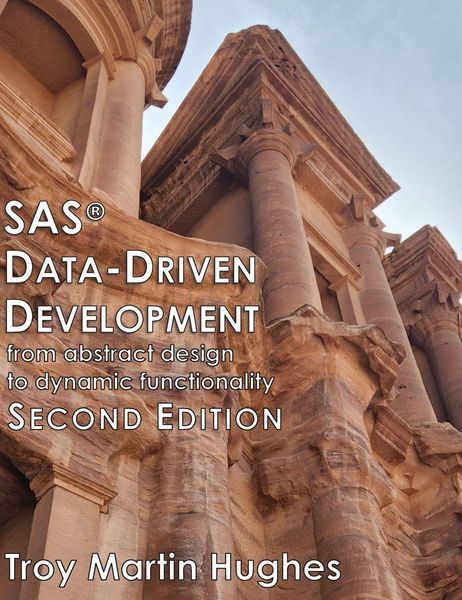
SAS® Data-Driven Development From Abstract Design to Dynamic Functionality, Second Edition
-
- Englisch ausgewählt
42,99 €
inkl. gesetzl. MwSt.,
Beschreibung
Produktdetails
Einband
Gebundene Ausgabe
Erscheinungsdatum
08.05.2026
Verlag
Data Llama AnalyticsSeitenzahl
570
Maße (L/B/H)
24,1/19,6/3,5 cm
Gewicht
1244 g
Auflage
26002 Auflage Second Edition
Sprache
Englisch
EAN
9798995947301
SAS® Data-Driven Development is the only comprehensive text that demonstrates how to build dynamic SAS software driven by control data. Data-driven design enables SAS practitioners to create flexible, reusable software that adapts to diverse industries, organizations, and data sources because business rules, data mappings, formatting, report style, program logic, and other dynamic elements are maintained as external control data - not as static code. Data-driven design is the key to unlocking highly configurable, "codeless" software that developers, SAS administrators, end users, and other stakeholders can reuse and configure - without modifying one line of code! This text introduces high-level design concepts, patterns, and principles, after which real-world scenarios demonstrate SAS development best practices:Part I. Data-Driven Design: Learn how to harness procedural abstraction, data abstraction, iteration abstraction, software modularity, data independence, and procedural communication, with concepts drawn from object-oriented programming (OOP), master data management (MDM), table-driven design, and business rules engines (BREs). Part II. Control Data: Understand the limitless data structures that can drive SAS software, including parameters, configuration files, control tables, decision tables, SAS data sets, and CSV, Excel, XML, and CSS files. Interoperability is modeled through control data that can be accessed by SAS and other applications. Throughout the text, requirements-based examples demonstrate data ingestion, data cleaning, data analysis, data mapping, data modeling, data governance, dynamic "traffic light" reporting, and other use cases. Examples contrast less desirable hardcoded design with abstract, data-driven design to illustrate the clear advantages of the latter.
Noch keine Bewertungen vorhanden
Verfassen Sie die erste Bewertung zu diesem Artikel
Helfen Sie anderen Kundinnen und Kunden durch Ihre Meinung.
Kurze Frage zu unserer Seite
Vielen Dank für Ihr Feedback
Wir nutzen Ihr Feedback, um unsere Produktseiten zu verbessern. Bitte haben Sie Verständnis, dass wir Ihnen keine Rückmeldung geben können. Falls Sie Kontakt mit uns aufnehmen möchten, können Sie sich aber gerne an unseren Kund*innenservice wenden.
zum Kundenservice