KI-Beratung Beta

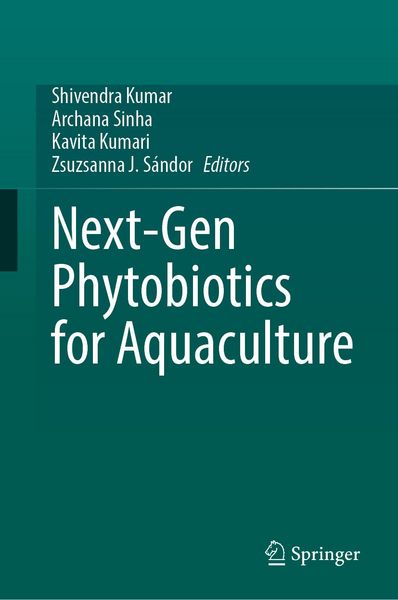
Produktbild: Next-Gen Phytobiotics for Aquaculture
Vorbesteller Neu

Next-Gen Phytobiotics for Aquaculture

195,99 €

inkl. gesetzl. MwSt., Versandkostenfrei


Beschreibung

Produktdetails

Einband

Gebundene Ausgabe

Erscheinungsdatum

13.03.2027

Abbildungen

Approx. 400 p. 70 illus., 20 illus. in color.

Herausgeber

Shivendra Kumar + weitere

Verlag

Springer Singapore

Seitenzahl

591

Maße (B/H)

15,5/23,5 cm

Sprache

Englisch

ISBN

978-981-9236-88-6

Beschreibung

Portrait

Dr. Shivendra Kumar is a Former Professor and Head at the Department of Aquaculture, College of Fisheries, Dr. Rajendra Prasad Central Agricultural University, Bihar, India. He is involved in research, research-based extension activities and teaching of graduate, postgraduate and doctorate students. Dr. Kumar pursued M.F.Sc and Ph.D in fish nutrition and biochemistry from ICAR – Central Institute of Fisheries Education, Mumbai, India. His doctoral research was mainly focused on nutritional requirements and metabolic utilization of nutrients and physiology of temperature regulation by fish. Dr. Kumar received post-doctoral research fellowship at HAKI, Szarvas, Hungary, financed by European Commission. Dr. Kumar's extensive work in aquaculture has made significant advancements in the field, particularly in the areas of low-cost fish feed, production efficiency and sustainable practices.

Dr. Archana Sinha is currently working as Head and Principal Scientist at Aquatic Environmental Biotechnology Division of ICAR-Central Inland Fisheries Research Institute (ICAR-CIFRI), Kolkata, India. She has working experience of more than 35 years in the field of aquaculture research, education and extension. She completed several research projects and developed technology for fisheries and aquaculture, especially in ornamental fish breeding and culture, fish feed technology, open water fish culture etc. She published more than 100 research papers, four books, and several technical and training manuals. 

Dr. Kavita Kumari did her masters in the discipline of fish genetics and biotechnology and PhD in fish biotechnology from ICAR-Central Institute of Fisheries Education, Mumbai, India. She is presently working as a scientist at the Division of Aquatic Environment Biotechnology at ICAR-Central Inland Fisheries 

Research Institute, Kolkata, India. Her area of research is application of molecular biology tools for assessment of physiological changes in fish, phylogeographic variation in fish diversity and impact of climatic variability on microbes. 

Dr. Zsuzsanna J. Sándor is a scientific advisor and head of the Fish Nutrition Research Group at the Research Center for Fisheries and Aquaculture, Hungarian University of Agriculture and Life Sciences, Hungary. Her research interests include the study of nutritional and metabolic processes in freshwater fish, the quality of fish meat as a function of feeding and environmental factors, and the accumulation of xenobiotics (e.g., heavy metals, pharmaceutical residues) in aquatic organisms, as well as monitoring various pollutants in the environment. Dr. Sándor has also served as a national and institutional project leader in an EU research project (ARRAINA) and was a consortium leader in national operative programs. She is well published in her field.

Produktdetails

Einband

Gebundene Ausgabe

Erscheinungsdatum

13.03.2027

Abbildungen

Approx. 400 p. 70 illus., 20 illus. in color.

Herausgeber

Verlag

Springer Singapore

Seitenzahl

591

Maße (B/H)

15,5/23,5 cm

Sprache

Englisch

ISBN

978-981-9236-88-6

Herstelleradresse

Springer Nature Customer Service Center GmbH
Europaplatz 3
69115 Heidelberg
DE
ProductSafety@springernature.com

Noch keine Bewertungen vorhanden

Verfassen Sie die erste Bewertung zu diesem Artikel

Helfen Sie anderen Kundinnen und Kunden durch Ihre Meinung.

Kundinnen und Kunden meinen

Bewertungen (0)

  • Produktbild: Next-Gen Phytobiotics for Aquaculture
  • Overview of aquaculture and its challenges.- Exploring Phytobiotics in Aquaculture Sources Mode of Action Effects Administration and its bioavailability.- Novel Plant based dietary ingredients as Phytobiotics for approaching aquatic sustainability.- Perspective on utilization of plant based feed additive in aquaculture.-  Phytobiotics An approach to nutritional pathology in aquaculture.- Technology prioritization for Phytobiotic applied fish.- Nutraceuticals in aquaculture prioritizing plant-based feed stuffs.- Innovative feed additives for sustainable aquaculture Phytobiotic encapsulated in organic nanoparticles.- Growth promoting and feed utilization effects of Phyto biotics as dietary supplements for teleost fish.- Phytobiotics as appetite stimulators in fish.- Metabolic adaptation of fishes under different consequences of Phytobiotic supplementation.- Phytobiotics Diet gut interaction and its impact on blood glucose homeostasis in fish.- Role of Phyto biotics in Glucosensing and carbohydrate utilization in fish.- Role of plant based dietary supplement in stress amelioration of teleost.-  Phyto additive fueling fertility Shatavar enhancing reproductive performance in females.- Phyto-additive fueling fertility Ashwagandha enhancing reproductive performance in males.-  Phytobiotics in functional food.- Utilization of phytochemicals as immunostimulants and antimicrobial agents in finfish aquaculture.- Plant based products and oral plant vaccines as feed supplements for managing bacterial diseases in fish.- Nyctanthes arbortristis A Remarkable Indian Herbal Remedy Deserving Healthcare Focus in aquaculture.- Role of Phytobiotics in modulating transcriptomic profile in carps .- Challenges in the commercialization of Phytobiotics.- Sustainable Aquaculture and Phytobiotics.- Future directions in phytobiotic research and innovation.- Phytobiotics based circular aquaculture for carbon footprint reduction of fed aquaculture.