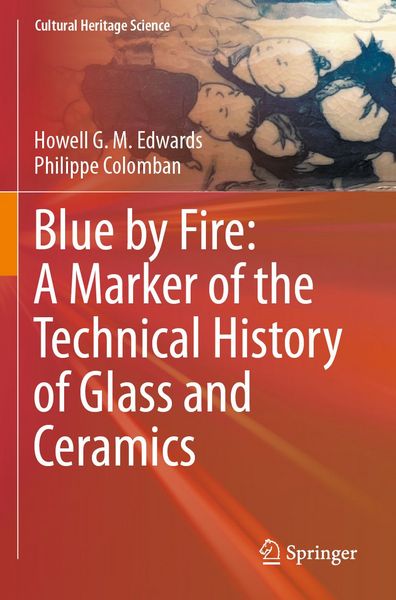
Blue by Fire: A Marker of the Technical History of Glass and Ceramics
-
- Hardcover
- Taschenbuch ausgewählt
- eBook
-
Sprache:Englisch
146,99 €
UVP
164,99 €
inkl. gesetzl. MwSt.,
Beschreibung
Produktdetails
Einband
Taschenbuch
Erscheinungsdatum
28.01.2026
Abbildungen
XVIII, 517 p. 142 illus., 115 illus. in color.
Verlag
SpringerSeitenzahl
517
Maße (L/B/H)
23,5/15,5/2,9 cm
Gewicht
803 g
Sprache
Englisch
ISBN
978-3-031-77124-8
The use of natural mineral and synthetic blue pigments in antiquity for wall paintings and illuminated manuscript historiation evolved into the most suitable blue pigments for the decoration of glazed and enamelled wares (ceramics, glass and metal) which required a stability at the high temperatures of the kilns used for glazing and firing. Historic literature is often vague regarding the blue pigments used for this purpose. The generic term “cobalt blue” covers a wide range of pigments that were actually used for the decoration of faience, majolica, stonewares, earthenwares and porcelains.
This book addresses the application of elemental and molecular spectroscopic analytical techniques to a range of diverse problems which arise for decorated ceramics, glass and enamels and related artefacts: a history of techniques, provenance and authentication. The text contains an introduction to the important analytical techniques that are used in destructive and nondestructive analytical measurements and highlights potential future applications based upon novel miniaturised instrumentation for
in-situ
studies. The book is co-authored by two international experts with many years’ experience in the application of analysis to artworks and archaeological artefacts and in the investigation of materials and sites for cultural heritage preservation. Among 19 chapters one is devoted to an evaluation of the analytical techniques that are used and the pitfalls which can arise in the interpretation of the data. The approach conveys the detailed information which has become available from the adoption of analytical techniques to diverse problems through the scientific interrogation of ceramic and related artefacts. Examples are given of how the pigment analysis and sourcing can provide unique information about ancient trade routes and pigment sourcing historically. A classic instance is provided by the transfer of European enamelling technologies carried out at the beginning of the 17th century in Japan (Arita) and at the turn of the 17th-18th centuries in China by the Jesuits established at the Court of, respectively, the Kyushu island of Daymios and the Chinese Qing Empero Kangxi. It has hence been demonstrated that some of the most beautiful porcelains emanating from Japan and China in this period incorporate blue decoration with pigments supplied from Europe. The interpretation of the analytical data can assist museum curators, archaeologists, art dealers/experts and cultural heritage historians in the preservation and conservation of ancient materials which have applied blue pigment decoration.
Noch keine Bewertungen vorhanden
Verfassen Sie die erste Bewertung zu diesem Artikel
Helfen Sie anderen Kundinnen und Kunden durch Ihre Meinung.
Kurze Frage zu unserer Seite
Vielen Dank für Ihr Feedback
Wir nutzen Ihr Feedback, um unsere Produktseiten zu verbessern. Bitte haben Sie Verständnis, dass wir Ihnen keine Rückmeldung geben können. Falls Sie Kontakt mit uns aufnehmen möchten, können Sie sich aber gerne an unseren Kund*innenservice wenden.
zum Kundenservice