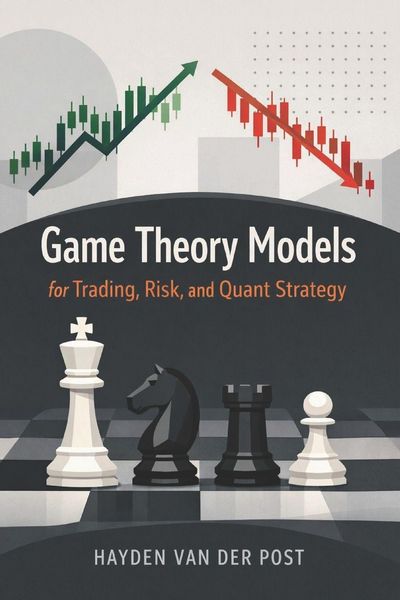
Game Theory Models for Trading, Risk, and Quant Strategy Predictive Market Behavior
-
- Englisch ausgewählt
34,99 €
inkl. gesetzl. MwSt.,
Beschreibung
Produktdetails
Einband
Taschenbuch
Erscheinungsdatum
18.01.2026
Herausgeber
Alice SchwartzVerlag
Independently PublishedSeitenzahl
456
Maße (L/B/H)
22,9/15,2/2,9 cm
Gewicht
548 g
Sprache
Englisch
EAN
9798244524321
Reactive Publishing
Financial markets are competitive ecosystems. Every trade is a strategic interaction, every price move an expression of incentives, information, and probability. This book treats markets as games and traders as agents, modeling their behavior with rigor, extracting predictive structure, and translating it into systematic edge.
Game Theory Models for Trading, Risk, and Quant Strategy integrates strategic decision theory, behavioral finance, and quantitative modeling to examine how market outcomes emerge from interacting participants. Instead of treating prices as exogenous data, it analyzes how expectations, bluffing, signaling, and information asymmetry shape volatility, liquidity, spreads, and execution.
Inside you will learn:
- How strategic interaction frameworks improve forecasting and risk assessment
- How signaling, incentives, and asymmetric information influence price behavior
- How to integrate behavioral biases into quantitative models
- How to use cooperative vs non-cooperative game structures for trading scenarios
- How to apply formal game theory to order flow, liquidity, and price formation
- How edge is created, defended, and eroded in competitive market environments
- Why prediction requires modeling agents, not just time series
- How market structure affects strategy, execution, and systemic risk
Designed for quantitative analysts, traders, researchers, and students of financial strategy, the book emphasizes practical utility over mathematical abstraction. Models are demonstrated with real-world applications, execution implications, and strategic takeaways that can be deployed in systematic frameworks or discretionary decision-making.
In an environment where alpha is increasingly scarce and market participants are increasingly sophisticated, forecasting market behavior demands more than statistical pattern recognition. It requires understanding how other players think, act, and adapt.
This book offers that lens, bridging theory and practice to help quants, traders, and strategists build more informed, resilient, and adaptive models for a competitive financial world.
Noch keine Bewertungen vorhanden
Verfassen Sie die erste Bewertung zu diesem Artikel
Helfen Sie anderen Kundinnen und Kunden durch Ihre Meinung.
Kurze Frage zu unserer Seite
Vielen Dank für Ihr Feedback
Wir nutzen Ihr Feedback, um unsere Produktseiten zu verbessern. Bitte haben Sie Verständnis, dass wir Ihnen keine Rückmeldung geben können. Falls Sie Kontakt mit uns aufnehmen möchten, können Sie sich aber gerne an unseren Kund*innenservice wenden.
zum Kundenservice