KI-Beratung Beta

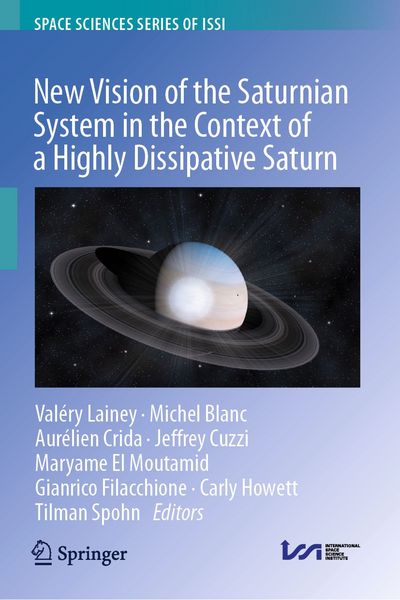
Produktbild: New Vision of the Saturnian System in the Context of a Highly Dissipative Saturn
Band 89

New Vision of the Saturnian System in the Context of a Highly Dissipative Saturn

54,99 €

inkl. gesetzl. MwSt., Versandkostenfrei


Beschreibung

Produktdetails

Einband

Gebundene Ausgabe

Erscheinungsdatum

21.07.2026

Abbildungen

VIII, 463 p. 113 illus., 91 illus. in color.

Herausgeber

Valéry Lainey + weitere

Verlag

Springer Netherland

Seitenzahl

463

Maße (L/B/H)

24,1/16/3,1 cm

Gewicht

867 g

Sprache

Englisch

ISBN

978-94-024-2386-0

Beschreibung

Portrait

Valéry Lainey is an astronomer specializing in astrometry, celestial mechanics, and the dynamical evolution of planetary systems. Based at the Observatoire de Paris, his research focuses on the orbital motion of natural satellites—especially those of the giant planets—and long-term tidal interactions. He combines astrometric observations with numerical modeling to study how satellite systems evolve.

Michel Blanc is a space plasma physicist and planetary scientist. He is Chair Professor at Shandong University and Emeritus Professor at the University of Toulouse. His research focuses on planetary magnetospheres and space environments, particularly those of Earth, Saturn, and Jupiter. He contributed to the Cassini–Huygens mission and is involved in NASA’s Juno mission, while following ESA’s JUICE and China’s TianWen-4 missions. 

Aurélien Crida is an astrophysicist and professor at Université Côte d’Azur, where he leads the Master of Astrophysics (MAUCA). His research focuses on planetary formation, especially planet–disc interactions driving migration, as well as satellite–ring interactions in systems like Saturn’s. He uses analytical methods and numerical simulations to study the formation and evolution of planetary systems.

Jeff Cuzzi is a planetary scientist whose research focuses on planetary rings and early planet formation. He pioneered microwave observations and radiative transfer models of Saturn’s rings and later joined the Voyager imaging team, studying the rings of Saturn, Uranus, and Neptune. He served as Interdisciplinary Scientist for Rings and Dust on the Cassini-Huygens mission. His work blends observational and theoretical approaches to understand ring evolution and planetesimal formation.

Maryame El Moutamid is a planetary scientist and celestial mechanician specializing in the dynamics of planetary rings, moons, and interiors. She is a Lead Scientist at the Southwest Research Institute and was previously at Cornell. She earned her Ph.D. from the Paris Observatory in 2013. Her work combines numerical simulations, spacecraft observations, and telescope data to study how gravitational interactions shape planetary systems over time.

Gianrico Filacchione is a planetary scientist and Director of Research specializing in the composition and evolution of Solar System bodies. He uses visible and infrared spectroscopy to study icy satellites, comets, asteroids, rings, and giant planets. He is Principal Investigator of the MIST-A instrument for the Emirates Mission to the Asteroid Belt and co-PI of the VIHI channel on ESA’s BepiColombo mission. He has contributed to major missions including Cassini, Rosetta, Juno, and JUICE.

Carly Howett is a planetary scientist focusing on the surface properties of airless bodies. She combines spacecraft data analysis, mission operations, and instrument development to study temperature, composition, and surface processes. She is an Instrument Scientist on NASA’s Lucy mission, a Co-Investigator on Europa Clipper, and Principal Investigator of the Ralph instrument on New Horizons, and previously contributed to Cassini.

Tilman Spohn is a planetary geophysicist specializing in the evolution of planets, satellites, and small bodies, and their potential habitability. He served as Executive Director of the International Space Science Institute (2019–2022) and previously directed the DLR Institute of Planetary Research. He has led key mission experiments, including MUPUS on Rosetta’s Philae lander and HP³ on NASA’s InSight mission, and is a Fellow of the American Geophysical Union.

Produktdetails

Einband

Gebundene Ausgabe

Erscheinungsdatum

21.07.2026

Abbildungen

VIII, 463 p. 113 illus., 91 illus. in color.

Herausgeber

Verlag

Springer Netherland

Seitenzahl

463

Maße (L/B/H)

24,1/16/3,1 cm

Gewicht

867 g

Sprache

Englisch

ISBN

978-94-024-2386-0

Herstelleradresse

Springer-Verlag KG
Sachsenplatz 4-6
1201 Wien
AT

Email: ProductSafety@springernature.com

Noch keine Bewertungen vorhanden

Verfassen Sie die erste Bewertung zu diesem Artikel

Helfen Sie anderen Kundinnen und Kunden durch Ihre Meinung.

Kundinnen und Kunden meinen

Bewertungen (0)

  • Produktbild: New Vision of the Saturnian System in the Context of a Highly Dissipative Saturn
  • Editorial.- Paving the Way for Future Space Missions in the Context of High Tidal Dissipation in the Saturnian System.- Tidal Dissipation in Giant Planets.- Quantification of Tides in Giant Planets from Observations.- Long-Term Evolution of the Saturnian System.- Geologic Constraints on the Formation and Evolution of Saturn’s Mid-Sized Moons.-  Constraining the Mass and Energy of Enceladus’ Dissipation Systems.-  Origin and Evolution of Enceladus’s Tidal Dissipation.- Tidal Deformation and Dissipation Processes in Icy Worlds.- The Composition of Saturn’s Rings.- The Origin and Composition of Saturn’s Ring Moons.- The Age and Origin of Saturn’s Rings.- Understanding the Formation of Saturn’s Regular Moons in the Context of Giant Planet Moons Formation Scenarios.