KI-Beratung Beta

Gutscheinbedingungen

**Gültig bis 30.11.2026 auf Spielzeug, Schreibwaren, Filme, Geschenke & Trends, Musik, tolino eReader & Zubehör, Hörbücher und Hörbuch-Downloads, nicht preisgebundene Bücher und Kalender online auf thalia.at und in der Thalia App. Einzelne Artikel können ausgeschlossen sein. Aufgrund der Buchpreisbindung sind deutschsprachige Bücher und eBooks ausgenommen. Zusätzlich ausgenommen sind Abos & Flatrates, Games, Geschenkkarten/-boxen, Shelfies, Software, Zeitschriften sowie einzelne Artikel von tonies®. Pro Einkauf einmal einlösbar. Nur gültig mit im Onlineshop hinterlegter Bonuscard. Click & Collect nur bei Onlinevorabzahlung möglich. Keine Barauszahlung. Nicht kombinierbar mit anderen Aktionen und Gutscheinen. Gutschein wird auf max. 500€ Bestellwert angerechnet. Nicht gültig für Versandkosten und Services.

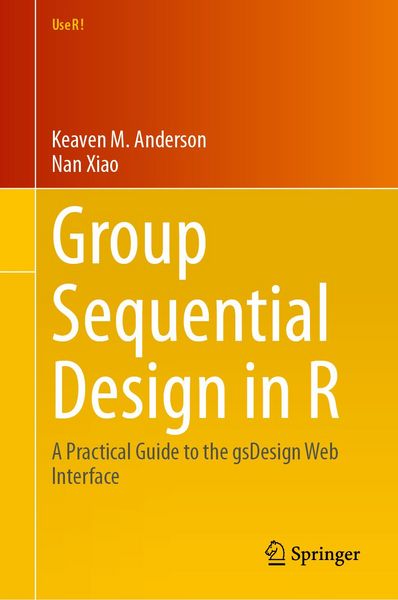
Produktbild: Group Sequential Design in R
Vorbesteller Neu

Group Sequential Design in R A Practical Guide to the gsDesign Web Interface

Aus der Reihe Use R!

119,99 €

inkl. gesetzl. MwSt., Versandkostenfrei


Beschreibung

This book provides a practical, hands-on guide to designing group sequential clinical trials using the gsDesign web interface, built on the R package gsDesign. Group sequential designs allow pre-planned interim analyses during a clinical trial, offering the potential to stop early for efficacy or futility...

Beschreibung

This book provides a practical, hands-on guide to designing group sequential clinical trials using the gsDesign web interface, built on the R package gsDesign. Group sequential designs allow pre-planned interim analyses during a clinical trial, offering the potential to stop early for efficacy or futility while maintaining control of the Type I error rate. The web interface enables users to generate flexible group sequential designs using only a web browser, with no need for specialized statistical software.
The book covers the full range of endpoint types supported by the interface, including time-to-event, binomial, and normal outcomes, with extensive worked examples throughout. Starting from the basics of converting a fixed design to a group sequential design, the presentation progresses through spending function families, information-based designs, and various testing configurations including two-sided, one-sided, and asymmetric designs with binding or non-binding futility bounds. Practical features such as saving and restoring designs, generating reproducible R Markdown reports, and updating bounds at the time of analysis are demonstrated in detail. An introduction to R coding with the gsDesign package extends the coverage to additional topics including conditional and predictive power, repeated confidence intervals, and sample size adaptation methods. Primarily written for biostatisticians and clinical trialists in academia and the pharmaceutical industry, the book keeps mathematical detail to a minimum, making group sequential design methods accessible to practitioners with a basic statistical background.

Produktdetails

Einband

Gebundene Ausgabe

Erscheinungsdatum

07.02.2027

Abbildungen

XIII, 166 p. 1 illus.

Verlag Springer

Produktdetails

Einband

Gebundene Ausgabe

Erscheinungsdatum

07.02.2027

Abbildungen

XIII, 166 p. 1 illus.

Verlag Springer
Seitenzahl

166

Maße (L/B)

23,5/15,5 cm

Sprache

Englisch

ISBN

978-3-032-31589-2

Herstelleradresse

Libri GmbH
Europaallee 1
36244 Bad Hersfeld
DE

Email: gpsr@libri.de

Noch keine Bewertungen vorhanden

Verfassen Sie die erste Bewertung zu diesem Artikel

Helfen Sie anderen Kundinnen und Kunden durch Ihre Meinung.

Kundinnen und Kunden meinen

Bewertungen (0)

  • Produktbild: Group Sequential Design in R
  • Welcome.- Acknowledgements.- Chapter1.Introduction.- Chapter 2.Your first design.- Chapter 3.Binary and continuous endpoints.- Chapter.4.Time-to-event endpoints.- Chapter.5.More time-to-event design.- Chapter.6.Information-based designs.- Chapter.7.Two-sided and other design types.- Chapter.8.Spending functions.- Chapter.9.Introduction to R coding.- Chapter.10.What have you (not) learned?.