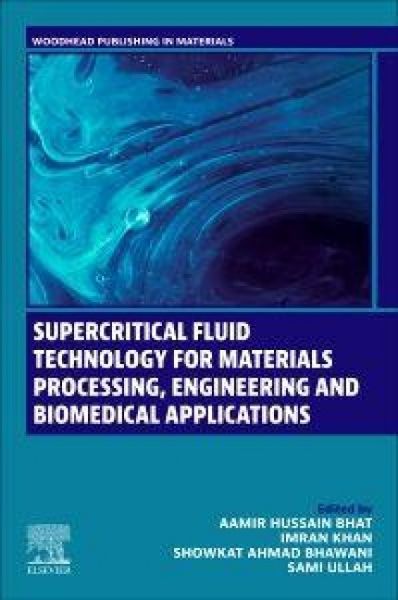
Supercritical Fluid Technology for Materials Processing, Engineering and Biomedical Applications
-
- Englisch ausgewählt
326,99 €
inkl. gesetzl. MwSt.,
Portrait
He has been the principal investigator for many government funded research projects such as the Fundamental Research Grant Scheme (FRGS) entitled “New Malaysian Green Nano fluid for drilling at high temperature and pressure, YUTP grant on “Biopolymer blend of Poly (lactic acid) and Poly (hydroxybutyrate co- valerate) based nano-biocomposites reinforced with nanocrystalline cellulose with potential application in packaging and Graphene Oxide Additives in Water Based Drilling Fluid for Enhanced Performance of Fluid Loss Control again funded by YUTP.
Dr. Imran Khan is currently an Assistant Professor in the Department of Chemistry, at Sultan Qaboos University, Muscat, Oman. Formerly, he was a Postdoctoral Fellow in Process and Product Applied Thermodynamics (PATh), in the associated laboratory CICECO (Center for Research in Ceramics & Composite Materials), Dept. of Chemistry, University of Aveiro, Portugal. His areas of research include solution chemistry, the thermophysical behavior of pure liquids and liquid mixtures with ionic liquids, surfactant and polymers, and extraction and separation using Ionic liquids. Dr. Khan has worked as a visiting scientist for three months in the Department of Chemistry, at the University of Delhi, India where he studied the effect of polymers on Ionic liquid solutions funded by FCT Portugal to expand collaboration between India and Portugal. As a postdoctoral fellow at the Universiti Sains Malaysia, from 2011 to 2013, he worked on the effect of fillers on pressure sensitive adhesives and published many research articles.
Showkat Ahmad Bhawani is currently an Associate Professor at the Faculty of Resource Science and Technology, UNIMAS Malaysia. He received his Ph D. in Applied Analytical Chemistry from Aligarh Muslim University, India. He is working on the synthesis of molecular imprinted polymers for removal/extraction of dyes, fungicides, and various natural products from environmental and biological samples. In addition to this, he is also working on the development of new test methods and determining standard conditions for analysis (separation, isolation, and determination) of various analytes from environmental and biological samples. He has published 3 books and 17 book chapters, and more than 50 papers in various journals. He is a life member of Asian polymer association and an editorial board member of several journals.
Dr Sami Ullah is currently working as an associate professor in the Department of Chemistry, at King Khalid University, Abha, Saudi Arabia. He received his PhD in Chemical Engineering in 2008 from School of Semiconductor and Chemical Engineering, Chonbuk National University, South Korea. He then joined as a postdoctoral research associate at Korea Institute of Science and Technology (KIST), South Korea, Pennsylvania State University, USA and Oklahoma University, USA. For the last 17 years, he has been involved in hydrogen storage studies of nanocrystalline metal and metal-CNT composites; complex metal hydrides and their composites for hydrogen storage applications; hydrogen and CO2 trapping in metal-organic frameworks (MOFs) and catalyst/MOFs composites; CNT functionalization and applications; ferrites and their composites synthesis and applications. He has more than 47 publications in high impact factor international journals. Furthermore, he has been a reviewer for more than 15 international journals including the Journal of Physical Chemistry, International Journal of Hydrogen Energy, Journal of Nanomaterials etc. His current research interests are focused on the development of Novel metallic organic frameworks (MOFs) for CO2 capture; synthesis, characterization, and energy storage of nanomaterials, highly porous materials, and composites; application of ferrites.
Produktdetails
Einband
Taschenbuch
Erscheinungsdatum
01.11.2026
Herausgeber
Aamir Hussain Bhat + weitereVerlag
ElsevierSeitenzahl
650
Maße (L/B)
22,9/15,2 cm
Sprache
Englisch
ISBN
978-0-443-21459-2
He has been the principal investigator for many government funded research projects such as the Fundamental Research Grant Scheme (FRGS) entitled “New Malaysian Green Nano fluid for drilling at high temperature and pressure, YUTP grant on “Biopolymer blend of Poly (lactic acid) and Poly (hydroxybutyrate co- valerate) based nano-biocomposites reinforced with nanocrystalline cellulose with potential application in packaging and Graphene Oxide Additives in Water Based Drilling Fluid for Enhanced Performance of Fluid Loss Control again funded by YUTP.
Dr. Imran Khan is currently an Assistant Professor in the Department of Chemistry, at Sultan Qaboos University, Muscat, Oman. Formerly, he was a Postdoctoral Fellow in Process and Product Applied Thermodynamics (PATh), in the associated laboratory CICECO (Center for Research in Ceramics & Composite Materials), Dept. of Chemistry, University of Aveiro, Portugal. His areas of research include solution chemistry, the thermophysical behavior of pure liquids and liquid mixtures with ionic liquids, surfactant and polymers, and extraction and separation using Ionic liquids. Dr. Khan has worked as a visiting scientist for three months in the Department of Chemistry, at the University of Delhi, India where he studied the effect of polymers on Ionic liquid solutions funded by FCT Portugal to expand collaboration between India and Portugal. As a postdoctoral fellow at the Universiti Sains Malaysia, from 2011 to 2013, he worked on the effect of fillers on pressure sensitive adhesives and published many research articles.
Showkat Ahmad Bhawani is currently an Associate Professor at the Faculty of Resource Science and Technology, UNIMAS Malaysia. He received his Ph D. in Applied Analytical Chemistry from Aligarh Muslim University, India. He is working on the synthesis of molecular imprinted polymers for removal/extraction of dyes, fungicides, and various natural products from environmental and biological samples. In addition to this, he is also working on the development of new test methods and determining standard conditions for analysis (separation, isolation, and determination) of various analytes from environmental and biological samples. He has published 3 books and 17 book chapters, and more than 50 papers in various journals. He is a life member of Asian polymer association and an editorial board member of several journals.
Dr Sami Ullah is currently working as an associate professor in the Department of Chemistry, at King Khalid University, Abha, Saudi Arabia. He received his PhD in Chemical Engineering in 2008 from School of Semiconductor and Chemical Engineering, Chonbuk National University, South Korea. He then joined as a postdoctoral research associate at Korea Institute of Science and Technology (KIST), South Korea, Pennsylvania State University, USA and Oklahoma University, USA. For the last 17 years, he has been involved in hydrogen storage studies of nanocrystalline metal and metal-CNT composites; complex metal hydrides and their composites for hydrogen storage applications; hydrogen and CO2 trapping in metal-organic frameworks (MOFs) and catalyst/MOFs composites; CNT functionalization and applications; ferrites and their composites synthesis and applications. He has more than 47 publications in high impact factor international journals. Furthermore, he has been a reviewer for more than 15 international journals including the Journal of Physical Chemistry, International Journal of Hydrogen Energy, Journal of Nanomaterials etc. His current research interests are focused on the development of Novel metallic organic frameworks (MOFs) for CO2 capture; synthesis, characterization, and energy storage of nanomaterials, highly porous materials, and composites; application of ferrites.
Noch keine Bewertungen vorhanden
Verfassen Sie die erste Bewertung zu diesem Artikel
Helfen Sie anderen Kundinnen und Kunden durch Ihre Meinung.
Kurze Frage zu unserer Seite
Vielen Dank für Ihr Feedback
Wir nutzen Ihr Feedback, um unsere Produktseiten zu verbessern. Bitte haben Sie Verständnis, dass wir Ihnen keine Rückmeldung geben können. Falls Sie Kontakt mit uns aufnehmen möchten, können Sie sich aber gerne an unseren Kund*innenservice wenden.
zum Kundenservice