Gutscheinbedingungen

**Gültig bis 06.07.2026 auf fremdsprachige Bücher online auf thalia.at, in der Thalia App ab einem Mindestbestellwert von 30€ und in allen Thalia Buchhandlungen in Österreich. In den Buchhandlungen nur gültig auf lagernde Ware. Einzelne Artikel können ausgeschlossen sein. Ausgenommen sind preisgebundene Artikel & eBooks. Pro Einkauf einmal einlösbar. Nur gültig gegen Vorlage oder im Onlineshop hinterlegter Bonuscard. Infos zur Einlösung in der Buchhandlung sind auf der Bonuscard-Vorteilspreisseite zu finden. Click & Collect nur bei Onlinevorabzahlung möglich. Keine Einlösung bei Scan & Go-Bezahlung. Keine Barauszahlung. Nicht kombinierbar mit anderen Aktionen und Gutscheinen. Gutschein wird auf max. 500€ Bestellwert angerechnet. Nicht gültig für Versandkosten und Services.

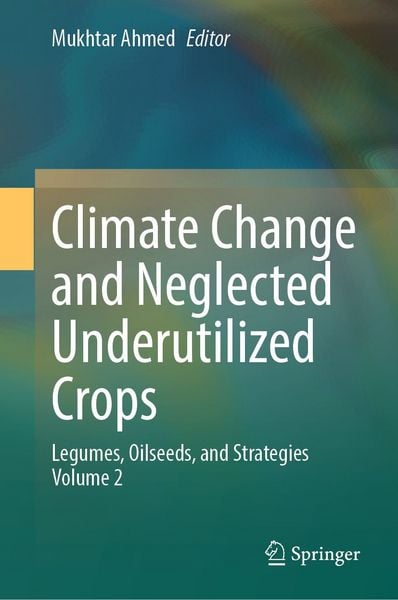
Produktbild: Climate Change and Neglected Underutilized Crops
Vorbesteller Neu

Climate Change and Neglected Underutilized Crops Legumes, Oilseeds, and Strategies Volume 2

156,99 €

inkl. gesetzl. MwSt., Versandkostenfrei


Beschreibung

Produktdetails

Einband

Gebundene Ausgabe

Erscheinungsdatum

04.09.2026

Abbildungen

XIV, 152 illus., 147 illus. in color., farbige Illustrationen, schwarz-weiss Illustrationen

Herausgeber

Mukhtar Ahmed

Verlag

Springer

Seitenzahl

503

Maße (L/B)

23,5/15,5 cm

Sprache

Englisch

ISBN

978-3-032-32061-2

Beschreibung

Portrait

Dr. Mukhtar Ahmed has served for over two decades at Pir Mehr Ali Shah Arid Agriculture University, Rawalpindi, Pakistan, where he is widely recognized as a senior agronomist, climate change expert, and crop modeler. His research centers on climate variability, IoT-based agricultural applications, and the impacts of climate change on crop ecology, physiology, cropping systems, and rainfed farming.

He is an expert in process-based crop and agro-ecosystem modeling and remote sensing, employing tools such as APSIM, AquaCrop, DSSAT, DNDC, CropSyst, STICS, and EPIC to develop and evaluate climate-resilient agricultural strategies. Since 2020, Dr. Ahmed has been consistently listed among the world’s top 2% of scientists, reflecting the global impact and citation strength of his research.

Dr. Ahmed has established extensive international collaborations with research institutions in Australia, Sweden, South Korea, South Africa, the West Indies, Thailand, the United Kingdom, and the United States. He has actively contributed to major global initiatives, including REACCH and AgMIP, and continues to play a key role in shaping global strategies for climate change adaptation and resilience in agriculture.

Produktdetails

Einband

Gebundene Ausgabe

Erscheinungsdatum

04.09.2026

Abbildungen

XIV, 152 illus., 147 illus. in color., farbige Illustrationen, schwarz-weiss Illustrationen

Herausgeber

Mukhtar Ahmed

Verlag

Springer

Seitenzahl

503

Maße (L/B)

23,5/15,5 cm

Sprache

Englisch

ISBN

978-3-032-32061-2

Herstelleradresse

Springer International Publishing AG
Gewerbestr. 11
6330 Cham
Schweiz
Url: www.springer.com

Noch keine Bewertungen vorhanden

Verfassen Sie die erste Bewertung zu diesem Artikel

Helfen Sie anderen Kundinnen und Kunden durch Ihre Meinung.

Kundinnen und Kunden meinen

Bewertungen (0)

Weitere Artikel finden Sie in

  • Produktbild: Climate Change and Neglected Underutilized Crops
  • Part III: Food Legume .- Horsegram (Macrotyloma uniflorum): Drought Resilience and Livelihood Security.- Grass Pea (Lathyrus sativus L.): Orphan Neglected Crop – A Vital Resource for Food Security.- Winged Bean (Psophocarpus tetragonolobus): Multi-Purpose Crop for Food, Feed and Soil Health.-

    African Yam Bean (Sphenostylis stenocarpa): Role in Sustainable Farming Systems.- Moth Bean (Vigna aconitifolia): Adaptation to Arid Environments and Resource Conservation.- Adzuki Bean (Vigna angularis): Climate Adaptation and Nutritional Security.- Bambara Groundnut (Vigna subterranea): Climate-Smart Legume for Food and Nutrition Security.- Ricebean (vigna umbellate): Biodiversity conservation and water management.- Part IV: Oil Seed Crops: Sustainable Production, Energy, and Environmental Benefits.- Safflower (Carthamus tinctorius): Drought, Salinity tolerance and bioenergy potential.- Sesame (Sesamum indicum L.): Water Use Efficiency and Climate Adaptation.- Spurge (Euphorbia lagascae): Environmental Protection and Biofuel Prospects.- Wild Hazel (Simmondsia chinensis): Sustainable Oil Production and Soil Conservation.- Camelina Sativa: low input crop for biofuel and climate resilience.- Amorphophallus paeoniifolius (Elephant Foot Yam): an underutilized tropical tuber crop.- Part V: Cross-cutting Themes and Strategies.- Climate-Smart Practices for NUS: Integrating Agroecology and Precision Agriculture.- Policy frameworks and institutional support for scaling up NUS in climate resilience.- Harnessing Indigenous Knowledge and Participatory Approaches for NUS Adaptation .- Food–Water–Energy Nexus: Optimizing Resource Use with Neglected and Underutilized Crops.- NUS and Biodiversity Conservation: Protecting Ecosystem Services under Climate Change.- Digital and technological innovations in monitoring and managing NUS systems.- Economic and social dimensions of NUS: Empowering smallholder farmers and rural communities.