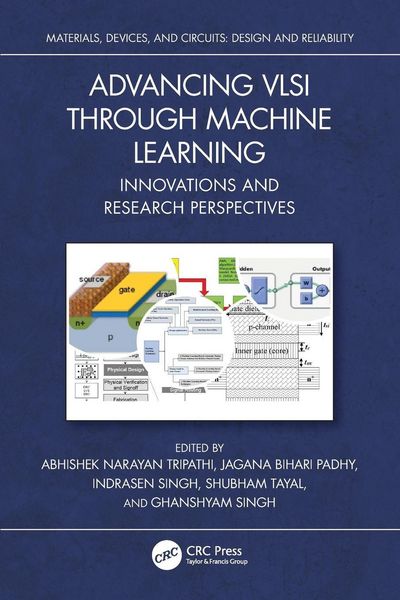
Advancing VLSI through Machine Learning Innovations and Research Perspectives
-
- Hardcover
- Taschenbuch ausgewählt
- eBook
-
Sprache:Englisch
86,99 €
inkl. gesetzl. MwSt.,
Portrait
Dr. Abhishek Narayan Tripathi is currently an Assistant Professor in the Department of Micro and Nanoelectronics, School of Electronics Engineering, Vellore Institute of Technology, Vellore, Tamil Nadu, India. He holds a Ph.D. in ECE with a specialization in VLSI Design and Embedded Technology from MANIT, Bhopal. His research work includes the development of methodologies for dynamic power and leakage power estimation in FPGA and ASIC¿based implementations, VLSI system design, AI, deep learning, and microprocessor architecture.
Dr. Jagana Bihari Padhy is an Assistant Professor in the Department of Embedded Technology, School of Electronics Engineering, Vellore Institute of Technology, Vellore, Tamil Nadu, India. He holds a Ph.D. in ECE with a specialization in optical wireless system design from IIIT Bhubaneswar. His research work includes the development of optical system design both in wired and wireless methodologies for the next generation of communication 5G and beyond.
Dr. Indrasen Singh is an Assistant Professor (Sr. Grade¿2) in the Department of Embedded Technology, School of Electronics Engineering, Vellore Institute of Technology, Vellore, Tamil Nadu, India. His research interests are in the areas of cooperative communication, stochastic geometry, modelling of wireless networks, heterogeneous networks, millimetre wave communications, device¿tödevice communication, and 5G/6G communication.
Dr. Shubham Tayal is an Assistant Professor in the Department of Electronics and Communication Engineering, SR University, Warangal, India. He has more than 6 years of academic/research experience in teaching at the UG and PG levels. He received his Ph.D. in Microelectronics and VLSI Design from the National Institute of Technology, Kurukshetra; M.Tech. (VLSI Design) from YMCA University of Science and Technology, Faridabad; and B.Tech. (Electronics and Communication Engineering) from MDU, Rohtak. His research interests include simulation and modelling of multi¿gate semiconductor devices, device¿circuit cödesign in digital/analogue domain, ML, and Internet of Things.
Prof. Ghanshyam Singh received a Ph.D. degree in Electronics Engineering from the Indian Institute of Technology, Banaras Hindu University, Varanasi, India, in 2000. At present, he is a full Professor with the Department of Electrical and Electronics Engineering, APK Campus, University of Johannesburg, South Africa. His research and teaching interests include RF/microwave engineering, millimetre/THz wave antennas and their applications in communication and imaging, next¿generation communication systems (OFDM and cognitive radio), and nanophotonics. He has more than 19 years of teaching and research experience in electromagnetic/microwave engineering, wireless communication, and nanophotonics.
Produktdetails
Einband
Taschenbuch
Erscheinungsdatum
20.07.2026
Abbildungen
schwarz-weiss Illustrationen, Raster,schwarz-weiss, Zeichnungen, schwarz-weiss, Tabellen, schwarz-weiss
Herausgeber
Abhishek Narayan Tripathi + weitereVerlag
Taylor and FrancisSeitenzahl
254
Maße (L/B/H)
23,4/15,6/1,4 cm
Gewicht
376 g
Sprache
Englisch
ISBN
978-1-03-277429-9
Dr. Abhishek Narayan Tripathi is currently an Assistant Professor in the Department of Micro and Nanoelectronics, School of Electronics Engineering, Vellore Institute of Technology, Vellore, Tamil Nadu, India. He holds a Ph.D. in ECE with a specialization in VLSI Design and Embedded Technology from MANIT, Bhopal. His research work includes the development of methodologies for dynamic power and leakage power estimation in FPGA and ASIC¿based implementations, VLSI system design, AI, deep learning, and microprocessor architecture.
Dr. Jagana Bihari Padhy is an Assistant Professor in the Department of Embedded Technology, School of Electronics Engineering, Vellore Institute of Technology, Vellore, Tamil Nadu, India. He holds a Ph.D. in ECE with a specialization in optical wireless system design from IIIT Bhubaneswar. His research work includes the development of optical system design both in wired and wireless methodologies for the next generation of communication 5G and beyond.
Dr. Indrasen Singh is an Assistant Professor (Sr. Grade¿2) in the Department of Embedded Technology, School of Electronics Engineering, Vellore Institute of Technology, Vellore, Tamil Nadu, India. His research interests are in the areas of cooperative communication, stochastic geometry, modelling of wireless networks, heterogeneous networks, millimetre wave communications, device¿tödevice communication, and 5G/6G communication.
Dr. Shubham Tayal is an Assistant Professor in the Department of Electronics and Communication Engineering, SR University, Warangal, India. He has more than 6 years of academic/research experience in teaching at the UG and PG levels. He received his Ph.D. in Microelectronics and VLSI Design from the National Institute of Technology, Kurukshetra; M.Tech. (VLSI Design) from YMCA University of Science and Technology, Faridabad; and B.Tech. (Electronics and Communication Engineering) from MDU, Rohtak. His research interests include simulation and modelling of multi¿gate semiconductor devices, device¿circuit cödesign in digital/analogue domain, ML, and Internet of Things.
Prof. Ghanshyam Singh received a Ph.D. degree in Electronics Engineering from the Indian Institute of Technology, Banaras Hindu University, Varanasi, India, in 2000. At present, he is a full Professor with the Department of Electrical and Electronics Engineering, APK Campus, University of Johannesburg, South Africa. His research and teaching interests include RF/microwave engineering, millimetre/THz wave antennas and their applications in communication and imaging, next¿generation communication systems (OFDM and cognitive radio), and nanophotonics. He has more than 19 years of teaching and research experience in electromagnetic/microwave engineering, wireless communication, and nanophotonics.
Noch keine Bewertungen vorhanden
Verfassen Sie die erste Bewertung zu diesem Artikel
Helfen Sie anderen Kundinnen und Kunden durch Ihre Meinung.
Kurze Frage zu unserer Seite
Vielen Dank für Ihr Feedback
Wir nutzen Ihr Feedback, um unsere Produktseiten zu verbessern. Bitte haben Sie Verständnis, dass wir Ihnen keine Rückmeldung geben können. Falls Sie Kontakt mit uns aufnehmen möchten, können Sie sich aber gerne an unseren Kund*innenservice wenden.
zum Kundenservice