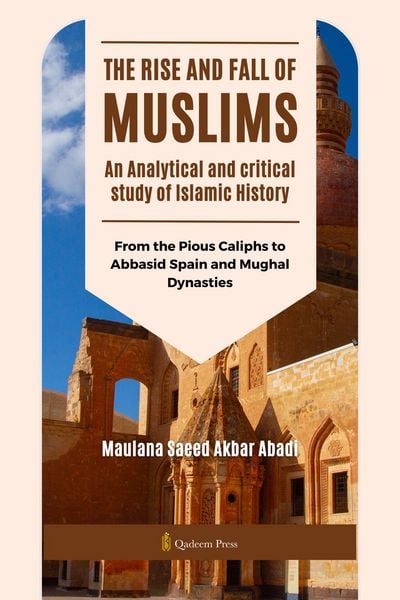
The Rise and Fall of Muslims - An Analytical and critical study of Islamic History
-
- Einzelkauf Download ausgewählt
-
Sprache:Englisch
9,80 €
inkl. gesetzl. MwSt.Beschreibung
Produktdetails
Format
ePUB
Kopierschutz
Nein
Family Sharing
Nein
Text-to-Speech
Ja
Erscheinungsdatum
26.05.2026
Verlag
Qadeem PressSeitenzahl
358 (Printausgabe)
Dateigröße
1148 KB
Auflage
2. Auflage
Sprache
Englisch
EAN
9789366080246
The Rise and Fall of Muslims examines the historical development of Muslim political civilization from the earliest generations of Islam to the fragmentation of Muslim authority in the modern period. Written with a strong concern for the relationship between power, morality, religion, and historical continuity, the book studies not only how Muslim societies expanded across vast regions of the world, but also how internal weaknesses gradually affected their cohesion, institutions, and intellectual life.
The work begins with the formative period of the Rightly Guided Caliphs, presenting that era as a distinctive model of governance shaped by restraint, accountability, consultation, and personal responsibility before God. Abu Bakr al-Siddiq, 'Umar ibn al-Khattab, 'Uthman ibn 'Affan, and 'Ali ibn Abi Talib are discussed not merely as political rulers, but as representatives of an early Islamic order in which public leadership remained closely tied to ethical discipline and communal trust. The transition from this model into dynastic monarchy marks one of the central historical shifts explored throughout the book.
From there, the narrative follows the rise of the Umayyad and Abbasid states, tracing the extraordinary territorial and administrative expansion of Muslim rule while also examining the tensions that accompanied imperial growth. Questions of succession, tribal rivalry, political authority, luxury, and statecraft appear repeatedly as the Muslim world transforms from a relatively unified community into a collection of increasingly complex political systems. The author pays particular attention to the emergence of hereditary rule and the changing nature of governance after the earliest caliphate.
The discussion of the Abbasid period moves beyond court politics and military affairs to include intellectual and scientific developments that shaped Islamic civilization for centuries. Scholarship, translation, jurisprudence, philosophy, literature, and urban development are treated as indicators of a broader civilizational confidence that extended far beyond military strength alone. Yet the same period also reveals signs of political fragmentation and administrative decline, demonstrating the author's recurring argument that intellectual vitality and political stability cannot remain detached indefinitely from questions of moral discipline and institutional integrity.
The book's treatment of the Crusades and the Mongol invasions situates these conflicts within larger historical processes rather than isolated military encounters. Figures such as Salah al-Din Ayyubi emerge not only as military leaders but as symbols of renewal during moments of civilizational vulnerability. Likewise, the devastation caused by the Mongol advance is explored as a turning point that exposed weaknesses already present within sections of the Muslim world.
Particular attention is given to the Ottoman experience, especially its early military discipline, administrative organization, and strategic expansion. The conquest of Constantinople under Sultan Muhammad al-Fatih is presented as a culmination of long-term political vision and institutional strength. At the same time, the later weakening of Ottoman authority is analyzed through recurring themes that appear throughout the book: complacency, factionalism, bureaucratic stagnation, military decline, and diminishing intellectual dynamism.
The chapters on Muslim Spain carry a distinct sense of historical gravity. Andalusia is presented as one of the most remarkable expressions of Muslim political and cultural achievement, marked by scholarship, architecture, scientific inquiry, urban development, and coexistence across communities. Yet the fall of Muslim Spain is not attributed solely to external aggression. Internal division, dynastic rivalry, and weakening political unity are treated as decisive factors that made eventual collapse possible. The loss of Andalusia becomes, in the author's presentation, one of the clearest historical examples of how fragmentation can erode even highly developed civilizations.
The later sections devoted to Muslim India occupy an important place within the broader argument of the work. From the Delhi Sultanate to the Mughal Empire, the author studies how Muslim political authority developed in the subcontinent under changing religious, social, and military conditions. Akbar's reign is examined critically in relation to questions of religious policy and imperial centralization, while Aurangzeb Alamgir is discussed within the context of governance, orthodoxy, expansion, and imperial strain.
The inclusion of figures such as Shah Waliullah al-Dihlawi and Sayyid Ahmad Shahid signals the author's continuing concern with reform and revival. Their efforts are presented as responses to political decline, colonial pressure, religious fragmentation, and weakening Islamic institutions in India. British expansion and the growing dominance of the East India Company are treated not merely as external developments but as events that interacted with existing Muslim vulnerabilities.
Throughout the book, historical decline is approached as a cumulative process rather than a single event. The author repeatedly returns to themes such as leadership failure, abandonment of justice, pursuit of luxury, internal conflict, weakening scholarship, and the erosion of moral seriousness. His analysis remains grounded in a traditional Muslim understanding of history in which political strength cannot be separated from ethical and spiritual conditions within society.
At the same time, the book avoids reducing Muslim history to a simple narrative of uninterrupted decline. Periods of renewal, reform, military revival, and intellectual flourishing appear across multiple centuries and regions. This balance gives the work a broader historical texture, allowing it to function not only as a political history but also as a reflection on civilizational continuity and fragility.
The prose maintains a serious and reflective tone throughout. Rather than adopting the detached style of purely academic historiography or the emotional register of devotional literature, the book occupies a middle ground that combines historical narration with civilizational analysis. This makes it accessible to general readers while still retaining value for students, teachers, seminary audiences, and researchers interested in Islamic historical thought.
For contemporary readers, the significance of the work lies partly in its method. It treats Muslim history neither as a romantic memory nor as a catalogue of failures, but as a field of moral and political inquiry. The rise and decline of societies are examined through the interaction of leadership, institutions, knowledge, public ethics, and collective purpose. In doing so, the book participates in a long-standing Muslim intellectual tradition concerned with understanding how civilizations are built, sustained, weakened, and sometimes renewed.
Noch keine Bewertungen vorhanden
Verfassen Sie die erste Bewertung zu diesem Artikel
Helfen Sie anderen Kundinnen und Kunden durch Ihre Meinung.
Kurze Frage zu unserer Seite
Vielen Dank für Ihr Feedback
Wir nutzen Ihr Feedback, um unsere Produktseiten zu verbessern. Bitte haben Sie Verständnis, dass wir Ihnen keine Rückmeldung geben können. Falls Sie Kontakt mit uns aufnehmen möchten, können Sie sich aber gerne an unseren Kund*innenservice wenden.
zum Kundenservice