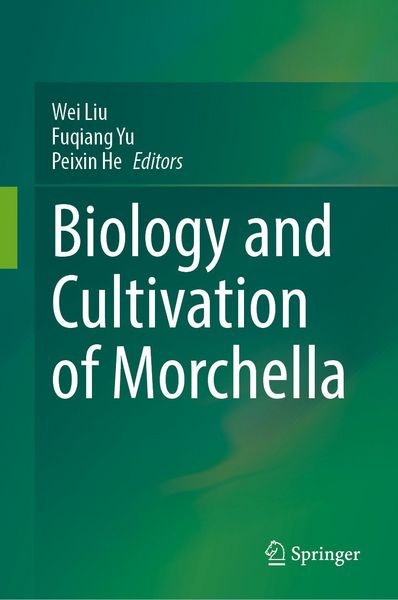
Produktbild: Biology and Cultivation of Morchella
Vorbesteller Neu

Biology and Cultivation of Morchella

154,99 €

inkl. gesetzl. MwSt., Versandkostenfrei


Beschreibung

Produktdetails

Einband

Gebundene Ausgabe

Erscheinungsdatum

28.08.2026

Abbildungen

XIV, 107 illus., 98 illus. in color., schwarz-weiss Illustrationen, farbige Illustrationen

Herausgeber

Wei Liu + weitere

Verlag

Springer Singapore

Seitenzahl

616

Maße (L/B)

23,5/15,5 cm

Sprache

Englisch

ISBN

978-981-9228-25-6

Beschreibung

Portrait

Wei Liu, Ph.D., is a professor and graduate supervisor at Yunnan Minzu University. Before joining Yunnan Minzu University, he worked as an engineer at the Institute of Hydrobiology, Chinese Academy of Sciences (CAS), from 2011 to 2015, and later served as an assistant researcher at the Kunming Institute of Botany, CAS, from 2021 to 2024. He received his master’s degree (2008–2011) and Ph.D. (2017–2020) from Huazhong Agricultural University. Dr. Liu serves as secretary general of the Morchella Industry Branch of the Mycological Society of China, and as an associate or guest editor for Horticulturae, Journal of Fungi, Journal of Agriculture and Food Research, and Acta Edulis Fungi. His research focuses on the domestication, cultivation, and genetic breeding of macrofungi, with particular emphasis on morel mushrooms. He has made systematic and in-depth contributions to understanding morel life cycles, spawn quality, mating-type genes, omics, and growth and development. With over ten years of hands-on experience in morel cultivation, Dr. Liu has promoted morel farming across more than 10,000 hectares in China. He has been instrumental in organizing national morel conferences and specialized training workshops for ten consecutive years, establishing himself as a leading figure in both fundamental research and applied extension of morel mushrooms. Three new morel varieties developed by his team have received official recognition. He has led 11 research projects, including grants from the National Natural Science Foundation of China, Yunnan provincial funds, and government–enterprise collaborations, with a total funding of 5.87 million RMB. He has published 101 scientific papers, of which 56 are indexed in SCI, and holds 14 invention patents, including one U.S. patent and one U.K. patent.

Fuqiang Yu, Ph.D., is a professor-grade senior engineer at the Kunming Institute of Botany, CAS, and deputy director of the Germplasm Bank of Wild Species and Yunnan Key Laboratory for Fungal Diversity and Green Development. Dr. Yu is the rotating chair of the International Workshop on Edible Mycorrhizal Mushrooms (IWEMM) and a member of the IUCN Sustainable Use and Livelihoods Specialist Group (SULi). His research focuses on the conservation and sustainable use of macrofungi. He developed a “crop–forest–livestock” synergy system that increased agricultural product value by 3.5-fold (up to 7.4-fold) and reduced antibiotic resistance genes by >80%. He bred three officially recognized morel varieties and achieved the world’s first artificial cultivation of Lactarius vividus and multi-cycle continuous fruiting of Chinese truffles. Since 2014, he has led poverty-alleviation efforts across 27 counties in southwest China, generating over 1 billion RMB in income and benefiting >12,000 farmer households. He has published 182 papers (137 SCI), holds 39 patents (30 invention patents), and has led more than 40 major research projects.

Peixin He, Ph.D., is a full professor and doctoral supervisor in microbiology at Zhengzhou University of Light Industry (ZZULI). Before joining ZZULI, he received his Ph.D. in science from Shandong University in July 2006. He is recognized as an outstanding young scientist in science and technology innovation in Henan Province and as a high-level talent of Henan Province. He also serves as vice president of the Morchella Mushroom Industry Branch of the Mycological Society of China. His research focuses primarily on fungal biotechnology, with deep expertise in the biology of morel mushrooms, breeding of new varieties, and development of novel cultivation techniques. He has led or participated in more than 10 provincial and ministerial-level research projects, published over 180 academic papers (including more than 40 indexed in SCI), authored 16 books, received two Second Prizes of the Henan Provincial Science and Technology Progress Award, and been granted five national invention patents.

Produktdetails

Einband

Gebundene Ausgabe

Erscheinungsdatum

28.08.2026

Abbildungen

XIV, 107 illus., 98 illus. in color., schwarz-weiss Illustrationen, farbige Illustrationen

Herausgeber

Verlag

Springer Singapore

Seitenzahl

616

Maße (L/B)

23,5/15,5 cm

Sprache

Englisch

ISBN

978-981-9228-25-6

Herstelleradresse

Springer Nature Customer Service Center GmbH
Europaplatz 3
69115 Heidelberg
DE
ProductSafety@springernature.com

Noch keine Bewertungen vorhanden

Verfassen Sie die erste Bewertung zu diesem Artikel

Helfen Sie anderen Kundinnen und Kunden durch Ihre Meinung.

Kundinnen und Kunden meinen

Bewertungen (0)

  • Produktbild: Biology and Cultivation of Morchella
  • Chapter 1. Global Morel Consumption Culture and the Role of China's Morel Industry in Agricultural Restructuring.- Chapter 2. Systematic Analysis of the Chemical Composition of Morels and Their Nutritional and Edible Value.- Chapter 3. Comprehensive Comparative Analysis of Amino Acid Profiles and Nutritional Quality in Morchella Species and Other Edible Fungi.- Chapter 4. Bioactive Components and Medicinal Value of Morels.- Chapter 5. Taxonomy, Evolution, and Domesticated Cultivable Species of Morchella.- Chapter 6. Cellular Structures and Definition of Cell Types Across the Complete Life Cycle of Morchella importuna.- Chapter 7. Life Cycle Complexity in Morels Inferred from Mating-Type Gene Architecture and the Evolution of Spermatial Function.- Chapter 8. Nutritional Modes, Ascocarpic Microecology, and Pyrophilous Traits of Morchella.- Chapter 9. Development and Application of Molecular Markers and Their Association with Development of Morchella.- Chapter 10. Genetics and Breeding of Morchella.- Chapter 11. Multi-Omics Insights into Morel Growth, Development, and Mechanisms of Stable Cultivation.- Chapter 12. Mitochondrial Genome Features and Evolution of Morchella.- Chapter 13. Microbial Succession, Community Function, and Potential Mechanisms of Stable Production in Morel Cultivation Habitats.- Chapter 14. Research Advances in Continuous Cropping Obstacles in Morel Cultivation.- Chapter 15. Strain Aging, Degeneration, and Loss of Mating-Type Genes in Morchella: Mechanisms and Impacts on Cultivation Stability.- Chapter 16. Spawn Making and Production Technologies of Morchella.- Chapter 17. Exogenous Nutrient Supplementation as a Foundation for Successful Morel Cultivation.- Chapter 18. Cultivation Techniques for Morels.- Chapter 19. Industrial Cultivation of Morels.- Chapter 20. Ascocarp Diseases of Morels: Pathogen Identification, Epidemiology, Pathogenic Mechanisms, and Integrated Management.