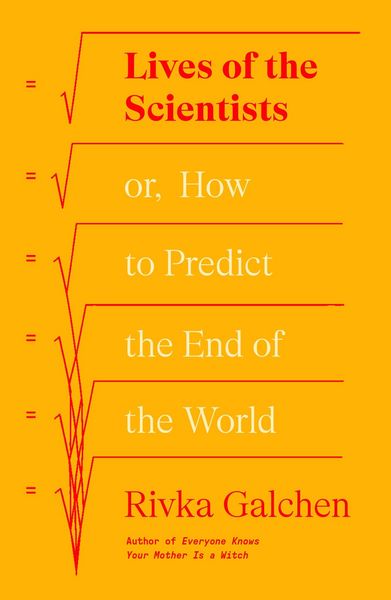
Lives of the Scientists: Or, How to Predict the End of the World
-
- Englisch ausgewählt
28,99 €
inkl. gesetzl. MwSt.,
- Kostenlose Lieferung ab 30 € Einkaufswert
- Versandkostenfrei für Bonuscard-Kund*innen
Beschreibung
Produktdetails
Einband
Gebundene Ausgabe
Erscheinungsdatum
20.04.2027
Verlag
Farrar, Straus and GirouxSeitenzahl
368
Maße (L/B/H)
21/13,7/2,5 cm
Gewicht
454 g
Sprache
Englisch
ISBN
978-0-374-60539-1
One of our most brilliant, acclaimed novelists turns to nonfiction with a mind-expanding, slyly humorous personal exploration of the scientific imagination.
In Lives of the Scientists: or, How to Predict the End of the World, Rivka Galchen offers a profound and playful exploration of the lives of scientists, the persistence of error, and the quixotic faith required to make sense of a turbulent reality. She finds both hope and warning-and many startling stories-in those who have devoted themselves to searching for the truth about our world, facing the unpredictable and the uncertain, and the occasional authoritarian leader.
Galchen's father-a spacy, otherworldly meteorologist-sends her a box containing two oversize T-shirts (one with the image of Shakespeare, the other of Einstein) and a copy of Don Quixote. The riddle of the gift, received only weeks before his death at fifty-three, becomes the catalyst for a journey into the minor mysteries of individual lives. We encounter the tragic genius of Nikolai Vavilov, who sought to conquer famine only to die of starvation in a Soviet prison; the eccentric Lewis Fry Richardson, who imagined a "forecast factory" of 64,000 human computers to predict both weather and war; and Ignaz Semmelweis, the doctor who discovered that washing hands could save lives, only to be dismissed as a madman by his peers. Part memoir, part history, part political meditation, Lives of the Scientists spans everything from the "Infinite Hotel" of the mathematician David Hilbert to the "memory palace" of a man who could never forget. Science, Galchen discovers, is much like the knight-errantry of Don Quixote: a fantasy that works back to improve the reality we are trying to evade.
With the precision of a poet and the imagination of a scientist, Galchen bridges the gap between the "scuffle of the small" and the cosmic scale of the universe. Whether discussing the Semmelweis Reflex (humans' tendency to irrationally reject the truth), the evolution of "Good Enough" mothers, or the "many worlds" of quantum physics where our lost dogs are still alive, she offers a "light to the soul"-a much-needed antidote to the blue light of our smartphones and their endless scroll of bad news.
Noch keine Bewertungen vorhanden
Verfassen Sie die erste Bewertung zu diesem Artikel
Helfen Sie anderen Kundinnen und Kunden durch Ihre Meinung.
Kurze Frage zu unserer Seite
Vielen Dank für Ihr Feedback
Wir nutzen Ihr Feedback, um unsere Produktseiten zu verbessern. Bitte haben Sie Verständnis, dass wir Ihnen keine Rückmeldung geben können. Falls Sie Kontakt mit uns aufnehmen möchten, können Sie sich aber gerne an unseren Kund*innenservice wenden.
zum Kundenservice