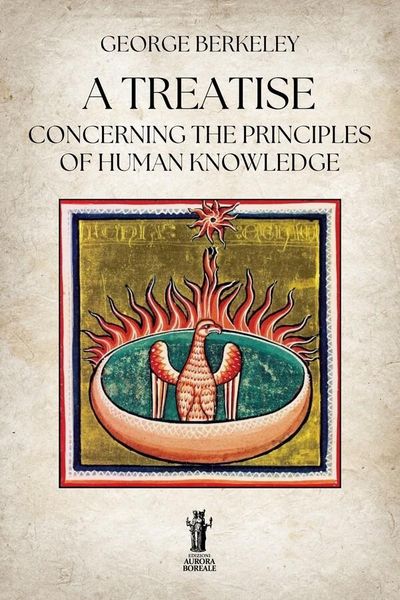
A Treatise Concerning the Principles of Human Knowledge
-
- Einzelkauf Download ausgewählt
-
Sprache:Englisch
7,00 €
inkl. gesetzl. MwSt.Beschreibung
Produktdetails
Format
ePUB
Kopierschutz
Nein
Family Sharing
Ja
Text-to-Speech
Ja
Erscheinungsdatum
09.05.2026
Verlag
Edizioni Aurora BorealeSeitenzahl
(Printausgabe)
Dateigröße
520 KB
Sprache
Englisch
EAN
9791224467236
George Berkeley (1685-1753) was an Irish philosopher, an anglican bishop and one of the three great British empiricists along with John Locke and David Hume. Ignored and derided in life, he is now widely re-evaluated and considered as a sort of indirect precursor of Ernst Mach, Albert Einstein and Niels Bohr for his thesis on the non-existence of matter and the impossibility of an objectively absolute time and space. His critiques of mathematics and science are among the most controversial, brilliant and revolutionary in the history of philosophy.
The publication of A Treatise Concerning the Principles of Human Knowledge in 1710 marked a seismic shift in the landscape of Western metaphysics. At a time when the "New Science" of Isaac Newton and the representational realism of John Locke were cementing a worldview defined by inert, material substances, George Berkeley-then a young Fellow at Trinity College, Dublin-ventured a thesis so audacious that it remains one of the most provocative challenges in the history of philosophy: the denial of the existence of Matter.
Berkeley's primary objective was not merely an exercise in academic skepticism; rather, it was a profound defense of theistic metaphysics against the rising tide of materialism and its perceived consequence, atheism. By dismantling the philosophical "prejudice" of material substance, Berkeley sought to reconcile the rigorous logic of empiricism with the spiritual demands of Christian theology, placing the human mind in immediate contact with the Divine.
In conclusion, George Berkeley's A Treatise Concerning the Principles of Human Knowledge is more than a historical curiosity; it is a rigorous interrogation of the limits of human understanding. By forcing us to question the leap from "perceived sensation" to "material object", Berkeley paved the way for later developments in phenomenalism, linguistic philosophy, and even certain interpretations of quantum mechanics.
Whether one accepts his theistic conclusions or not, Berkeley's insistence on the "scandal of the external world" remains a vital spark in the philosophical tradition. He invites the reader to "open their eyes" and see that the "mighty frame of the world" does not subsist in a dark, unknowable Matter, but in the light of the perceiving mind and the sustaining presence of the Eternal Spirit.
The publication of A Treatise Concerning the Principles of Human Knowledge in 1710 marked a seismic shift in the landscape of Western metaphysics. At a time when the "New Science" of Isaac Newton and the representational realism of John Locke were cementing a worldview defined by inert, material substances, George Berkeley-then a young Fellow at Trinity College, Dublin-ventured a thesis so audacious that it remains one of the most provocative challenges in the history of philosophy: the denial of the existence of Matter.
Berkeley's primary objective was not merely an exercise in academic skepticism; rather, it was a profound defense of theistic metaphysics against the rising tide of materialism and its perceived consequence, atheism. By dismantling the philosophical "prejudice" of material substance, Berkeley sought to reconcile the rigorous logic of empiricism with the spiritual demands of Christian theology, placing the human mind in immediate contact with the Divine.
In conclusion, George Berkeley's A Treatise Concerning the Principles of Human Knowledge is more than a historical curiosity; it is a rigorous interrogation of the limits of human understanding. By forcing us to question the leap from "perceived sensation" to "material object", Berkeley paved the way for later developments in phenomenalism, linguistic philosophy, and even certain interpretations of quantum mechanics.
Whether one accepts his theistic conclusions or not, Berkeley's insistence on the "scandal of the external world" remains a vital spark in the philosophical tradition. He invites the reader to "open their eyes" and see that the "mighty frame of the world" does not subsist in a dark, unknowable Matter, but in the light of the perceiving mind and the sustaining presence of the Eternal Spirit.
Kundinnen und Kunden meinen
Verfassen Sie die erste Bewertung zu diesem Artikel
Helfen Sie anderen Kund*innen durch Ihre Meinung
Kurze Frage zu unserer Seite
Vielen Dank für Ihr Feedback
Wir nutzen Ihr Feedback, um unsere Produktseiten zu verbessern. Bitte haben Sie Verständnis, dass wir Ihnen keine Rückmeldung geben können. Falls Sie Kontakt mit uns aufnehmen möchten, können Sie sich aber gerne an unseren Kund*innenservice wenden.
zum Kundenservice