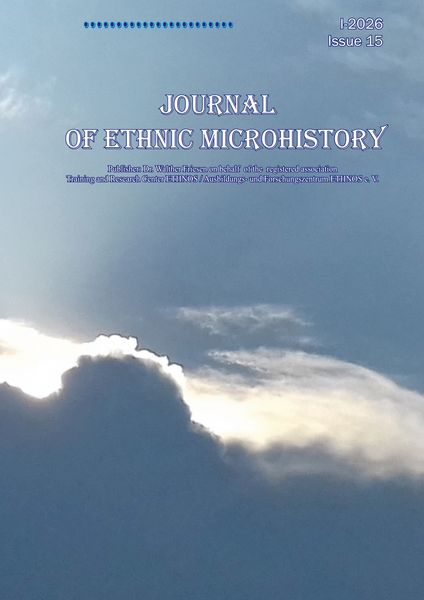
Journal of Ethnic Microhistory Issue 15, I-2026
-
- Taschenbuch ausgewählt
- eBook
-
Sprache:Englisch, Russisch
14,40 €
inkl. gesetzl. MwSt.,
- Kostenlose Lieferung ab 30 € Einkaufswert
- Versandkostenfrei für Bonuscard-Kund*innen
Beschreibung
Produktdetails
Einband
Taschenbuch
Erscheinungsdatum
08.05.2026
Verlag
BoD – Books on DemandSeitenzahl
46
Maße (L/B/H)
29,7/21/0,4 cm
Gewicht
164 g
Auflage
1
Sprache
Englisch, Russisch
ISBN
978-3-696-39782-1
1. In his essay, Gregory Popov asks whether the Rus people truly played a decisive role in averting a Mongol invasion of Europe by acting as a physical barrier between the advancing forces and the European continent. He concludes that the Catholic states of Europe were capable of mounting effective resistance against the Mongol conquerors. He employs a comparative method in his work, combining medieval chronicles with archaeological research. He posits the hypothesis that following the Battle of the Sit River on 4 March 1238, the Russian principalities did not consolidate their position in order to resist the Mongol conquerors. He concludes that the Rus possessed weak military capabilities at the outset of the Mongol invasion of Europe.
2. The autobiographical story of Reinhold Schulz contains valuable microhistorical material, reflecting the realities of Russia-German history and everyday life from the mid-20th to the early 21st century. The author attempts to be objective about the first half of his life, which he spent in the Soviet Union.
3. The article, written by Kazakh scientists Begman Iskak and Ileskan Smanov, is dedicated to the creative work of the renowned Kazakh writer, Berdibek Soqpaqbaev. He is best known for his 1957 novella My Name Is Kozha. Soqpaqbaev is widely regarded as a classic of Kazakh children's literature. His works contain microhistorical material from the period when Kazakhstan was a union republic of the USSR. The article is written in Kazakh and is preceded by an English abstract.
4. Robert Korn focuses on the creative work of the Russia-German writer Bernhard Vogau, who wrote under the pseudonym Boris Andreevich Pilnyak. In the first part of his essay, Robert Korn dispels the myth of the "Russification" of Bernhard Wogau and the Volga-Germans, with whom the renowned writer identified. In the second part of his essay, Robert Korn draws on the critical views of Bernhard Vogau to examine the social phenomenon of "blessed fools", who were revered in Russia. There are no known studies that have examined attempts to export the phenomenon of "Russian profane blasphemy" to other countries. The article is written in Russian and is preceded by an English abstract.
5. In his article, Walther Friesen considers the possibility of granting aristocratic titles to prominent members of the Russia-German community.
Noch keine Bewertungen vorhanden
Verfassen Sie die erste Bewertung zu diesem Artikel
Helfen Sie anderen Kundinnen und Kunden durch Ihre Meinung.
Kurze Frage zu unserer Seite
Vielen Dank für Ihr Feedback
Wir nutzen Ihr Feedback, um unsere Produktseiten zu verbessern. Bitte haben Sie Verständnis, dass wir Ihnen keine Rückmeldung geben können. Falls Sie Kontakt mit uns aufnehmen möchten, können Sie sich aber gerne an unseren Kund*innenservice wenden.
zum Kundenservice