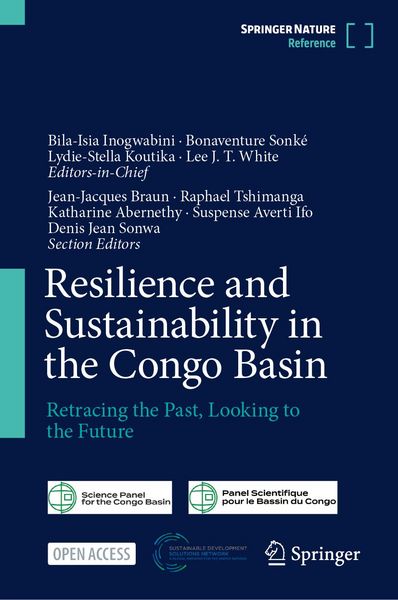
Produktbild: Resilience and Sustainability in the Congo Basin
Vorbesteller Neu

Resilience and Sustainability in the Congo Basin Retracing the Past, Looking to the Future

673,99 €

inkl. gesetzl. MwSt., Versandkostenfrei


Beschreibung

Produktdetails

Einband

Gebundene Ausgabe

Erscheinungsdatum

27.08.2026

Abbildungen

XXXV, 150 illus., 139 illus. in color., farbige Illustrationen, schwarz-weiss Illustrationen

Herausgeber

Bila-Isia Inogwabini + weitere

Verlag

Springer Us

Seitenzahl

1063

Maße (L/B)

23,5/15,5 cm

Sprache

Englisch

ISBN

978-1-07-165511-5

Beschreibung

Portrait

Bila-Isia Inogwabini is a National Geographic and UNESCO Award-Winning Biodiversity Scholar affiliated with the Department of Aquatic Sciences and Assessment, Swedish University of Agricultural Sciences, Uppsala (External Resource) and the School of Management, Catholic University of Congo (Kinshasa). With a 30 year-long experience in Biodiversity Conservation Research, Humanitarian and Sustainable Development Programs, Inogwabini published multiple dozens of peer-reviewed articles and books. He is currently Science Officer for the Science Panel for the Congo Basin.

Bonaventure Sonké is Professor of biodiversity of African rainforests and a plant taxonomist based at the University of Yaoundé 1, Cameroon. He has been working on the dynamics of forest in Central Africa for more than 35 years during which he described more than 70 new species to science; he co-authored over 140 publications in international peer-reviewed journals. He is also one of the three Co-Chairs for the Science Panel for the Congo Basin.

Lydie-Stella Koutika is a soil scientist with over 30 years of experience in applied research on agroecosystems in South America, Europe, and Africa. She has authored numerous papers on soil management, carbon and nitrogen dynamics. Over the past decade, her work has focused on improving and expanding soil knowledge in Central Africa to address climate change, land degradation, food insecurity, and biodiversity loss—contributing significantly to the scientific community and the livelihoods of local farmers. She is one of the three co-chairs for the Science Panel for the Congo Basin and an editor-in-chief of this report.

Lee JT White,  CBE  is an honorary professor at the  University of Stirling (UK). He has over 40 years of experience in the tropical rain forests of Africa; he was director of Gabon’s National Parks Agency and Gabon’s Minister of Water, Forests, Sea and Environment. He publishes widely on the natural history and ecology of the African rain forests and has 125 publications. He is the Special Envoy of the Science Panel for the Congo Basin and an editor-in-chief of this report.

Produktdetails

Einband

Gebundene Ausgabe

Erscheinungsdatum

27.08.2026

Abbildungen

XXXV, 150 illus., 139 illus. in color., farbige Illustrationen, schwarz-weiss Illustrationen

Herausgeber

Verlag

Springer Us

Seitenzahl

1063

Maße (L/B)

23,5/15,5 cm

Sprache

Englisch

ISBN

978-1-07-165511-5

Herstelleradresse

Libri GmbH
Europaallee 1
36244 Bad Hersfeld
DE

Email: GPSR Kontakt

Noch keine Bewertungen vorhanden

Verfassen Sie die erste Bewertung zu diesem Artikel

Helfen Sie anderen Kundinnen und Kunden durch Ihre Meinung.

Kundinnen und Kunden meinen

Bewertungen (0)

Weitere Artikel finden Sie in

  • Produktbild: Resilience and Sustainability in the Congo Basin
  • Introduction: Congo Basin Resilience and Sustainability: From Past to Future.- Geology and Geodynamics Evolution of the Congo Basin.- Climate of the Congo Basin.- The Evolution of Congo Basin Ecosystem Diversity.- The Hydrology of the Congo Basin.- Hydrology of the Ogooué and Sanaga Watershed Systems: Critical Case Studies in the Context of the Congo Basin Forest.- Central African Rainforest Archaeology.- Human Occupation of the Congo Basin.- Critical Interconnections Between Cultural and Biological Diversity in the Congo Basin.- The Ecological Functions of Congo Basin Ecosystems and Basin-Wide Carbon Cycle.- Global, Regional, and National Economic Drivers of Deforestation and Forest Degradation in the Congo Basin.- Agriculture, Ecosystem Functions, and Services in the Congo Basin.- Pastoralism: Access to Land and Ecosystem Functions and Services in the Congo Basin.- Timber Production and Ecosystem Functions and Services in the Congo Basin.- Mining and Ecosystem Functions and Services in the Congo Basin.- Hunting, Fishing, and Ecosystem Functions and Services in the Congo Basin.- Climate Change and Ecosystem Functions and Services in the Congo Basin.- Urbanization, Biodiversity, Ecosystem Functions and Services in the Congo Basin.- History, Development, and Politics of Protected Areas in the Congo Basin Countries.- Ecosystem Functions and Services.- Effects of Diseases on Wildlife Species in the Congo Basin.- Human Influence on Current Status of Biodiversity of the Congo Basin.- Opportunities and Potential for Sustainable Development in the Congo Basin from an Environmental Sustainability Perspective.- Future Risks of Disease Emergence in Humans, Wildlife, and Livestock in the Congo Basin: Predicting Outcomes Under Current Trends and Policy-Driven Solutions.- The Climate and Land-Use Change Feedback.- Cities, Infrastructure, Energy, and the Future of the Basin.- How Could Logging Policies and Practices Influence the Future of the Congo Basin Biodiversity and Ecosystems?.- How Could Agricultural Policies and Practices Influence the Future of the Congo Basin’s Biodiversity and Ecosystems?.- How Could Hunting and Fishing Policies and Practices Influence the Future of the Congo Basin Biodiversity and Ecosystems?.- Mining Influence on the Future of the Congo Basin.- What Might Influence Economic Forecasts for the Congo Basin?.- The future of biodiversity in the Congo Basin.- The SPCB Vision for the Congo Basin in 2050.- Trends Protected Areas Will Take in the Context of 30 × 30 Congo Basin Engagements.- Natural Resource Management Policies in the Congo Basin.- The Potential for Restoring and Rewilding Degraded Ecosystems Across the Congo Basin to Play a Role in Land Management and Conservation.- Solutions of Global, International, Regional, and National Economic Initiatives.- Nature-Based Solutions in the Congo Basin.- Tapping into Indigenous and Local Knowledge in the Congo Basin to Increase Understanding of Its Ecology.- Spatial Dimensions of Existing Conservation Areas and Other Land Uses in the Congo Basin.