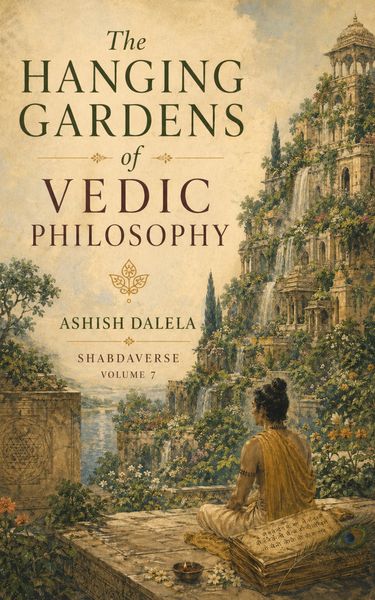
The Hanging Gardens of Vedic Philosophy SHABDAVERSE, #7
-
- Einzelkauf Download ausgewählt
-
Sprache:Englisch
7,99 €
inkl. gesetzl. MwSt.Beschreibung
Produktdetails
Format
ePUB
Kopierschutz
Ja
Family Sharing
Ja
Text-to-Speech
Ja
Erscheinungsdatum
03.05.2026
Verlag
Shabda PressSeitenzahl
(Printausgabe)
Dateigröße
711 KB
Sprache
Englisch
EAN
9789385384578
Western philosophy began with the study of matter. Religion added life and creator to matter. Science added laws to matter. History tells the story of these additions. Vedic philosophy instead begins with the study of persons. Religion talks about the origin of many persons in one person. Matter is the thoughts and actions of a person. Science is about order created by persons, for persons, in a world of persons. History is about persons going from one world to another, based on the ideas of self and world in them.
If we add attributes to matter, they inherit materialism. If we add attributes to persons, they inherit personalism. Western thinking universalizes, separates, and mechanizes based on its ideas of matter. Vedic thinking individualizes, connects, and organizes based on its ideas of persons. Western thinking extends outer-world idea into the inner-world, and Vedic thinking extends inner-world idea to the outer-world. Western and Vedic thinking diverge because of different starting pointsmatter vs. persons.
This stark contrast makes Vedic ideas incomprehensible to the Western mind, which is why when the West found Vedic ideas it was either fascinated without understanding, or it rejected them as primitive myths. The ideas that the West understood were impersonal, universal, and substantive caricatures of Vedic thinking, rejected by the Vedic traditionalists. There is nothing in Western academia that explains the Vedic worldview because we can never bridge the chasm from materialism to personalism.
However, it is possible to discuss the same subjects in a new way, and this what this anthology of articles does. It discusses Western philosophy topics like epistemology, ontology, logic, perception, reasoning, realism, idealism, personhood, mechanism, mind, nature, quantity, quality, God, mathematics, duality, non-duality, etc., from a Vedic worldview. We can never go from the worldview of matter to that of persons, but we can discuss them side-by-side, and show why one fails and the other succeeds.
Noch keine Bewertungen vorhanden
Verfassen Sie die erste Bewertung zu diesem Artikel
Helfen Sie anderen Kundinnen und Kunden durch Ihre Meinung.
Kurze Frage zu unserer Seite
Vielen Dank für Ihr Feedback
Wir nutzen Ihr Feedback, um unsere Produktseiten zu verbessern. Bitte haben Sie Verständnis, dass wir Ihnen keine Rückmeldung geben können. Falls Sie Kontakt mit uns aufnehmen möchten, können Sie sich aber gerne an unseren Kund*innenservice wenden.
zum Kundenservice