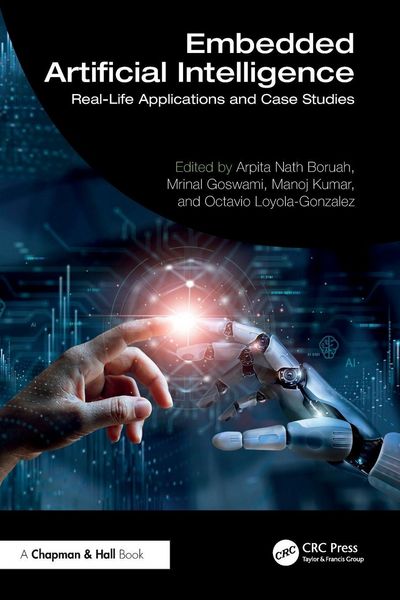
Embedded Artificial Intelligence Real-Life Applications and Case Studies
-
- Hardcover
- Taschenbuch ausgewählt
- eBook
-
Sprache:Englisch
78,99 €
inkl. gesetzl. MwSt.,
Portrait
Arpita Nath Boruah is an Assistant Professor, Programme Computer Science and Engineering in the Faculty of Engineering and Technology at Assam Down Town University, Assam, India. She earned her doctorate degree from the National Institute of Technology, Silchar, Assam, in the Department of Computer Science and Engineering. She holds an MTech degree in Computer Science and Engineering from NERIST, Arunachal Pradesh, and a bachelor's degree in Computer Science and Engineering from Jorhat Engineering College, Assam. She is currently involved in research areas that include data mining, machine learning, data science, and transparent decision¿making system. She has published several international journal articles in SCI/SCIE¿indexed journals from various reputed publishers and has attended many international conferences.
Mrinal Goswami earned his BTech degree in Computer Science and Engineering from the North Eastern Regional Institute of Science and Technology, India, in 2012. He earned his MTech and PhD in Computer Science and Engineering from the National Institute of Technology, Durgapur, West Bengal, India, in 2014 and 2019, respectively. He has over eight years of research and teaching experience as an assistant professor. Currently, he is with the Faculty of Engineering and Technology, Programme of Computer Science and Engineering, Assam Down Town University, Guwahati, Assam, India, and working as an Associate Professor. Before this, he was an Assistant Professor in the Department of Computer Science and Engineering at the University of Petroleum and Energy Studies (NIRF Rank 54 & NACC A accredited) and North Eastern Regional Institute Science and Technology (Deemed¿to¿be¿University under the Ministry of Education, Govt. of India). He is a member of the Institute of Electrical and Electronics Engineers (IEEE) and Cellular Automata India Chapter. He has published several international research articles on design, testing, security, and fault¿tolerance issues in digital systems, quantum dot cellular automata, quantum computing, and AI.
Manoj Kumar completed his PhD from The Northcap University and MSc (Information Security and Digital Forensics) from Technological University Dublin, Ireland, in 2013. He received a fully funded scholarship for the MTech and MSc programmes from the Irish Government and the MHRD, respectively. He has more than 13 years of research, teaching, and corporate experience. He is currently an Associate Professor of Cyber Security at the University of Wollongong in Dubai, UAE, and a Research Head for the Network and Cyber Security Cluster @UOWD. He has published over 170 articles in various journals and conferences. He published over 10 patents and delivered three international research¿funded projects. He published three authored books and eight edited books. His specializations are digital forensics, machine learning, information security, image processing, IOT, and computer networking. He is a member of numerous renowned professional bodies including IEEE, ACM, IAENG, ISTS, and UACEE. He received the Best Researcher Award in 2020, an Outstanding Scientist Award in 2021, and a Young Researcher Award in 2021 from recognized international professional societies.
Octavio LoyoläGonzalez earned his PhD in Computer Science from the National Institute of Astrophysics, Optics, and Electronics, Mexico. He has won several awards from different institutions for his research work on applied projects. Consequently, he is a member of the National System of Researchers in Mexico (Rank 1). He worked as a distinguished professor and researcher at the Tecnologico de Monterrey, Campus Puebla, for undergraduate and graduate programmes of Computer Sciences. He was a Managing Director for Altair Management Consultants, having branches in the USA, UK, Spain, and Mexico, where he led several teams of data scientists for AI and ML, business intelligence reporting, and traditional consulting. Currently, he serves as an AI Executive Consulting Manager at NTT DATA. His responsibilities include bringing in clients from the automotive, manufacturing, real estate, infrastructure, and services sectors for deals related to advanced analytics (AI & GenAI). Additionally, he oversees the operations and activities of a team of data scientists, guiding them on both technical and business strategy aspects. Furthermore, he is actively involved in publishing scientific papers and books in reputable journals to promote advancements in AI research.
Produktdetails
Einband
Taschenbuch
Erscheinungsdatum
22.06.2026
Abbildungen
schwarz-weiss Illustrationen, Raster, schwarz-weiss, Zeichnungen, schwarz-weiss, Tabellen, schwarz-weiss
Herausgeber
Arpita Nath Boruah + weitereVerlag
Taylor and FrancisSeitenzahl
310
Maße (L/B/H)
23,4/15,6/1,7 cm
Gewicht
600 g
Sprache
Englisch
ISBN
978-1-03-277067-3
Arpita Nath Boruah is an Assistant Professor, Programme Computer Science and Engineering in the Faculty of Engineering and Technology at Assam Down Town University, Assam, India. She earned her doctorate degree from the National Institute of Technology, Silchar, Assam, in the Department of Computer Science and Engineering. She holds an MTech degree in Computer Science and Engineering from NERIST, Arunachal Pradesh, and a bachelor's degree in Computer Science and Engineering from Jorhat Engineering College, Assam. She is currently involved in research areas that include data mining, machine learning, data science, and transparent decision¿making system. She has published several international journal articles in SCI/SCIE¿indexed journals from various reputed publishers and has attended many international conferences.
Mrinal Goswami earned his BTech degree in Computer Science and Engineering from the North Eastern Regional Institute of Science and Technology, India, in 2012. He earned his MTech and PhD in Computer Science and Engineering from the National Institute of Technology, Durgapur, West Bengal, India, in 2014 and 2019, respectively. He has over eight years of research and teaching experience as an assistant professor. Currently, he is with the Faculty of Engineering and Technology, Programme of Computer Science and Engineering, Assam Down Town University, Guwahati, Assam, India, and working as an Associate Professor. Before this, he was an Assistant Professor in the Department of Computer Science and Engineering at the University of Petroleum and Energy Studies (NIRF Rank 54 & NACC A accredited) and North Eastern Regional Institute Science and Technology (Deemed¿to¿be¿University under the Ministry of Education, Govt. of India). He is a member of the Institute of Electrical and Electronics Engineers (IEEE) and Cellular Automata India Chapter. He has published several international research articles on design, testing, security, and fault¿tolerance issues in digital systems, quantum dot cellular automata, quantum computing, and AI.
Manoj Kumar completed his PhD from The Northcap University and MSc (Information Security and Digital Forensics) from Technological University Dublin, Ireland, in 2013. He received a fully funded scholarship for the MTech and MSc programmes from the Irish Government and the MHRD, respectively. He has more than 13 years of research, teaching, and corporate experience. He is currently an Associate Professor of Cyber Security at the University of Wollongong in Dubai, UAE, and a Research Head for the Network and Cyber Security Cluster @UOWD. He has published over 170 articles in various journals and conferences. He published over 10 patents and delivered three international research¿funded projects. He published three authored books and eight edited books. His specializations are digital forensics, machine learning, information security, image processing, IOT, and computer networking. He is a member of numerous renowned professional bodies including IEEE, ACM, IAENG, ISTS, and UACEE. He received the Best Researcher Award in 2020, an Outstanding Scientist Award in 2021, and a Young Researcher Award in 2021 from recognized international professional societies.
Octavio LoyoläGonzalez earned his PhD in Computer Science from the National Institute of Astrophysics, Optics, and Electronics, Mexico. He has won several awards from different institutions for his research work on applied projects. Consequently, he is a member of the National System of Researchers in Mexico (Rank 1). He worked as a distinguished professor and researcher at the Tecnologico de Monterrey, Campus Puebla, for undergraduate and graduate programmes of Computer Sciences. He was a Managing Director for Altair Management Consultants, having branches in the USA, UK, Spain, and Mexico, where he led several teams of data scientists for AI and ML, business intelligence reporting, and traditional consulting. Currently, he serves as an AI Executive Consulting Manager at NTT DATA. His responsibilities include bringing in clients from the automotive, manufacturing, real estate, infrastructure, and services sectors for deals related to advanced analytics (AI & GenAI). Additionally, he oversees the operations and activities of a team of data scientists, guiding them on both technical and business strategy aspects. Furthermore, he is actively involved in publishing scientific papers and books in reputable journals to promote advancements in AI research.
Noch keine Bewertungen vorhanden
Verfassen Sie die erste Bewertung zu diesem Artikel
Helfen Sie anderen Kundinnen und Kunden durch Ihre Meinung.
Kurze Frage zu unserer Seite
Vielen Dank für Ihr Feedback
Wir nutzen Ihr Feedback, um unsere Produktseiten zu verbessern. Bitte haben Sie Verständnis, dass wir Ihnen keine Rückmeldung geben können. Falls Sie Kontakt mit uns aufnehmen möchten, können Sie sich aber gerne an unseren Kund*innenservice wenden.
zum Kundenservice