Gutscheinbedingungen

**Gültig von 22.06.2026 ab 19 Uhr bis 23.06.2026 24 Uhr auf Spielzeug, Schreibwaren, Filme, Geschenke & Trends, Musik, tolino eReader & Zubehör, Hörbücher und Hörbuch-Downloads (außer Abo), nicht preisgebundene Bücher und Kalender online auf thalia.at und in der Thalia App. Einzelne Artikel können ausgeschlossen sein. Aufgrund der Buchpreisbindung sind deutschsprachige Bücher und eBooks ausgenommen. Zusätzlich ausgenommen sind preisgebundene Artikel, Abos & Flatrates, eBooks, Games, Geschenkkarten/-boxen, Shelfies, Software, Zeitschriften sowie einzelne Artikel von tonies®. Pro Einkauf einmal einlösbar. Click & Collect nur bei Onlinevorabzahlung möglich. Keine Barauszahlung. Nicht kombinierbar mit anderen Aktionen und Gutscheinen. Gutschein wird auf max. 500€ Bestellwert angerechnet. Nicht gültig für Versandkosten und Services.

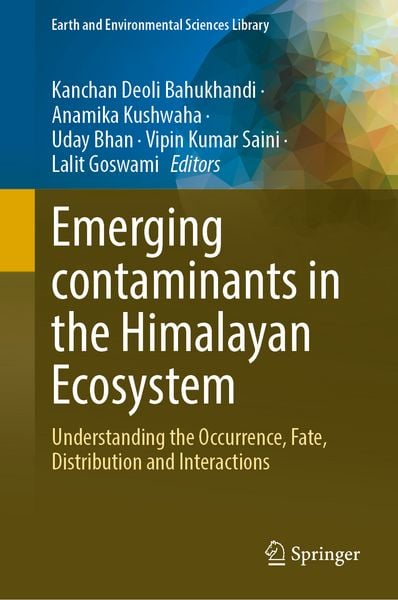
Produktbild: Emerging contaminants in the Himalayan Ecosystem
Vorbesteller Neu

Emerging contaminants in the Himalayan Ecosystem Understanding the Occurrence, Fate, Distribution and Interactions

157,99 €

inkl. gesetzl. MwSt., Versandkostenfrei


Beschreibung

Produktdetails

Einband

Gebundene Ausgabe

Erscheinungsdatum

25.08.2026

Abbildungen

VIII, 21 illus. in color., farbige Illustrationen

Herausgeber

Kanchan Deoli Bahukhandi + weitere

Verlag

Springer

Seitenzahl

208

Maße (L/B)

23,5/15,5 cm

Sprache

Englisch

ISBN

978-3-032-28371-9

Beschreibung

Portrait

Dr. Kanchan Deoli Bahukhandi is a Senior Associate Professor in the Sustainability Cluster at the School of Advanced Engineering, UPES, India. With over 25 years of experience, she specializes in environmental science, hydrogeochemistry, water pollution, microplastics, and solid waste management, particularly in Himalayan ecosystems. She holds a Ph.D. from the Wadia Institute of Himalayan Geology. Dr. Bahukhandi has published 85+ research papers, 35 book chapters, and 4 edited books. She has supervised 7 Ph.D. scholars and is guiding 5 more. She has led government-funded projects (DST, UCOST, ANRF) worth over INR 90 lakhs and serves as Associate Editor and reviewer for reputed international journals.


Dr. Anamika Kushwaha obtained her Ph.D. in Biotechnology from Motilal Nehru National Institute of Technology (MNNIT), Allahabad, India. She is currently serving as a Postdoctoral Fellow at Chungbuk National University, Republic of Korea. Her research expertise lies in environmental biotechnology, focusing on phyto- and bioremediation, biogeochemical analysis of heavy metals, plant–microbe–soil interactions, microplastics, resource recovery, and environmental microbiome studies. Dr. Kushwaha has made significant scholarly contributions through numerous peer-reviewed publications, book, and patents, reflecting the applied impact and innovation of her research work.


Dr. Uday Bhan did his Ph.D. in Earth Sciences in 2012. Currently, he serves as Professor in the Energy Cluster, School of Advance Engineering at UPES. Dr. Bhan specializes in organic geochemistry, groundwater chemistry, atmospheric pollution studies, and basin analysis. He has supervised 7 PhD including four Ph.D. scholars worked in the Himalayan region. His work also encompasses reservoir analysis, drilling fluids, and atmospheric pollutants. His contributions significantly advance research in environmental geosciences, energy resources, and sustainable development.


Dr. Vipin Kumar Saini is an Associate Professor of Environmental Chemistry at Doon University, India. He earned his PhD from Indian Institute of Technology Roorkee and completed postdoctoral research in Portugal. His research interests include functional porous materials for adsorption, catalysis, and sustainable environmental remediation.

Dr. Lalit Goswami is currently an Assistant Professor at Gachon University, Republic of Korea. He received his Ph.D. in The Environment from Indian Institute of Technology Guwahati, India. His research interest includes environmental biotechnology, bio-hydrogeochemistry, bio-inspired carbonaceous nano-materials, organic micropollutants, and resource recovery.

Produktdetails

Einband

Gebundene Ausgabe

Erscheinungsdatum

25.08.2026

Abbildungen

VIII, 21 illus. in color., farbige Illustrationen

Herausgeber

Verlag

Springer

Seitenzahl

208

Maße (L/B)

23,5/15,5 cm

Sprache

Englisch

ISBN

978-3-032-28371-9

Herstelleradresse

Libri GmbH
Europaallee 1
36244 Bad Hersfeld
DE

Email: gpsr@libri.de

Kundinnen und Kunden meinen

0 Bewertungen

Informationen zu Bewertungen

Zur Abgabe einer Bewertung ist eine Anmeldung im Konto notwendig. Die Authentizität der Bewertungen wird von uns nicht überprüft. Wir behalten uns vor, Bewertungstexte, die unseren Richtlinien widersprechen, entsprechend zu kürzen oder zu löschen.

Die Bewertungen sind nach Format, Anzahl Sterne und Datum sortiert.

Verfassen Sie die erste Bewertung zu diesem Artikel

Helfen Sie anderen Kund*innen durch Ihre Meinung

Kundinnen und Kunden meinen

0 Bewertungen filtern

  • Produktbild: Emerging contaminants in the Himalayan Ecosystem
  • Emerging Contaminants in Himalayan Water Bodies.- Emerging Organic Contaminants in the Himalayan Ganga River Basin: Sources, Transport, and Environmental Fate.- Emerging Contaminants in the Himalayas: Understanding Sources, Pathways, Ecotoxicological Impacts, Policies and Mitigation Strategies.- Health Risks and Ecotoxicological Impacts of Emerging Contaminants in the Himalayan Ecosystem.- Toxicological and Environmental Risks Imposed by Aerosols and Emerging Pollutants in the Himalayan Region.- Atmospheric transportation and deposition of Emerging Contaminants in Himalayan Region.- Characterization and Factors contributing Particulate Matter pollution over Himalayan Region.- Microplastics in the Himalayan glaciers, lakes and rivers: Sources, Occurrence, environmental impacts and future directions.- Per- and polyfluoroalkyl substances (PFAS) in the Himalayan cryosphere.- Predictive modelling of Organic micropollutants using machine learning algorithms & Remote Sensing in the Himalayan region.- Oscillating impacts of organic pollutants in the Ganga River Basin impedimenting conservation and SDGs.- Emerging contaminant as a threat to the Himalayan water sustainability.