KI-Beratung Beta

Gutscheinbedingungen

**Gültig bis 30.11.2026 auf Spielzeug, Schreibwaren, Filme, Geschenke & Trends, Musik, tolino eReader & Zubehör, Hörbücher und Hörbuch-Downloads, nicht preisgebundene Bücher und Kalender online auf thalia.at und in der Thalia App. Einzelne Artikel können ausgeschlossen sein. Aufgrund der Buchpreisbindung sind deutschsprachige Bücher und eBooks ausgenommen. Zusätzlich ausgenommen sind Abos & Flatrates, Games, Geschenkkarten/-boxen, Shelfies, Software, Zeitschriften sowie einzelne Artikel von tonies®. Pro Einkauf einmal einlösbar. Nur gültig mit im Onlineshop hinterlegter Bonuscard. Click & Collect nur bei Onlinevorabzahlung möglich. Keine Barauszahlung. Nicht kombinierbar mit anderen Aktionen und Gutscheinen. Gutschein wird auf max. 500€ Bestellwert angerechnet. Nicht gültig für Versandkosten und Services.

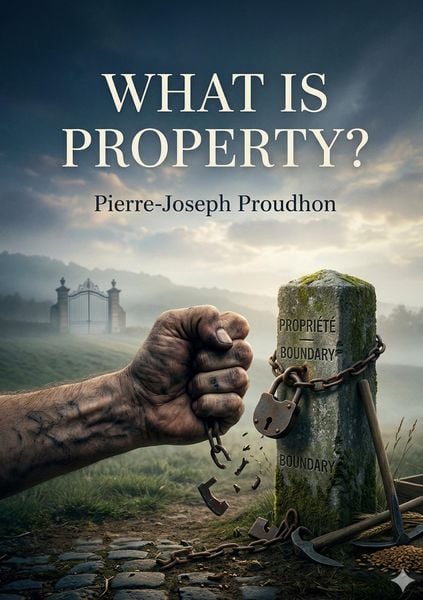
Produktbild: What Is Property?

What Is Property? by Pierre-Joseph Proudhon

26,99 €

inkl. gesetzl. MwSt., zzgl. Versandkosten


  • Kostenlose Lieferung ab 30 € Einkaufswert
  • Versandkostenfrei für Bonuscard-Kund*innen

Beschreibung

"Property is robbery!" This slogan coined by the French political philosopher Pierre-Joseph Proudhon is one of his answers to the titular question of his 1840 treatise, What Is Property? A fervent attack against the established order of capitalism and private property, the publication of What Is Property?...

Beschreibung

"Property is robbery!" This slogan coined by the French political philosopher Pierre-Joseph Proudhon is one of his answers to the titular question of his 1840 treatise, What Is Property? A fervent attack against the established order of capitalism and private property, the publication of What Is Property? almost immediately led to Proudhon's official prosecution and the revocation of Proudhon's scholarship by the Academy of Besançon. (Proudhon, an autodidact of humble origins who began his working life as a printer, relied on the scholarship for financial support.) Proudhon evaded the worst of the consequences thanks to the intervention of the economist Jérôme-Adolphe Blanqui, to whom the second memoir contained in the book is addressed.In this treatise, Proudhon contrasts the legitimate right to possession, in which individuals own the products of their labor and the necessary means of production, and the illegitimate right to property, the absolute right granted to proprietors by civil laws to "use and abuse." Proudhon examines the implications of the right to property and concludes that, among other things, property is "impossible," "homicide," and "the mother of tyranny." As an alternative to both the proprietary and communist systems of economic organization, Proudhon advances his anarchist economic theory of "mutualism," in which a socialist society would be organized based on free market exchanges wherein the value of a good or service is determined by the time and expense it has cost the laborer to produce.This edition of What Is Property? was translated in 1876 by Benjamin Tucker, who was a notable advocate of individualist anarchism in his own right in the United States.

Produktdetails

Einband

Taschenbuch

Erscheinungsdatum

08.04.2026

Verlag Culturea
Seitenzahl

554

Produktdetails

Einband

Taschenbuch

Erscheinungsdatum

08.04.2026

Verlag Culturea
Seitenzahl

554

Maße (L/B/H)

21/14,8/3 cm

Gewicht

708 g

Auflage

1. Tirage

Sprache

Englisch

ISBN

979-10-431-4649-7

Herstelleradresse


Email: info@bod.de

Noch keine Bewertungen vorhanden

Verfassen Sie die erste Bewertung zu diesem Artikel

Helfen Sie anderen Kundinnen und Kunden durch Ihre Meinung.

Kundinnen und Kunden meinen

Bewertungen (0)

Weitere Artikel finden Sie in

  • Produktbild: What Is Property?