KI-Beratung Beta

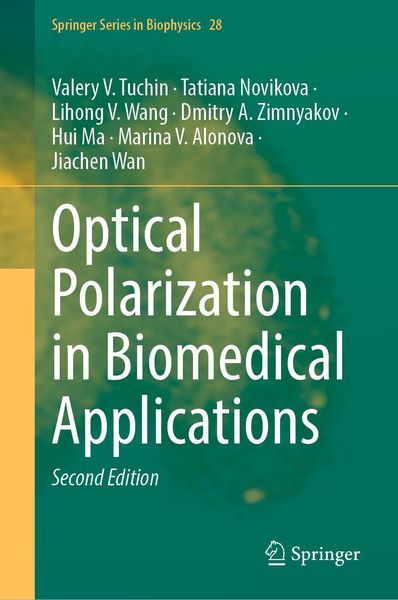
Produktbild: Optical Polarization in Biomedical Applications

Optical Polarization in Biomedical Applications

  • Form:Einzelkauf Download
  • Sprache:Englisch

186,99 €

inkl. gesetzl. MwSt.

Beschreibung

The second edition of the book published by Springer in 2006, Optical Polarization in Biomedical Applications concerns the optical methods exploring a unique feature of light -its polarization-for quantitative tissue characterization. The new edition will introduce new topics and expand on existing,...

Beschreibung

The second edition of the book published by Springer in 2006, Optical Polarization in Biomedical Applications concerns the optical methods exploring a unique feature of light -its polarization-for quantitative tissue characterization. The new edition will introduce new topics and expand on existing, cutting-edge developments in this field. Particular attention is paid to recent theoretical and instrumental advances in Mueller polarimetry and their potential clinical applications, a discussion of the principles and concepts of optical tissue clearing, orbital angular momentum, and quantum entangled photons in tissue polarization optics, polarization encoding and symbolic mapping of DNA sequences, and machine learning for pathology signature extraction.

Some polarization-sensitive optical methods have already found clinical application, while others are still in the research phase but could become breakthrough technologies in various medical fields in the near future. Recent developments in Stokes-Muller polarimetry have led to extensive ex vivo and in vivo studies of various tissues. Important advances have been made in the field of matrix Mueller algebra for post-processing of diagnostic data, in the extension of the polarization Monte Carlo method to the study of scattering anisotropic media for the purpose of simulating the interaction of polarized light with tissue, and in the search for optimal optical markers for certain types of pathologies. These results are of interest to optical engineers, researchers, students, and clinicians seeking new, revolutionary approaches to solving diagnostic problems by assessing the presence of microstructural features to determine tissue integrity and in the development of new polarimetric technologies.

Produktdetails

Format

PDF

Kopierschutz

Nein

Family Sharing

Nein

Text-to-Speech

Nein

Produktdetails

Format

PDF

Format

eBooks im PDF-Format haben eine festgelegte Seitengröße und eignen sich daher nur bedingt zum Lesen auf einem tolino eReader oder Smartphone. Für den vollen Lesegenuss empfehlen wir Ihnen bei PDF-eBooks die Verwendung eines Tablets oder Computers.

Kopierschutz

Nein

Kopierschutz

Dieses eBook können Sie uneingeschränkt auf allen Geräten der tolino Familie, allen sonstigen eReadern und am PC lesen. Das eBook ist nicht kopiergeschützt und kann ein personalisiertes Wasserzeichen enthalten. Weitere Hinweise zum Lesen von eBooks mit einem personalisierten Wasserzeichen finden Sie unter Hilfe/Downloads.

Family Sharing

Nein

Family Sharing

Mit Family Sharing können Sie eBooks innerhalb Ihrer Familie (max. sechs Mitglieder im gleichen Haushalt) teilen. Sie entscheiden selbst, welches Buch Sie mit welchem Familienmitglied teilen möchten. Auch das parallele Lesen durch verschiedene Familienmitglieder ist durch Family Sharing möglich. Um eBooks zu teilen oder geteilt zu bekommen, muss jedes Familienmitglied ein Konto bei Thalia oder einem anderen tolino-Buchhändler haben. Weitere Informationen finden Sie unter Hilfe/Family-Sharing.

Text-to-Speech

Nein

Text-to-Speech

Bedeutet Ihnen Stimme mehr als Text? Mit der Funktion Text-to-Speech können Sie sich im tolino webReader und in der aktuellen Thalia – Lesen & Hören App das eBook vorlesen lassen. Weitere Informationen finden Sie unter Hilfe/Text-to-Speech.

Erscheinungsdatum

15.04.2026

Verlag Springer
Seitenzahl

429 (Printausgabe)

Dateigröße

34942 KB

Auflage

Second Edition 2026

Sprache

Englisch

EAN

9783032160737

Barrierefreiheit
  • alle zum Verständnis notwendigen Inhalte sind über Screenreader zugänglich
  • navigierbares Inhaltsverzeichnis
  • logische Lesereihenfolge eingehalten
  • kurze Alternativtexte (z.B. für Abbildungen) vorhanden
  • hoher Kontrast zwischen Text und Hintergrund
  • entspricht der Vorgabe Barrierefreiheit PDF / UA 1
  • nicht oder eingeschränkt barrierefrei
  • keine Vorlesefunktionen des Lesesystems deaktiviert
  • Inhalt auch ohne Farbwahrnehmung verständlich dargestellt
  • Navigation über vorher / nachher Elemente

Noch keine Bewertungen vorhanden

Verfassen Sie die erste Bewertung zu diesem Artikel

Helfen Sie anderen Kundinnen und Kunden durch Ihre Meinung.

Kundinnen und Kunden meinen

Bewertungen (0)

Weitere Artikel finden Sie in

  • Produktbild: Optical Polarization in Biomedical Applications