KI-Beratung Beta

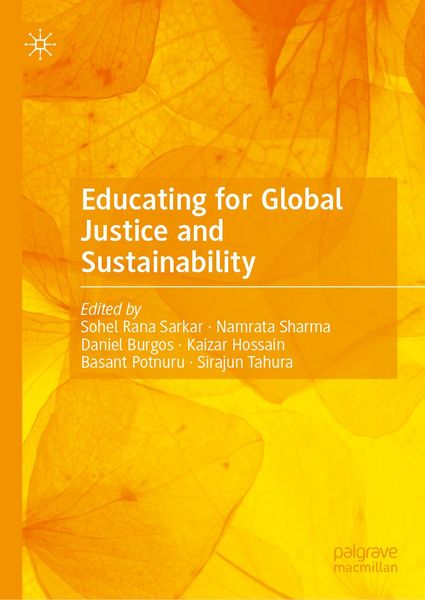
Produktbild: Educating for Global Justice and Sustainability
Vorbesteller Neu

Educating for Global Justice and Sustainability

186,99 €

inkl. gesetzl. MwSt., Versandkostenfrei


Beschreibung

This volume places education at the center of today's accelerating global polycrisis. Moving beyond disciplinary silos, it introduces an "Integrated Triadic Focus," positioning education as a transformative force in addressing climate change, forced migration, and systemic inequality. Bringing together...

Beschreibung

This volume places education at the center of today's accelerating global polycrisis. Moving beyond disciplinary silos, it introduces an "Integrated Triadic Focus," positioning education as a transformative force in addressing climate change, forced migration, and systemic inequality. Bringing together leading international scholars, the book delivers a rigorous, multidisciplinary synthesis across theory, lived realities of displacement, indigenous knowledge, and global governance. It challenges Eurocentric paradigms, interrogates institutions such as UNESCO and UNHCR, and advances justice-centered frameworks aligned with the United Nations Sustainable Development Goals.

Portrait

Sohel Rana Sarkar is Assistant Professor and Head of the Department of Education at Hingalganj Mahavidyalaya, affiliated with West Bengal State University, India.

Namrata Sharma is a faculty member at the State University of New York, USA, and the author of Value-Creating Global Citizenship Education for Sustainable Development.

Daniel Burgos is the Vice-Rector for International Research at Universidad Internacional de La Rioja (UNIR), Spain.

Kaizar Hossain is Assistant Professor in the Department of Environmental Science at Asutosh College, affiliated with the University of Calcutta, West Bengal, India.

Basant Potnuru is Professor and Chair of Economics and Business Policy at the FORE School of Management, New Delhi, India.

Sirajun Tahura is a PhD Scholar in Education in the Department of Education at Alagappa University, India.

Produktdetails

Einband

Gebundene Ausgabe

Erscheinungsdatum

23.12.2026

Abbildungen

XXVIII, 394 p. 21 illus.

Herausgeber Sohel Rana Sarkar + weitere

Produktdetails

Einband

Gebundene Ausgabe

Erscheinungsdatum

23.12.2026

Abbildungen

XXVIII, 394 p. 21 illus.

Herausgeber
Verlag Springer
Seitenzahl

394

Maße (L/B)

21/14,8 cm

Sprache

Englisch

ISBN

978-3-032-27392-5

Herstelleradresse

Libri GmbH
Europaallee 1
36244 Bad Hersfeld
DE

Email: gpsr@libri.de

Noch keine Bewertungen vorhanden

Verfassen Sie die erste Bewertung zu diesem Artikel

Helfen Sie anderen Kundinnen und Kunden durch Ihre Meinung.

Kundinnen und Kunden meinen

Bewertungen (0)

  • Produktbild: Educating for Global Justice and Sustainability
  • Part I Theoretical Foundations: Reframing Justice Through Education, Environment, and Migration.- Chapter 1. Climate Migration as an Adaptation Strategy Through Decolonial Theory and Environmental Justice Perspectives.- Chapter 2. Dark Pedagogy in the Anthropocene: A Speculative Realism.- Chapter 3. Reflecting on Climate Change Education in Indonesia: A Freirean Ecopedagogy.- Chapter 4. Interdisciplinarity as Method and Mandate: Re-Mapping Education in an Era of Climate Displacement.- Part II Displacement, Inequality, and Educational Exclusion in the Climate Crisis.- Chapter 5. Disrupted Learning in a Drowning World: Climate-Induced Migration and Educational Marginalization in South Asia.- Chapter 6. From Crisis Inequities to Ethical Capital: Gendered Learning Ecologies and Workplace Inclusion.- Chapter 7. Interdisciplinary Pathways for Sustainability and Social Inclusion: A STEAM-Based Model for Refugee Education.- Part III Community Knowledge, Indigenous Learning, and Resilience.- Chapter 8. Songs of the Land: Rural Music, Epistemic Justice, and Critical Environmental Education in the Global South.- Chapter 9. Youth Climate Mobilizations as Epistemic Infrastructures for Civic Scientific Learning in the Global South: Protest Praxeologies, Curriculum, and Assessment Architectures.- Chapter 10. Mapping Global Research on Informal Education in Transitional and Mobile Learning Spaces: A Bibliometric Analysis.- Part IV Governance, Innovation, and Global Futures of Education.- Chapter 11. Justice for Whom in Response to Climate Change?.- Chapter 12. When Technology Meets Constraint: Deconstructing Techno-Solutionism in EdTech for Displaced and Climate-Affected Learners.- Chapter 13. Transnational Governance of Migration, Climate, and Education: Institutions and Injustice.