KI-Beratung Beta

Gutscheinbedingungen

**Gültig bis 30.11.2026 auf Spielzeug, Schreibwaren, Filme, Geschenke & Trends, Musik, tolino eReader & Zubehör, Hörbücher und Hörbuch-Downloads, nicht preisgebundene Bücher und Kalender online auf thalia.at und in der Thalia App. Einzelne Artikel können ausgeschlossen sein. Aufgrund der Buchpreisbindung sind deutschsprachige Bücher und eBooks ausgenommen. Zusätzlich ausgenommen sind Abos & Flatrates, Games, Geschenkkarten/-boxen, Shelfies, Software, Zeitschriften sowie einzelne Artikel von tonies®. Pro Einkauf einmal einlösbar. Nur gültig mit im Onlineshop hinterlegter Bonuscard. Click & Collect nur bei Onlinevorabzahlung möglich. Keine Barauszahlung. Nicht kombinierbar mit anderen Aktionen und Gutscheinen. Gutschein wird auf max. 500€ Bestellwert angerechnet. Nicht gültig für Versandkosten und Services.

Produktbild: Crop Breeding for Rainfed Agricultural Systems
Vorbesteller Neu

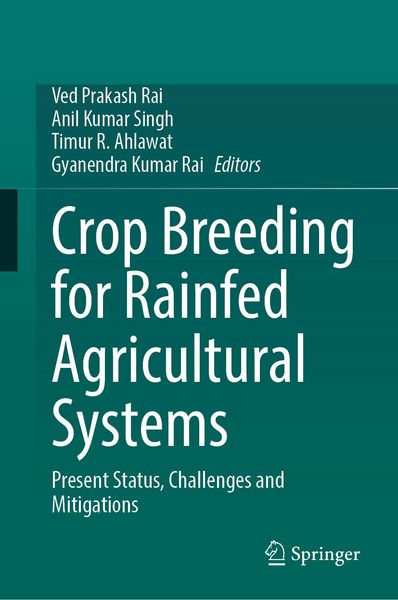
Crop Breeding for Rainfed Agricultural Systems Present Status, Challenges and Mitigations

219,99 €

inkl. gesetzl. MwSt., Versandkostenfrei


Beschreibung

This contributed volume provides insights into crop breeding strategies tailored for rainfed agricultural systems, focusing on past successes, future challenges, and effective mitigation strategies.

Rainfed agriculture accounts for nearly 80% of the world's cultivated land. With one-third of the developing...

Beschreibung

This contributed volume provides insights into crop breeding strategies tailored for rainfed agricultural systems, focusing on past successes, future challenges, and effective mitigation strategies.

Rainfed agriculture accounts for nearly 80% of the world's cultivated land. With one-third of the developing world's population residing in these rainfed regions, enhancing the adaptability and resilience of rainfed crops is crucial to maintain consistent productivity under changing climate scenarios. In India specifically, where rainfed agriculture occupies 60% of the agricultural area, it serves as a major source of sustenance for a significant portion of the population, particularly those living in poverty. Therefore, it is necessary to reassess and discuss the achievements, breeding methodologies, and biotechnological advancements to find ways to better adapt rainfed crops for upcoming climate change. This book consolidates knowledge, methodologies, and innovations essential for enhancing the resilience of crops to varying climatic conditions. Each chapter delves into specific aspects of rainfed crop breeding, covering topics such as pre-breeding approaches, conventional breeding methods, mutation breeding, molecular breeding techniques, genomics-assisted breeding, epigenetics, speed breeding for accelerated crop improvement, functional genomics, genetic engineering, proteomics, miRNA-mediated engineering, genome editing, drought stress signaling responses, phenomics combined with artificial intelligence, and genomic selection.

It serves as a valuable resource for students, researchers, practitioners and policymakers involved in promoting resilient and sustainable agriculture in rainfed regions worldwide.

Portrait

Ved Prakash Rai is currently working as Senior Scientist at ICAR-National Institute of Seed Science and Technology, Mau, India. He completed his doctoral research at the Department of Genetics and Plant Breeding, Institute of Agricultural Sciences, Banaras Hindu University, Varanasi, India. He has 15 years of research experience in the area of molecular breeding for biotic and abiotic stresses in pepper, rice, wheat, sorghum, and pulse crops. Presently, he is working on breeding for seed quality improvement in pulses and cereal crops suitable for climate-resilient agricultural systems. He has successfully completed five externally funded research projects. He has published over 35 research articles in international and national journals. He has been awarded a Young Scientist - Start up Research Grant from SERB-DST, New Delhi, and was conferred “Young Scientist Award” from Bioved Research Society, Allahabad, India in 2015 and “Excellence in Research” award from Society for Scientific Development in Agriculture and Technology, Meerut, India, in 2023. He is a life member of various scientific societies such as Indian Society of Genetics and Plant Breeding, Indian Society of Vegetable Science, and Gujarat Society of Genetics and Plant Breeding. 

Dr. Anil Kumar Singh is currently working at Department of Genetics and Plant Breeding, Institute of Agricultural Sciences, Banaras Hindu University, Varanasi, Uttar Pradesh, India. Dr. Singh is working as a plant breeder in ICAR sponsored 02 pulse improvement projects at country level. His research is mainly focused on biotic and abiotic stress tolerance. Dr. Singh has published more than 50 research articles in journals of national and international repute. He has successfully completed 07 externally funded research projects and has been conferred with many awards in academic excellence including 02 gold medals during post-graduation, “Young Scientist of the Year 2015” by International Foundation for Environment and Ecology, Kolkata, India and “Young Scientist Associate Award- 2016” by Bioved Research Institute of Agriculture, Technology and Sciences, Allahabad, India.

Dr. Timur R. Ahlawat is currently working as Professor at Department of Horticulture, ASPEE College of Horticulture; and Director of Research, Navsari Agricultural University, Navsari, Gujarat, India. Dr. Ahlawat has completed his doctoral research from Anand Agricultural University, Anand, India. He has more than 17 years of teaching and 20 years of research experience in the area fruit and vegetable production. He has published more than 60 research articles in journals of national and international repute edited three books on Horticulture and authored 23 book chapters. He has successfully completed three externally funded research projects. Dr. Ahlawat conferred with the fellowship of Confederation of Horticulture Associations of India, New Delhi in 2014; Best teacher a     ward of Navsari Agricultural University in 2015, and Bir Singh Aasi Memorial Award in 2015.

Dr. Gyanendra Kumar Rai is working as Professor at School of Biotechnology, Sher-e-Kashmir University of Agricultural Sciences and Technology of Jammu. He is Post Graduate in Biochemistry from University of Allahabad, Allahabad and D. Phil. from University of Allahabad, India. He has over 20 years research and 15 years teaching experience and his work focused on Abiotic stress tolerance mechanism in crop plants. Dr. Rai awarded as young scientist associate award, Vimla Devi medal and Fellow Award from Society of Applied Biotechnology. Dr. Rai completed and conducted many research projects as a PI or Co PI. Dr. Rai has ninety-five research papers in international and national reputed journals, forty-one book chapters published in reference book, training manual and compendium and fifty-three popular articles published in various science magazines.
Produktdetails

Einband

Gebundene Ausgabe

Erscheinungsdatum

24.12.2026

Abbildungen

XIII, 333 p. 17 illus., 14 illus. in color.

Herausgeber Ved Prakash Rai + weitere

Produktdetails

Einband

Gebundene Ausgabe

Erscheinungsdatum

24.12.2026

Abbildungen

XIII, 333 p. 17 illus., 14 illus. in color.

Herausgeber
Verlag Springer Singapore
Seitenzahl

333

Maße (L/B)

23,5/15,5 cm

Sprache

Englisch

ISBN

978-981-9212-10-1

Herstelleradresse

Libri GmbH
Europaallee 1
36244 Bad Hersfeld
DE

Email: gpsr@libri.de

Noch keine Bewertungen vorhanden

Verfassen Sie die erste Bewertung zu diesem Artikel

Helfen Sie anderen Kundinnen und Kunden durch Ihre Meinung.

Kundinnen und Kunden meinen

Bewertungen (0)

  • Produktbild: Crop Breeding for Rainfed Agricultural Systems
  • Chapter 1: Rainfed Crop Breeding-Problems and Prospects.- Chapter 2: Integrated Prebreeding Research Strategies in Rainfed Agriculture for Sustainable Productivity.- Chapter 3: Mutation Breeding in Rainfed Crops.- Chapter 4: Empowering Rainfed Agriculture Genomics-Assisted Breeding for Resilience and Productivity.- Chapter 5: Speed breeding for accelerated rainfed crop breeding.- Chapter 6: Advancing Functional Genomics in Rainfed Crops Current Insights and Future Direction.- Chapter 7: Tailoring Crops for Rainfed Environments.- Chapter 8: CRISPR-Driven Genome Editing for Resilient Rainfed Crops Paving the Way for Climate-Ready Agriculture.- Chapter 9: miRNA-Mediated Engineering For Crop Improvement.- Chapter 10:Proteomics: a tool for crop assessment in rainfed agricultural ecosystems.- Chapter 11:An Insight into Drought Stress Signaling Responses in Higher Plants.- Chapter 12:Optimizing Rainfed Crop Management with Artificial Intelligence.- Chapter 13:Revolutionizing Rainfed Crop Breeding-The Promise of Genomic Selection            

    .- Chapter 14:Phenomics and Artificial Intelligence in Enhancing Rainfed Crop Resilience.