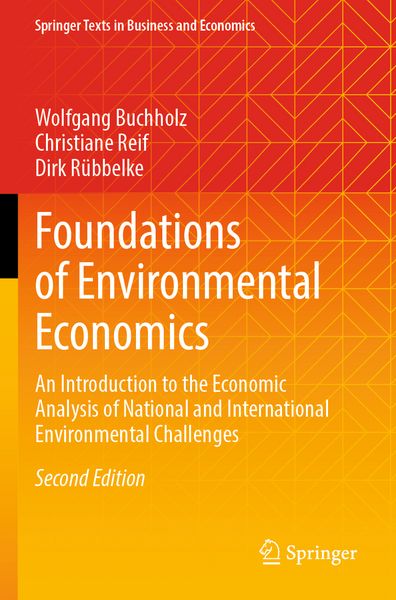
Foundations of Environmental Economics An Introduction to the Economic Analysis of National and International Environmental Challenges
-
- Hardcover
- Taschenbuch ausgewählt
- eBook
-
Sprache:Englisch
49,99 €
inkl. gesetzl. MwSt.,
Beschreibung
Produktdetails
Einband
Taschenbuch
Erscheinungsdatum
25.12.2025
Abbildungen
XV, 256 p. 57 illus., 27 illus. in color.
Verlag
SpringerSeitenzahl
256
Maße (L/B/H)
23,5/15,5/1,5 cm
Gewicht
417 g
Auflage
Second Edition 2024
Sprache
Englisch
ISBN
978-3-031-63483-3
This textbook provides a solid introduction to the theoretical and empirical aspects of environmental economics and their links to environmental policy. In this second edition, all chapters have been updated and restructured, and new sections have been added to reflect a greater focus on climate policy.
Starting from the need to balance the social costs of pollution against the financial costs of emission abatement, the book discusses the major issues that arise in the context of environmental policy – such as the potential and limitations of monetary valuation of the environment (and in particular the contingent valuation method) and the design of environmental policy. With regard to the choice of environmental policy instruments, the book focuses on the price-based instruments preferred by economists, i.e., environmental taxes and emissions trading, discussing in detail not only their many advantages but also their drawbacks.
The second edition especially focuses on green industrial policy as a complementary measure to price-based instruments, the distributional effects of environmental policies, and the resulting challenges for political feasibility. Moreover, the book deals extensively with international environmental problems, in particular climate protection, which is a global public good that will be underprovided when certain countries refuse to cooperate and contribute. Approaches to overcoming this underprovision are described in far more detail than in the first edition, both theoretically and empirically – in particular by assessing the functions of the many international environmental agreements in this field. Finally, a new chapter considers adaptation strategies, especially in the water sector, as an additional pillar of climate policy.
Noch keine Bewertungen vorhanden
Verfassen Sie die erste Bewertung zu diesem Artikel
Helfen Sie anderen Kundinnen und Kunden durch Ihre Meinung.
Kurze Frage zu unserer Seite
Vielen Dank für Ihr Feedback
Wir nutzen Ihr Feedback, um unsere Produktseiten zu verbessern. Bitte haben Sie Verständnis, dass wir Ihnen keine Rückmeldung geben können. Falls Sie Kontakt mit uns aufnehmen möchten, können Sie sich aber gerne an unseren Kund*innenservice wenden.
zum Kundenservice