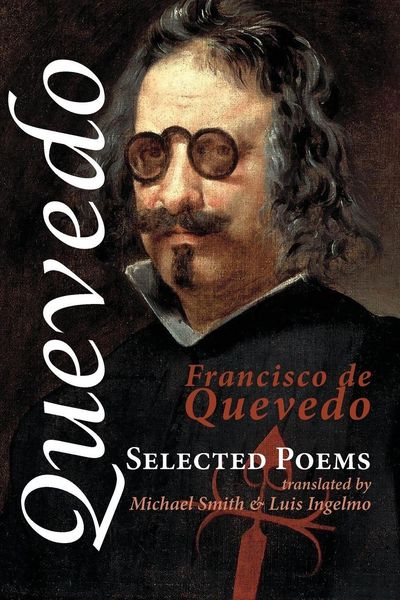
Selected Poems
-
- Englisch ausgewählt
25,99 €
inkl. gesetzl. MwSt.,
- Kostenlose Lieferung ab 30 € Einkaufswert
- Versandkostenfrei für Bonuscard-Kund*innen
Beschreibung
Produktdetails
Einband
Taschenbuch
Erscheinungsdatum
17.04.2026
Verlag
Shearsman BooksSeitenzahl
214
Maße (L/B/H)
22,9/15,2/1,3 cm
Gewicht
355 g
Sprache
Englisch
ISBN
978-1-83738-016-9
Francisco Gómez de Quevedo y Santibáñez Villegas (1580-1645), was a nobleman, whose parents were both at the royal court, and one of the most important poets of Spain's literary golden age, the siglo de oro. Quevedo was lame, had deformed feet, and was also overweight and shortsighted, but took refuge in books as a student in the Jesuit school in Madrid. In 1596 he went on to study at the University of Alcalá de Henares, after which he studied theology in Valladolid. He was already well-known as a poet by this time, and went on to establish a formidable reputation as both poet and novelist. He was a disputatious character, and engaged in many a public battle of words with his main poetic rival, Góngora, as well as with Alarcón and Pérez de Montalbán, all of whom were to feel the impact of Quevedo's bile. It must be admitted however, that Góngora, at least, repaid him with equal (verbal) measure. Quevedo was involved in a conspiracy in Venice in 1618, after which he was put under house arrest. In 1620, he was exiled, following the death of his patron, but he was pardoned when Philip IV came to the throne. Quevedo accompanied the young King on some of his journeys, but fell afoul of the Inquisition when some of his satiric verses were printed without permission. His private life seems to have been somewhat disordered, and Góngora accused him in a satire of being a drunk, referring to him as Francisco de Quebebó (i.e. Francis WhatamIdrinking). He was to be constantly involved in controversies, both political and literary, and incurred the wrath of the Count-Duke of Olivares, the most powerful nobleman in Spain, through his criticism of the government. This led to his imprisonment in León for four years from 1639. He died two years after his release. His oeuvre offers a bewildering range: theological works, literary and critical commentaries, satires, and novels. His poetry fills over a thousand pages in modern editions, and he is without doubt one of the great literary figures of his age.
Noch keine Bewertungen vorhanden
Verfassen Sie die erste Bewertung zu diesem Artikel
Helfen Sie anderen Kundinnen und Kunden durch Ihre Meinung.
Kurze Frage zu unserer Seite
Vielen Dank für Ihr Feedback
Wir nutzen Ihr Feedback, um unsere Produktseiten zu verbessern. Bitte haben Sie Verständnis, dass wir Ihnen keine Rückmeldung geben können. Falls Sie Kontakt mit uns aufnehmen möchten, können Sie sich aber gerne an unseren Kund*innenservice wenden.
zum Kundenservice