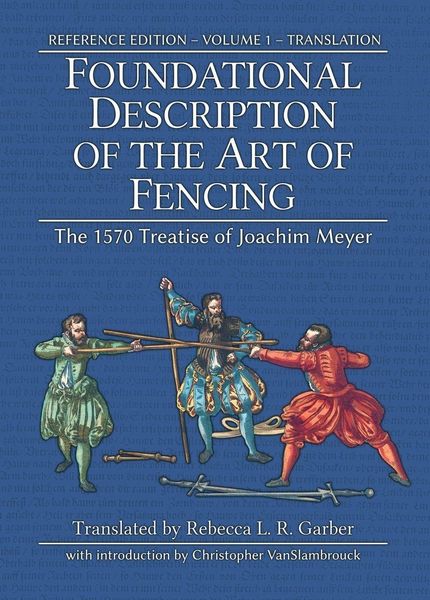
Foundational Description of the Art of Fencing The 1570 Treatise of Joachim Meyer (Reference Edition Vol. 1)
-
- Englisch ausgewählt
69,99 €
inkl. gesetzl. MwSt.,
Beschreibung
Produktdetails
Einband
Gebundene Ausgabe
Erscheinungsdatum
24.12.2023
Herausgeber
Michael ChidesterVerlag
HEMA BookshelfSeitenzahl
514
Maße (L/B/H)
28,5/21,5/3,2 cm
Gewicht
1411 g
Sprache
Englisch
ISBN
978-1-953683-30-4
In his short life, master cutler and Freifechter Joachim Meyer appears to have had quite a successful career as a fencing master, teaching craftsmen and noblemen alike while also authoring at least four different fencing treatises (and possibly more). His works became renowned far outside of his own nation and were copied by other authors for over a hundred years after his death. This book contains Dr. Rebecca Garber's entirely new translation of Meyer's longest and most developed treatise, Foundational Description of the Free, Knightly, and Noble Art of Fencing, published in 1570. It teaches complex and sophisticated methods for using all the typical weapons of his day, beginning with the two-handed sword prized by the tradition of Johannes Liechtenauer, then showing how traditional German fencing should be applied to the eastern European dusack and the Mediterranean rapier which had become popular as sidearms, and finally covering the dagger and polearms that were commonly used in the militias of the Imperial Free Cities. To aid in the study of this important work, it has been separated into two volumes. In Volume 1, Michael Chidester's transcription of the original German text is included alongside the translation, and hundreds of footnotes have been added throughout. In addition, Christopher VanSlambrouck provides an exhaustive introduction to Meyer and the world that he inhabited. In Volume 2, the 62 elaborate Figures created by the workshop of Hans Christoph Stimmer are printed in two different formats-a set that were lavishly painted in 1574, and a black and white set with the backgrounds removed for clarity-along with compilations of all references to each Figure in the text. The illustrations from the München, Lund, and Rostock manuscripts are also included in appendices for reference, and an introduction by Michael Chidester describes Meyer's book itself and the process of creating books in the 16th century. This book will prove to be an important resource for any student of medieval or early modern fencing.
Noch keine Bewertungen vorhanden
Verfassen Sie die erste Bewertung zu diesem Artikel
Helfen Sie anderen Kundinnen und Kunden durch Ihre Meinung.
Kurze Frage zu unserer Seite
Vielen Dank für Ihr Feedback
Wir nutzen Ihr Feedback, um unsere Produktseiten zu verbessern. Bitte haben Sie Verständnis, dass wir Ihnen keine Rückmeldung geben können. Falls Sie Kontakt mit uns aufnehmen möchten, können Sie sich aber gerne an unseren Kund*innenservice wenden.
zum Kundenservice