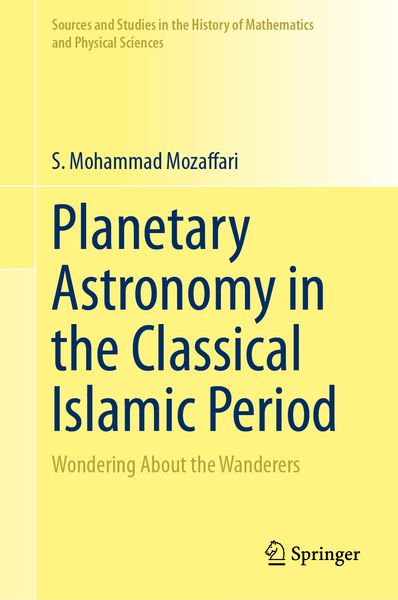
Planetary Astronomy in the Classical Islamic Period Wondering About the Wanderers
-
- Englisch ausgewählt
169,99 €
inkl. gesetzl. MwSt.,
Beschreibung
Produktdetails
Einband
Gebundene Ausgabe
Erscheinungsdatum
04.07.2026
Abbildungen
XIII, 287 p. 2 illus. in color.
Verlag
SpringerSeitenzahl
287
Maße (L/B)
23,5/15,5 cm
Sprache
Englisch
ISBN
978-3-032-27141-9
This book provides the first comprehensive analysis of planetary observations preserved in Ibn Yūnus's (d. 1009 CE)
Ḥākimī zīj
, a unique treasure from the classical period of Islamic astronomy (9th -10th centuries). It offers readers a detailed reconstruction of how medieval astronomers observed, tested, and refined quantitative planetary theories developed on the basis of Ptolemaic models, revealing the dynamic interplay between empirical practice and theoretical innovation.
The study focuses on the observational records of Ḥabash, al-Māhānī, Ibn Yūnus, and the Banū Amājūr family, situating them within the broader intellectual tradition of early Islamic astronomy. By examining these selective but invaluable reports, the book demonstrates how astronomers used conjunctions, appulses, and occultations to evaluate the accuracy of planetary theories and to propose corrective strategies to refine them. The analysis is broadened to include other prominent figures, such as Battānī, Ibn al-Aʿlam, Kūshyār, and Bīrūnī, in order to assess whether and in what manner their theories were contingent upon observational activities and empirical methodologies.
The main topics include: the methodological link between observation and theory in Islamic astronomy; technical reconstructions of sky configurations to assess visibility, precision, and instrument capability; the identification of anomalies in Ptolemaic planetary models and the corrective strategies (
istidrāk
/
taṣḥīḥ
) devised by Islamic astronomers; and the transformation of tools—from printed ephemerides to modern sky-simulation software—that now allow scholars to revisit ancient records with clarity.
These topics are important and relevant because they challenge the prevailing narrative of Islamic astronomy. The evidence shows a vibrant culture of empirical testing, methodological innovation, and theoretical refinement. The book highlights how Islamic astronomers recognized deep-seated deficiencies in Ptolemaic models and developed heuristic remedies, anticipating later scientific transformations.
Historians of science, scholars of Islamic intellectual history, astronomers interested in the evolution of observational practice, and early-career researchers seeking methodological clarity in the study of historical astronomy will find great value in this text.
Noch keine Bewertungen vorhanden
Verfassen Sie die erste Bewertung zu diesem Artikel
Helfen Sie anderen Kundinnen und Kunden durch Ihre Meinung.
Kurze Frage zu unserer Seite
Vielen Dank für Ihr Feedback
Wir nutzen Ihr Feedback, um unsere Produktseiten zu verbessern. Bitte haben Sie Verständnis, dass wir Ihnen keine Rückmeldung geben können. Falls Sie Kontakt mit uns aufnehmen möchten, können Sie sich aber gerne an unseren Kund*innenservice wenden.
zum Kundenservice