Gutscheinbedingungen

**Gültig bis 06.07.2026 auf fremdsprachige Bücher online auf thalia.at, in der Thalia App ab einem Mindestbestellwert von 30€ und in allen Thalia Buchhandlungen in Österreich. In den Buchhandlungen nur gültig auf lagernde Ware. Einzelne Artikel können ausgeschlossen sein. Ausgenommen sind preisgebundene Artikel & eBooks. Pro Einkauf einmal einlösbar. Nur gültig gegen Vorlage oder im Onlineshop hinterlegter Bonuscard. Infos zur Einlösung in der Buchhandlung sind auf der Bonuscard-Vorteilspreisseite zu finden. Click & Collect nur bei Onlinevorabzahlung möglich. Keine Einlösung bei Scan & Go-Bezahlung. Keine Barauszahlung. Nicht kombinierbar mit anderen Aktionen und Gutscheinen. Gutschein wird auf max. 500€ Bestellwert angerechnet. Nicht gültig für Versandkosten und Services.

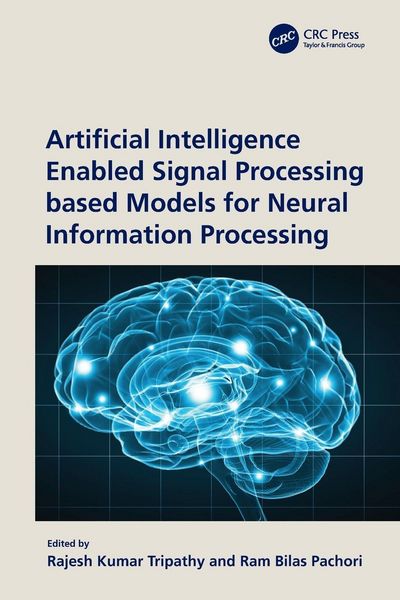
Produktbild: Artificial Intelligence Enabled Signal Processing based Models for Neural Information Processing

Artificial Intelligence Enabled Signal Processing based Models for Neural Information Processing

79,99 €

inkl. gesetzl. MwSt., Versandkostenfrei


Beschreibung

Produktdetails

Einband

Taschenbuch

Erscheinungsdatum

22.05.2026

Abbildungen

schwarz-weiss Illustrationen, Raster, schwarz-weiss, Zeichnungen, schwarz-weiss, Tabellen, schwarz-weiss

Herausgeber

Rajesh Kumar Tripathy + weitere

Verlag

Taylor and Francis

Seitenzahl

210

Maße (L/B/H)

23,4/15,6/1,2 cm

Gewicht

420 g

Sprache

Englisch

ISBN

978-1-03-276765-9

Beschreibung

Portrait

Rajesh Kumar Tripathy received a B.Tech degree in Electronics and Telecommunication Engineering from the Biju Patnaik University of Technology (BPUT), Odisha, India, in 2009; and the M.Tech degree in Biomedical Engineering from the National Institute of Technology (NIT) Rourkela, Rourkela, India, in 2013; and a Ph.D. degree in machine learning for biomedical signal processing from the Indian Institute of Technology (IIT) Guwahati, Guwahati, India in 2017. He worked as an Assistant Professor at the Faculty of Engineering and Technology (FET), Siksha `O' Anusandhan Deemed to be University from March 2017 to June 2018. Since July 2018, he has worked as an Assistant Professor in the Department of Electrical and Electronics Engineering (EEE), Birla Institute of Technology and Science (BITS), Pilani, Hyderabad Campus. His research interests are machine learning, deep learning, biomedical signal processing, sensor data processing, medical image processing, and the Internet of Things (IoT) for healthcare. He has published research papers in reputed international journals and conferences. He has served as a reviewer for more than 15 scientific journals and served as a technical program committee (TPC) member in various national and international conferences. He is an associate editor for IEEE Access and Frontier in Physiology journals.

Ram Bilas Pachori received a B.E. degree with honours in electronics and communication engineering from Rajiv Gandhi Technological University, Bhopal, India, in 2001, and M.Tech. and Ph.D. degrees in electrical engineering from IIT Kanpur, India, in 2003 and 2008, respectively. Before joining the IIT Indore, India, faculty, he was a postdoctoral fellow at the Charles Delaunay Institute, University of Technology of Troyes, France (2007-2008) and an Assistant Professor at the Communication Research Center, International Institute of Information Technology, Hyderabad, India (2008-2009). He was an assistant professor (2009-2013) and an associate professor (2013-2017) at the Department of Electrical Engineering, IIT Indore, where he has now been a Professor since 2017. He is also associated with the Center for Advanced Electronics, IIT Indore. He was a visiting professor at the Department of Computer Engineering, Modeling, Electronics and Systems Engineering, University of Calabria, Rende, Italy, in July 2023; Faculty of Information & Communication Technology, University of Malta, Malta, from June 2023 to July 2023; Neural Dynamics of Visual Cognition Lab, Free University of Berlin, Germany, from July 2022 to September 2022; School of Medicine, Faculty of Health and Medical Sciences, Taylor's University, Malaysia, from 2018 to 2019. Previously, he was a Visiting Scholar at the Intelligent Systems Research Center, Ulster University, Londonderry, UK, in December 2014. His research interests include signal and image processing, biomedical signal processing, non-stationary signal processing, speech signal processing, brain-computer interface, machine learning, and artificial intelligence and the Internet of Things in health care. He is an Associate Editor of Electronics Letters, IEEE Transactions on Neural Systems and Rehabilitation Engineering, and Biomedical Signal Processing and Control, and an Editor of IETE Technical Review. He is a Fellow of IETE, IEI, and IET. He has 307 publications: journal articles (189), conference papers (82), books (10), and book chapters (26). He has also eight patents, including one Australian patent (granted) and seven Indian patents (published). His publications have been cited approximately 15,000 times with an h-index of 66 according to Google Scholar.

Produktdetails

Einband

Taschenbuch

Erscheinungsdatum

22.05.2026

Abbildungen

schwarz-weiss Illustrationen, Raster, schwarz-weiss, Zeichnungen, schwarz-weiss, Tabellen, schwarz-weiss

Herausgeber

Verlag

Taylor and Francis

Seitenzahl

210

Maße (L/B/H)

23,4/15,6/1,2 cm

Gewicht

420 g

Sprache

Englisch

ISBN

978-1-03-276765-9

Herstelleradresse

Libri GmbH
Europaallee 1
36244 Bad Hersfeld
DE

Email: gpsr@libri.de

Noch keine Bewertungen vorhanden

Verfassen Sie die erste Bewertung zu diesem Artikel

Helfen Sie anderen Kundinnen und Kunden durch Ihre Meinung.

Kundinnen und Kunden meinen

Bewertungen (0)

Die Leseprobe wird geladen.
  • Produktbild: Artificial Intelligence Enabled Signal Processing based Models for Neural Information Processing
  • 1. Introduction to Neural Signals and Information Systems. 2. Artificial intelligence (AI)-enabled Signal Processing-based Methods for the Automated Detection of Epileptic Seizures using EEG Signals. 3. Machine Learning or Deep Learning Combined with Signal Processing for the Automated Classification of Sleep Stages using EEG Signals. 4. Classification of Normal and Alcoholic EEG Signals using Signal Processing and Machine Learning Models. 5. Artificial Intelligence-enabled Signal Processing-based Approach for the Automated Detection of Depression using EEG Signals. 6. Detection of Sleep Disorders from EEG Signals using Signal Processing and Machine Learning Techniques. 7. Automated Emotion Recognition from EEG Signals using Signal Processing and Machine Learning Techniques. 8. Signal Processing and Machine Learning-based Automated Approach for the Detection of Parkinson's Disease using EEG Signals. 9. Automated Detection of Alzheimer's Disease from EEG Signal using Signal Processing and Machine Learning-based Methods. 10. Artificial Intelligence-enabled Signal Processing-based Method for Brain-Computer Interface (BCI) Applications using EEG Signals. 11. Detection of Dementia from EEG Signals using Signal Processing and Machine Learning-based Techniques. 12. Signal Processing enabled Machine Learning based Approach for Automated Recognition of Cognitive tasks using EEG Signals.