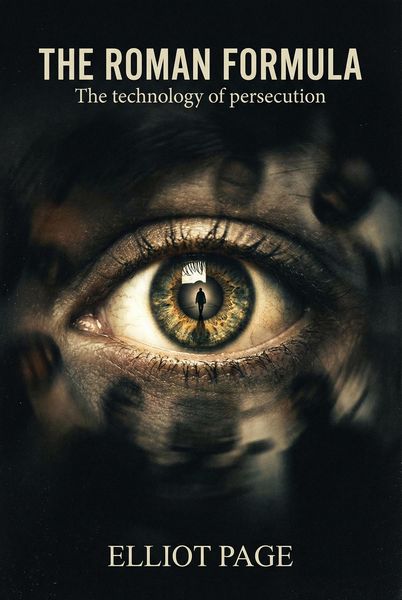
The Roman formula. The technology of persecution
-
- Einzelkauf Download ausgewählt
-
Sprache:Englisch
3,99 €
inkl. gesetzl. MwSt.Beschreibung
Produktdetails
Format
ePUB
Kopierschutz
Ja
Family Sharing
Ja
Text-to-Speech
Ja
Erscheinungsdatum
31.03.2026
Verlag
Oleksii KolbasenkoSeitenzahl
(Printausgabe)
Dateigröße
771 KB
Sprache
Englisch
EAN
9798232579463
The Roman Formula: The Technology of Persecution is a documentary and analytical investigation into how anti-cult persecution is launched and legalized in the modern world: from the first labels in the media to raids, arrests, and bans. The author collects stories that seem unrelatedterrorist attacks, police operations, campaigns against "sects," "extremists," and "foreign agents"and reveals a recurring protocol that works like malicious code in the social system.
At the heart of the book is a principle tentatively called the "Roman formula": it is not the act itself that becomes a crime, but the name and membership of the group. To launch repression, there is no need to prove the action it is enough to create an image of the "enemy of the human race" and then reinforce it in institutions. The text examines three stages of the technology in detail:
Linguistic coding dehumanizing definitions and "verbal templates" that disable empathy and turn people into a "threat."
Institutional discrimination when propaganda language is presented as "expertise," "analysis," or "specialist conclusions," and the law is adapted to fit a predetermined conclusion.
Open persecution when a prepared society no longer doubts and even applauds: "it is not people who are being destroyed, but the virus."
The book reveals the role of Alexander Dvorkin as one of the key ideologues of modern anti-cult rhetoric and infrastructure. Elliot Page shows how the terminology he introduced (in particular, the concept of a "totalitarian sect") has become a universal tool for delegitimization: a convenient label that has no strict legal nature but works well in the media, expert reports, and courts. The book also traces Alexander Dvorkin's connections and influence at the international levelincluding his participation in the governing structures of the European Federation of Anti-Cult Organizationsand how this discourse "flows" between countries, changing its labels but retaining its mechanics.
This is not a book "for" or "against" a particular faith, party, or movement. It is a practical map of how democracy is killed: who writes the dictionary of hate, how it turns into an administrative procedure, and why violence almost always begins not with a blow but with a word.
Noch keine Bewertungen vorhanden
Verfassen Sie die erste Bewertung zu diesem Artikel
Helfen Sie anderen Kundinnen und Kunden durch Ihre Meinung.
Kurze Frage zu unserer Seite
Vielen Dank für Ihr Feedback
Wir nutzen Ihr Feedback, um unsere Produktseiten zu verbessern. Bitte haben Sie Verständnis, dass wir Ihnen keine Rückmeldung geben können. Falls Sie Kontakt mit uns aufnehmen möchten, können Sie sich aber gerne an unseren Kund*innenservice wenden.
zum Kundenservice