Produktbild: Outdoor Health
Neu

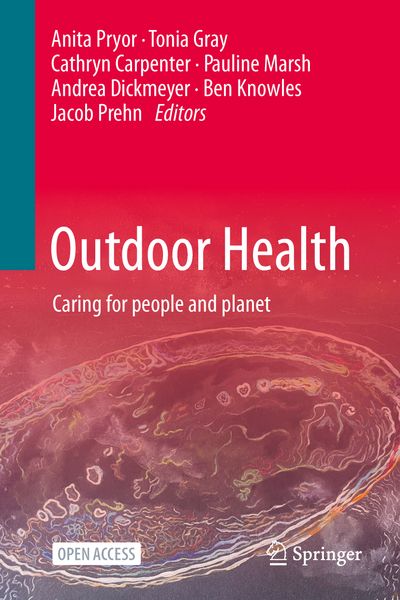
Outdoor Health Caring for people and planet

51,99 €

inkl. gesetzl. MwSt., Versandkostenfrei


Beschreibung

Produktdetails

Einband

Gebundene Ausgabe

Erscheinungsdatum

26.10.2026

Abbildungen

IV, 784 p.

Herausgeber

Anita Pryor + weitere

Verlag

Springer Singapore

Seitenzahl

784

Maße (B/H)

15,5/23,5 cm

Sprache

Englisch

ISBN

978-981-9205-84-4

Beschreibung

Portrait

Anita Pryor  has devoted over 30 years to Bush Adventure Therapy and nature‑based healing practices worldwide. Her early work as a river and mountain guide and outdoor experiential educator laid foundations for a career in adventure therapy, research and policy. As codirector of Adventure Works Australia, a non‑profit outdoor health provider, she works alongside Aboriginal mentors and friends to support quality outdoor therapy practice, training and research, reflecting a lifelong commitment to the wellbeing of people and planet.

Tonia Gray  is a Senior Researcher at Western Sydney University with more than 40 years in education and teacher training. Her transdisciplinary research examines human‑nature relationships, outdoor learning, wellbeing, gender leadership, and climate justice. Former Chair of the Australian Tertiary Outdoor Educators Network and co‑editor of the Journal of Outdoor and Environmental Education, Tonia’s awards include the Australian Award for University Teaching (2014) and the Association of Experiential Education’s Distinguished Researcher of the Year (2019).

Cathryn Carpenter 's employment in the outdoor health sector spans more than 45 years. Primarily an outdoor educator, tour guide, or University academic; she has contributed research and publications focusing on human and environmental health and wellbeing, while also providing leadership and coordination in the development of adventure therapy in Australia and internationally. Cathryn has recently retired and is enjoying more time in the outdoors and volunteering with a range of cultural and environmentally focused community-based initiatives.

Pauline Marsh  is a health geographer and senior lecturer in dementia studies whose research explores community‑ and nature‑based approaches to wellbeing. Her expertise spans end‑of‑life care, therapeutic landscapes, inclusivity, ageing, dementia, film theory and community development. She co-leads the Nature Connection Storytelling Project and Venture Out Nature and Dementia research groups at UTAS.

Andrea Dickmeyer  is a Clinical Psychologist focused on integrating nature connection, physical activity, and mental health in practice and research. She is completing a PhD in Psychological Sciences at the University of Newcastle, Australia. She studied Psychology and Philosophy in the US and received a 2019 Watson Fellowship to explore cultural connections with nature for mental health. She has worked across inpatient, community, wilderness therapy, and private practice settings.

Ben Knowles  has worked with people in the outdoors for nearly three decades. Trained in education, outdoor education, experiential learning and narrative therapy, he lives on Bpangerang and Taungurung Lands in Northeast Victoria. His PhD examines ethics in outdoor health practices. He helped found the Australian Association for Bush Adventure Therapy and supported its transition to Outdoor Health Australia (OHA). He codirects Adventure Works Australia, sits on the OHA board, and co-convenes Ethical Practice & Quality for the International Association for Adventure & Nature based Therapies.

Jacob Prehn  is Worimi (Aboriginal Australian) and an Associate Professor of Social Work at the University of Tasmania. Jacob’s outdoor health research examines Indigenous people’s experiences of nature and wellbeing. His scholarship primarily focuses on Indigenous Data Sovereignty and Indigenous masculinities, men’s health, and fatherhood. Jacob’s previous work includes  Aboriginal Social Work Voices (2026).
Produktdetails

Einband

Gebundene Ausgabe

Erscheinungsdatum

26.10.2026

Abbildungen

IV, 784 p.

Herausgeber

Verlag

Springer Singapore

Seitenzahl

784

Maße (B/H)

15,5/23,5 cm

Sprache

Englisch

ISBN

978-981-9205-84-4

Herstelleradresse

Springer Nature Customer Service Center GmbH
Europaplatz 3
69115 Heidelberg
DE
ProductSafety@springernature.com

Noch keine Bewertungen vorhanden

Verfassen Sie die erste Bewertung zu diesem Artikel

Helfen Sie anderen Kundinnen und Kunden durch Ihre Meinung.

Kundinnen und Kunden meinen

Bewertungen (0)

  • Produktbild: Outdoor Health
  • Foreword: Intentions, realities and reflections.- Introduction: Outdoor Health in Australia: Looking back, around, and forward.- Section One: Practice and Quality.- Chapter 1: Cultural Outdoor Healthcare: What is Aboriginal informed outdoor therapy on country in lutruwita Tasmania?.- Chapter 2: A ‘superfood’ for children: the benefits of nature and risky play in educational settings.- Chapter 3: Boys to Men: Healing the wounds of intergenerational toxic masculinity.- Chapter 4: Making Forest Bathing and Nature Connection accessible.- Chapter 5: The invitational approach: Equine Facilitated Therapy and Learning.- Chapter 6: I’m glad I don’t know: Working with anxiety in facilitating outdoor experiences.- Chapter 7: Human Nature Adventure Therapy: A model for young people.- Chapter 8: Regenerate: Supporting women survivors of family violence and their children.- Chapter 9: Ecological restoration and HumanHealth.- Section Two: Community and Engagement.- Chapter 10: Country-centric pedagogies in initial teacher education for social and ecological wellness and balance.- Chapter 11: Nature based occupational therapy – for people, for communities, and for nature.- Chapter 12: A Professional Journey in outdoor and nature-based work: Collaboration with partners.- Chapter 13: Taiwan’s development of adventure therapy practice.- Chapter 14: The Eco-coffin project: What is a sustainable death?.- Chapter 15: The Mycelium Metaphor: A picture of Adventure Therapy in Europe.- Chapter 16: “It’s good for the soul”: Benefits of the Master Gardener Program for vulnerable communities.- Chapter 17: Integrating Daoism with nature-based therapy.- Chapter 18: A perspective on the Japanese approach to Outdoor Health.- Section Three: Research and Evidence.- Chapter 19: Nature-based Therapy and the Healthand Well-being of Aboriginal Men.- Chapter 20: “If you look you will see the light shining through the darkness”: A photovoice phenomenological study exploring a nature walking group for people using mental health services.- Chapter 21: Underlying mechanisms of nature-based interventions and intention to change behaviour through a social psychology lens.- Chapter 22: Positive Body Image in Women and Outdoor Physical Activity: A Qualitative Analysis.- Chapter 23: Mobilising wellbeing, learning and sustainability in the campus community garden relationscape.- Chapter 24: Living close to nature to foster ‘living well with dementia.- Chapter 25: Climate anxiety features and factors: Perspectives from professionals.- Section Four: Policy and Advocacy.- Chapter 26: Recreating Song lines from Trauma Trails: The Ceremony of Indigenous Facilitation Practice - Country holds the space.- Chapter 27: Outdoor Therapeutic Adventure -A case for inclusion in mainstream health policy.- Chapter 28: Human and Environmental Rights in Outdoor Health Practices.- Chapter 29: The ten dimensions of health and well-being and the influences of outdoor learning.- Chapter 30: Campfire Conversations: A Reflection of Diversity, Equity, Belonging, and Inclusion in the Outdoor Health and Nature Based Solutions Fields.- Chapter 31: Transformative Ethics for Outdoor Health Practices.- Chapter 32: Nature as medicine: A doctor’s view- advocating for a nature-fueled healthcare revolution.- Conclusion: Caring for people and planet.