Gutscheinbedingungen

**Gültig bis 17.08.2026 auf Schreibwaren & Office-Artikel online auf thalia.at, in der Thalia App und in teilnehmenden Thalia Buchhandlungen in Österreich mit Schulsortiment. In den Buchhandlungen nur gültig auf lagernde Ware. Einzelne Artikel können ausgeschlossen sein. Ausgenommen sind preisgebundene Artikel. Pro Einkauf einmal einlösbar. Nur gültig gegen Vorlage oder im Onlineshop hinterlegter Bonuscard. Infos zur Einlösung in der Buchhandlung sind auf der Bonuscard-Vorteilspreisseite zu finden. Click & Collect nur bei Onlinevorabzahlung möglich. Keine Einlösung bei Scan & Go-Bezahlung. Keine Barauszahlung. Nicht kombinierbar mit anderen Aktionen und Gutscheinen. Gutschein wird auf max. 500€ Bestellwert angerechnet. Nicht gültig für Geschenkkarten, Versandkosten und Services.

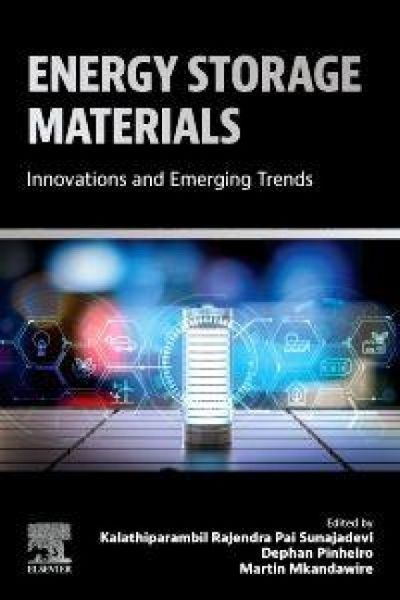
Produktbild: Energy Storage Materials
Vorbesteller Neu

Energy Storage Materials Innovations and Emerging Trends

217,99 €

inkl. gesetzl. MwSt., Versandkostenfrei


Beschreibung

Produktdetails

Einband

Taschenbuch

Erscheinungsdatum

01.11.2026

Herausgeber

Kalathiparambil Rajendra Pai Sunajadevi + weitere

Verlag

Elsevier

Seitenzahl

500

Maße (L/B)

22,9/15,2 cm

Gewicht

450 g

Sprache

Englisch

ISBN

978-0-443-45852-1

Beschreibung

Portrait

Dr. Sunaja Devi K. R. completed her Master’s in Chemistry from Mahatma Gandhi University, Kerala, India, in 1999, and received her PhD in Chemistry from Cochin University of Science and Technology, Kochi, India. She is currently working as a professor at the Department of Chemistry, CHRIST (Deemed to be University), Bangalore. Her research interests include Nanochemistry, Organocatalysis, Material science, MXene, Photocatalysis, Energy storage and production. Throughout her career, she has published more than 100 peer-reviewed papers in journals and has 6 patents to her credit. According to Google Scholar, her h-index stands at 20 (Citations more than 1000). In addition, she also serves as a reviewer in several reputed peer-reviewed journals.

Dr Dephan Pinheiro completed his Master’s in Chemistry from Bharathidasan University, Tiruchirappalli, in 1989, and completed his PhD from CHRIST (Deemed to be University), Bangalore, India. He is currently working as a professor at the Department of Chemistry, CHRIST (Deemed to be University), Bangalore, India. His research interests include Nanochemistry, Catalysis, and Materials science.

Martin Mkandawire is a Professor of Solid-State Chemistry and the Chair of the Chemistry Department at Cape Breton University in Nova Scotia, Canada. He holds a Habilitation degree with a venia legendi and a Doctorate (Dr. rer. nat.). His research specializes in smart and advanced materials and technologies, aimed at providing cost-effective and energy-efficient solutions for medical and environmental applications. With over 200 publications to his name, including journal articles, book chapters, conference proceedings, and abstracts, he has also authored and edited three scientific books as well as two poetry anthologies. In addition, he serves as an adjunct professor at both Dalhousie University and Karunya University in India and has been appointed as an Extraordinary Professor at North-West University in South Africa.

Produktdetails

Einband

Taschenbuch

Erscheinungsdatum

01.11.2026

Herausgeber

Verlag

Elsevier

Seitenzahl

500

Maße (L/B)

22,9/15,2 cm

Gewicht

450 g

Sprache

Englisch

ISBN

978-0-443-45852-1

Herstelleradresse

Libri GmbH
Europaallee 1
36244 Bad Hersfeld
DE

Email: GPSR Kontakt

Noch keine Bewertungen vorhanden

Verfassen Sie die erste Bewertung zu diesem Artikel

Helfen Sie anderen Kundinnen und Kunden durch Ihre Meinung.

Kundinnen und Kunden meinen

Bewertungen (0)

  • Produktbild: Energy Storage Materials
  • Part I: Fundamentals of Energy Storage
    1. Energy Storage Fundamentals: Design and Performance Metrics
    2. Essentials of Battery Technology: Principles and Performance Indicators
    3. Electrolytes and Separators in Energy Storage: Optimizing Ion Transport and Device Stability

    Part II: Advanced Functional Materials for Energy Storage Systems
    4. Carbon Quantum Dots and Composite Materials: Versatile Platforms for Energy Storage
    5. Graphene-Based Materials: Engineering Advanced Energy Storage Solutions
    6. Metal Oxides: High-Performance Electrode Materials for Batteries and Supercapacitors
    7. Metal Sulfides: Promising Electrode Materials for Energy Storage Systems
    8. Conducting Polymers in Energy Storage Systems
    9. MXenes: Emerging 2D Carbides and Nitrides for Next-Generation Energy Storage
    10. MBenes: Emerging 2D Boride Materials for Energy Storage Systems
    11. Organometallic Frameworks: Tunable Architectures for Electrochemical Energy Storage
    12. MOF-Derived Porous Materials: Bridging Structural Design and Energy Applications
    13. MOF/MXene Composites: Synergistic Architectures for High-Performance Energy Devices
    14. MXene-Polymer Composites: Engineering Conductive and Flexible Energy Storage Materials

    Part III: Emerging Technologies and Future Directions
    15. Biomass-Derived Materials: Green and Sustainable Electrodes for Energy Storage
    16. Hydrogel-Based Electrodes: Soft and Flexible Materials for Energy Storage
    17. Self-Healing Energy Storage Materials: Adaptive Solutions for Long-Term Stability
    18. Thin-Film Energy Storage Devices: Nanoscale Engineering for Sustainable Energy Solutions
    19. Computational Modeling in Energy Storage: Designing Materials and Predicting Performance
    20. Energy Storage Revolution: Challenges, Breakthroughs, and Market Prospects